.svg)
.svg)
.svg)
.svg)


.svg)


As a business owner or human resources manager, you may come across the term "global employer" in today's interconnected business environment. A global employer is an organization that operates and works with employees in many different countries across the world. Engaging as a global employer allows companies to access specialized skills and expertise beyond their local talent pool, offering flexibility and the ability to scale operations efficiently. This approach enables businesses to operate around the clock by leveraging different time zones and brings high-quality expertise from around the world. Employees can include designers, software developers, marketing consultants, and more.
For example, consider a U.S.-based tech company developing a new software application. To enhance the application's user interface, the company hires a graphic designer based in South Africa as a global employee. This arrangement enables the company to leverage the designer's unique perspective and skills while the designer benefits from collaborating on a high-profile project. Similarly, a company in the U.S. may hire a software developer from India to work on a specific project due to their specialized skills and cost advantages. Such partnerships can lead to innovative solutions and mutual growth opportunities.
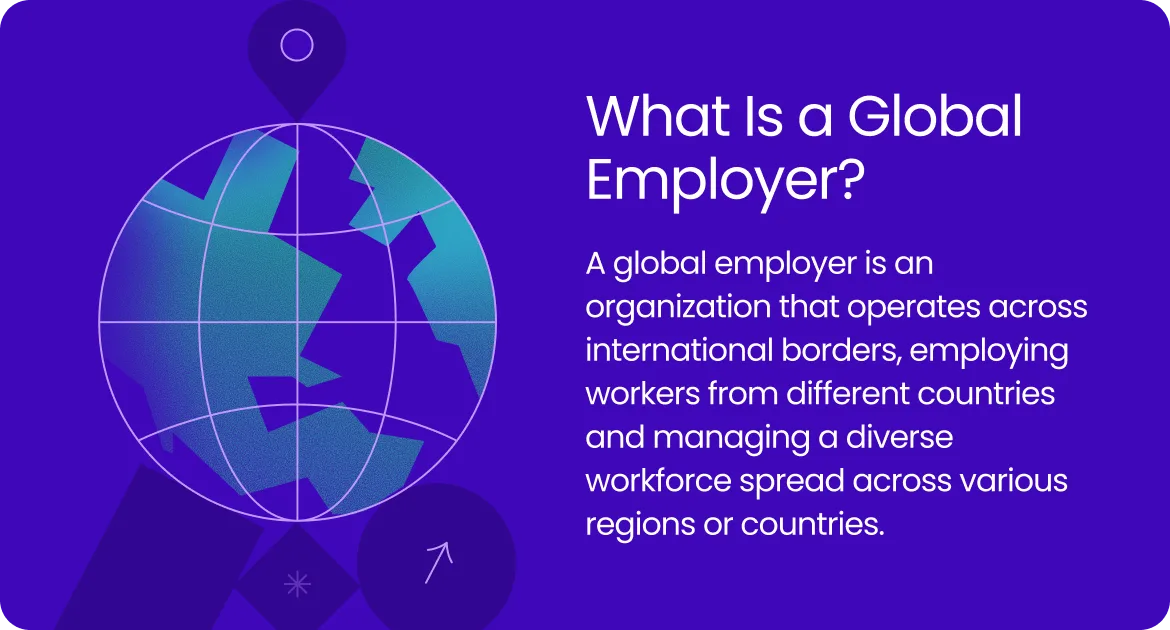
Understanding Global Employers
In today's interconnected world, many businesses operate on a global scale, employing workers from diverse backgrounds and locations. Global employers play a vital role in managing international teams, fostering collaboration, and driving organizational success in a globalized economy.
Responsibilities of Global Employers
Global employers have various responsibilities, including:
- Compliance: Ensuring compliance with labor laws, regulations, and employment standards in each country where they operate.
- Cultural Sensitivity: Promoting diversity and inclusion, respecting cultural differences, and creating an inclusive work environment.
- Employee Benefits: Providing competitive benefits packages that meet the needs of employees in different regions.
- Talent Acquisition: Recruiting and retaining top talent from around the world, leveraging global talent mobility strategies and talent acquisition platforms.
- Risk Management: Mitigating risks associated with international operations, such as legal, financial, and geopolitical risks.
Challenges in Managing International Teams
Managing international teams presents unique challenges for global employers, including:
- Communication Barriers: Overcoming language barriers, time zone differences, and cultural differences that may hinder effective communication and collaboration.
- Legal and Compliance Issues: Navigating complex labor laws, tax regulations, and employment requirements in multiple jurisdictions.
- Cultural Differences: Understanding and respecting cultural norms, values, and customs to foster a harmonious work environment.
- Remote Work Challenges: Addressing the challenges of managing remote teams across different locations, including coordinating work schedules, maintaining productivity, and ensuring team cohesion.
Strategies for Effective Global Workforce Management
To overcome the challenges of managing international teams, global employers can adopt the following strategies:
- Cross-Cultural Training: Provide cultural sensitivity training to employees and managers to promote understanding and collaboration across diverse teams.
- Technology Solutions: Invest in technology platforms and collaboration tools that facilitate remote work, virtual meetings, and real-time communication.
- Local Partnerships: Partner with local experts, consultants, and legal advisors to navigate local regulations and cultural nuances effectively.
- Regular Communication: Foster open communication channels, regular check-ins, and team meetings to promote transparency and alignment among global teams.
- Flexibility and Adaptability: Embrace flexibility and adaptability in work arrangements, policies, and practices to accommodate diverse employee needs and preferences.
Importance of Cultural Sensitivity
Cultural sensitivity is essential for global employers to foster an inclusive work environment, build trust and respect among team members, and enhance collaboration and productivity. By promoting cultural sensitivity, global employers can create a workplace where employees feel valued, respected, and empowered to contribute their unique perspectives and talents.
FAQs about Global Employers
What industries typically employ global workers?
Industries such as technology, finance, manufacturing, healthcare, and professional services often employ global workers due to the nature of their operations and the need to access talent from around the world.
How can global employers ensure compliance with international labor laws?
Global employers can ensure compliance with international labor laws by conducting thorough legal research, consulting with legal experts in each jurisdiction, and implementing robust compliance programs and policies.
What are the benefits of having a diverse global workforce?
A diverse global workforce brings various benefits, including increased innovation, creativity, and problem-solving abilities, enhanced cultural competence, broader market insights, and improved employee morale and engagement.

Global Employer FAQs

.png)
Yes, in some circumstances a cross-border remote worker's home office can be treated as a taxable presence (permanent establishment) of the employer, exposing the company to corporate tax in that country. The 2025 update to the OECD Model Tax Convention clarifies that a home office generally will not create a permanent establishment if the employee works there less than 50% of their working time over a twelve-month period, or if there is no commercial reason for their presence in that country, such as when remote work is allowed purely for the employee's convenience or to retain talent. If the employee regularly deals with local customers or suppliers, or has authority to conclude contracts, the risk rises significantly, so global employers should assess each remote arrangement against local rules and applicable tax treaties.
In most cases, yes: the country where the employee physically works, not where the company is incorporated, determines payroll obligations, so the employer typically must register with local tax and social security authorities, withhold income tax, and remit employer contributions there. Some jurisdictions allow a non-resident or foreign employer registration for payroll purposes without a full legal entity, while others effectively require a local entity or an Employer of Record. Failing to withhold correctly can leave the company liable for the unpaid tax plus interest and penalties, and in some jurisdictions directors can face personal liability.
A choice-of-law clause does not override the mandatory employment protections of the country where the employee habitually works. In the EU, Article 8 of the Rome I Regulation expressly states that a chosen governing law cannot deprive the employee of protections that cannot be contracted away under the law of their habitual place of work, and many other jurisdictions apply similar principles. Practically, this means a global employer must still honor local rules on minimum wage, working time, notice periods, and dismissal protection, even if the contract says otherwise.
Without relief, an employee working in a different country from the employer can trigger social security liability in both countries on the same earnings. Bilateral totalization agreements, such as the agreements the United States has with 25 countries, assign coverage to a single country's system and exempt the wages from the other country's contributions, generally requiring a Certificate of Coverage from the home country's social security agency as proof. If no agreement exists between the two countries, both the employer and employee may genuinely owe dual contributions, which global employers should factor into the cost of international assignments.
Misclassifying workers who function as employees is one of the most common and costly mistakes global employers make, because classification is judged on the actual working relationship rather than the contract label. In the U.S., the Department of Labor applies a multifactor economic reality test (under a final rule effective March 11, 2024) to assess whether a worker is economically dependent on the employer, and misclassification can trigger back wages, liquidated damages, civil money penalties, and retroactive payroll taxes and benefits. Other countries apply their own tests and penalties, so global employers engaging contractors abroad should audit each relationship against local standards, particularly where the contractor works exclusively for one company under its direction.

ABOUT THE AUTHOR
Milani Notshe
Milani is a seasoned research and content specialist at Playroll, a leading Employer Of Record (EOR) provider. Backed by a strong background in Politics, Philosophy and Economics, she specializes in identifying emerging compliance and global HR trends to keep employers up to date on the global employment landscape.

.svg)




















.svg)