.svg)
.svg)
.svg)
.svg)


.svg)


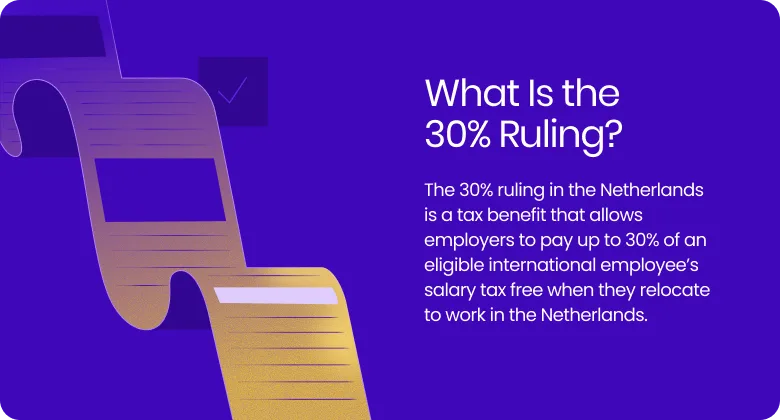
The 30% ruling in the Netherlands, often called the Dutch 30 ruling or simply the 30 ruling, is a tax exemption under the Dutch Wage Tax Act 1964 that allows you to pay up to 30% of an eligible international employee’s salary tax-free. It exists to cover the additional costs of living and relocation when someone moves to the Netherlands for work.
Here’s the key point: this isn’t a bonus, and it’s not extra pay. It’s a payroll mechanism. You reclassify up to 30% of agreed gross compensation as tax-free, reducing taxable income while keeping total salary costs stable. For you, that means stronger net pay for your hire without inflating your compensation budget. For globally scaling companies competing in the Dutch labour market, that’s a serious strategic lever.
Who Can Qualify for the 30 Ruling?
Not every international hire will qualify, and the Dutch government applies the criteria strictly.
To qualify for the 30% Ruling, your employee must:
• Be recruited from outside the Netherlands or transferred from abroad
• Have lived more than 150 km from the Dutch borders for at least 16 of the 24 months before their first working day
• Meet minimum taxable salary thresholds (toetsloon) set annually
• Demonstrate specific expertise that is scarce in the Dutch labour market
There’s a special rule for employees under 30 years old with a master's degree. For this group (often working in scientific research or other highly skilled roles), a lower salary threshold applies.
One critical technical rule: after applying the 30% tax free portion, the remaining taxable salary must still meet the minimum threshold. If it falls below, the employee does not qualify. If the individual previously worked in the Netherlands, earlier Dutch tax residence may reduce or eliminate eligibility. This is where many employers get caught out.
How Does the Dutch 30 Ruling Work in Practice?
Once approved, you can designate up to 30% of the employee’s agreed gross salary as tax-free. The remaining 70% is subject to Dutch wage tax and social security contributions.
For example, let’s say you offer a €100,000.00 gross salary: €30,000.00 (30% of the total) may be paid tax-free, but €70,000.00 remains taxable.
The structure must be clearly reflected in employment contracts and payroll reporting. This is not a reimbursement model, meaning you do not need to prove actual relocation expenses, but you must maintain documentation proving eligibility, prior residence outside Dutch borders, and compliance with salary thresholds.
Timing matters. You must jointly apply the 30% ruling within four months of the employee’s first working day. Miss that deadline, and the tax benefit only applies from the application date onwards, which could result in a lost tax advantage and potential friction with your hire.
Duration, Interaction With Dutch Regulations, and Recent Reforms
The 30% ruling is granted for a maximum statutory duration under current Dutch law. However, the structure and duration have been amended several times in recent years. Transitional rules have applied depending on when the ruling was granted.
Why does this matter? Because outdated assumptions can distort your long-term workforce cost modelling. If you’re budgeting a multi-year assignment or building a leadership team in the Netherlands, you need to verify the current regulatory framework at the time of hire.
The ruling also interacts with broader Dutch tax rules. Employees benefiting from the 30% ruling may opt for partial non-resident taxpayer status, which can affect how certain foreign income and assets are taxed. While this is primarily employee-facing, it can influence mobility structuring and cross-border assignment planning within multinational groups.
Compliance Risks and Employer Exposure
The 30% ruling in the Netherlands is enforced by the Dutch Tax and Customs Administration. If misapplied, the consequences are financial and sometimes significant.
Common employer risk areas include:
• Applying the tax exemption before formal approval
• Miscalculating salary thresholds
• Continuing to apply the benefit after it expires
• Failing to reassess eligibility after role or compensation changes
• Overlooking prior periods when the employee worked in the Netherlands
If errors are discovered, the tax authority can issue retroactive wage tax assessments. That means back taxes, statutory interest, and administrative penalties. Because this impacts wage tax filings, errors can also trigger broader payroll audits.
The lesson here? You should treat the 30% ruling as a regulated payroll instrument, not a recruitment perk.
30 Ruling Netherlands – Key Takeaways for Global Employers
- Applies to: Employees recruited from abroad with qualifying specific expertise under Dutch employment contracts
- Required by: The Dutch Wage Tax Act of 1964 and related implementing decrees
- Enforced by: The Dutch Tax and Customs Administration
- Risk of non-compliance: Retroactive wage tax, statutory interest, administrative fines, expanded payroll audits
- Effective since: 1964 (with significant reforms and threshold updates implemented in recent years)
For global employers expanding into the Netherlands, the Dutch 30% ruling is more than a tax perk. It is a strategic hiring tool that, when structured correctly, strengthens your offer in a competitive Dutch labour market while keeping employment costs predictable. The key is disciplined eligibility assessment, accurate payroll execution, and close attention to evolving Dutch government regulations.
Explore how Playroll’s HR Compliance Software helps you apply the 30% Ruling correctly, manage Dutch payroll requirements, and stay compliant with evolving tax regulations as you scale your global team.
Learn More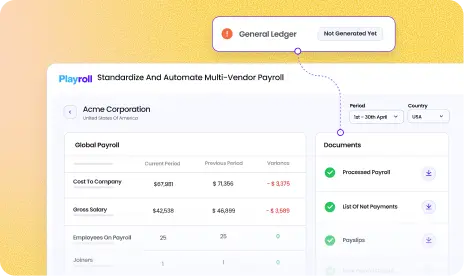
The 30% Ruling FAQs

.png)
The 30 ruling is a Dutch tax benefit that allows employers to pay up to 30% of an eligible international employee’s salary tax-free to offset extraterritorial costs.
Employees recruited from abroad who meet the 150 km distance requirement and minimum salary thresholds, including reduced thresholds for employees under 30 years old with a master’s degree, may qualify.
No, it’s optional, but once granted, you must apply it correctly in payroll and comply with Dutch wage tax regulations.

ABOUT THE AUTHOR
Milani Notshe
Milani is a seasoned research and content specialist at Playroll, a leading Employer Of Record (EOR) provider. Backed by a strong background in Politics, Philosophy and Economics, she specializes in identifying emerging compliance and global HR trends to keep employers up to date on the global employment landscape.

.svg)






















.svg)