.svg)
.svg)

.svg)
.svg)

Copied to Clipboard

Ready to get Started?


Key Takeaways
Most international payroll costs don’t come from visible fees, but from hidden FX spreads and repeated currency conversions across fragmented systems.
The biggest driver of FX cost is structural: mismatched currencies between where you earn revenue and where you pay employees.
You can reduce FX costs by consolidating payroll infrastructure and minimizing when and how often currency conversion happens.
When you run payroll across borders, the math doesn’t stop at gross-to-net. At some point, money has to move between currencies and that’s where costs add up. Global cross-border payments can still carry significant costs, reaching around 6% in some corridors, well above the 3% or less benchmark most finance teams target.
The real issue, over and above fees, is currency mismatch between your cash inflows and payroll outflows. If you collect revenue in one currency but need to pay employees in another, FX exposure becomes unavoidable in the flow unless inflows and outflows are aligned. And because payroll is fixed and legally protected, employees must receive the amount and currency defined in their contract. That means any exchange rate movement, spread, or transfer cost is absorbed by your business, not the employee.
The impact adds up quickly. With $9.6 trillion traded daily in FX markets, even small exchange rate markups can materially increase payroll costs over time. Every conversion, whether for salaries, bonuses, contractor payments, or statutory obligations, compounds that exposure.
In this guide, we’ll break down where those costs arise. Plus, learn how you can reduce FX exposure at the source by structuring payroll and treasury flows correctly rather than just optimizing around it.
What Are Payroll FX Fees, And Where Do They Show Up?
Payroll FX costs arise when there is a mismatch between the currency you fund payroll in and the currency employees must be paid in. They apply whether you're paying employees, contractors, or tax authorities.
If your company operates in one base currency but pays teams in five or ten local currencies, FX becomes embedded in your operating model unless you align inflows and outflows by currency.
This is most relevant in centralized, cross-border payroll setups. In contrast, when payroll is executed in-country through local infrastructure, FX can be reduced to fewer, more controlled funding decisions rather than repeated in every payroll cycle.
In practice, payroll FX fees show up in several places:
- When headquarters funds payroll in one currency but employees are paid in another.
- When a payroll provider converts funds before disbursement.
- When statutory payments are made to local authorities.
- When off-cycle payments require additional cross-border transfers.
- When contractor payments are processed separately from payroll for full-time employees.
They can appear as explicit transaction fees, but more often they are embedded in the FX rate you are quoted.
FX Fee vs FX Spread vs Rate Volatility
Three different FX concepts often get lumped together under “FX cost,” even though they behave differently, show up differently in reporting, and require different solutions. Without separating them, it’s almost impossible to explain payroll variances, forecast international payroll accurately, or negotiate with providers effectively.
In practice, when an employee’s payroll costs don’t match expectations, or shift without headcount changes, one of these three drivers is usually responsible:
- FX Fee: A clearly stated charge for processing an international transaction. For example, a $20–$50 international wire fee.
- FX Spread (exchange-rate markup): The difference between the mid-market rate and the rate your provider applies. This is usually the largest hidden cost.
- Rate Volatility: The movement of exchange rates due to market conditions. Even with zero markup, exchange rates fluctuate daily.
The distinction between these three definitions is important because if an employee receives the incorrect salary amount at the end of the payment process, it means you haven't correctly absorbed a cost somewhere. From an FX perspective it could be because:
- The conversion rate included a 2–4% markup
- The rate was locked in days earlier during unfavorable market conditions
- An intermediary bank deducted lifting fees
Where FX Costs Appear in the Payroll Flow
To control FX costs, you need to map the full payroll and treasury flow from inflow to final payout:
- Payroll calculations are finalized in local currency
- Headquarters funds payroll in base currency
- Funds are converted
- Payments are routed through local or international rails
- Statutory filings are funded
In fragmented setups, conversion may happen more than once. For example:
- USD → EUR at HQ
- EUR → local currency via provider
Each conversion introduces a new spread. In multi-vendor environments, payroll funds may pass through several systems before reaching employees and tax authorities. That layering often means multiple currency conversions, separate FX markups, and fragmented reporting.
Pro tip: Consolidated payroll infrastructure (where calculations, funding, and payments are coordinated under a unified platform) can reduce duplicate conversion events. The key is ensuring currency is converted as few times as possible, with clear visibility into when and how rates are applied.
Reduce FX Noise in Your Global Payroll
Playroll brings payroll calculations, payments, and reporting into one unified platform, so currency is converted fewer times and FX costs are fully visible.
Book a Demo
The Biggest Cost Driver: FX Spread & How to Calculate It
When companies start investigating payroll FX fees, they usually look at transaction fees first. In reality, the FX spread is almost always the primary cost driver.
High-spread corridors like those in Sub-Saharan Africa can see average remittance-style costs of ~8.78%, while digital money transfer operators (MTOs) and modern platforms often deliver 3.55–4.96% all-in costs compared to traditional banks at 12–14.55%. For payroll volumes, even a 1–2% difference compounds quickly in volatile or emerging markets.
Here’s what typically drives FX-related payroll cost upward:
- FX Spread or Exchange-Rate Markup: Often 1% to 5%, depending on provider and corridor.
- Bank and Intermediary Fees: SWIFT, lifting fees, OUR vs SHA cost splits.
- Operational Overhead: Payment recalls, retries, reconciliation mismatches.
- Compliance Penalties: Late tax payments caused by delayed funding.
- Vendor Sprawl: Multiple providers leading to repeated currency conversion.
The spread is particularly impactful because it scales directly with payroll volume. A 3% spread on a $2 million monthly payroll equals $60,000 per month. That is $720,000 annually in embedded FX costs.
The One Formula Finance Teams Can Use
Finance teams often ask whether payroll FX fees are tax-deductible. In most jurisdictions, they are typically fully deductible as ordinary business expenses tied to payroll operations (consult your accountant for classification as transaction fees vs. exchange losses).
However, accounting treatment may differ depending on whether they’re classified as transaction fees or exchange losses. Your finance team should confirm classification with your accounting advisor.
To calculate your implied payroll FX spread:
Implied spread % = (provider rate − mid-market rate) / mid-market rate
Spread cost = payroll amount × implied spread %
For example:
- Mid-market rate: 1.10
- Provider rate: 1.07
Implied spread: 2.73%
If your payroll run is $800,000, your FX cost is approximately $21,840 for that cycle.
What Good Transparency Looks Like
Most providers will tell you they offer “competitive FX rates.” That phrase means very little unless you can see how the rate is constructed. Good transparency goes beyond a final converted amount. It should allow finance teams to reconstruct exactly what happened during each currency conversion.
When evaluating providers, you should be able to see:
- The exact mid-market rate reference: What benchmark are they using? Reuters? Bloomberg? ECB? Without a reference point, you can’t calculate implied spread.
- The timestamp of rate lock-in: When was the exchange rate fixed? At payroll approval? At funding? At payout? A rate locked 48 hours earlier can materially impact cost in volatile markets.
- The applied markup percentage: Is the spread fixed across all corridors, or variable by country? Is it tiered based on volume? You should not have to reverse-engineer this manually every month.
- Clear reporting on conversion moments: Did conversion happen once centrally, or multiple times across different steps? Each conversion event should be visible in reporting.
- Visibility into transaction fees: Are SWIFT fees, intermediary bank deductions, or payment rail charges itemized separately? Or bundled into a single line item?
If you're reviewing vendors, FX methodology should be part of your checklist when choosing a payroll provider.
How Do Cross-Border Payroll Payment Rails Change Your Total Cost?
When finance teams review payroll FX fees, they often focus on exchange rates. But the route your money takes – the payment rail – can have just as much impact on cost and predictability. Two payroll runs with the same FX rate can land at different final amounts depending on how the funds were routed.
CFOs sometimes struggle to explain why payroll costs are higher than expected, even when payroll calculations were correct. Understanding payment rails helps control both FX spread and variability.
SWIFT/Wires vs Local Rails
The difference between SWIFT/Wires and local rails is operational, and operational differences drive cost. Let’s take a more detailed look at what exactly that means.
SWIFT/International Wires
SWIFT payments move money internationally through a chain of correspondent banks. Your funds may pass through multiple intermediary institutions before reaching the destination.
It’s used for international fund movement, but it isn’t required in all cross-border scenarios. In regions like the EU, systems such as SEPA can process cross-border payments without relying on SWIFT.
This can introduce:
- Intermediary bank deductions
- Lifting fees
- Variable settlement timing
- Less predictable final costs
From a finance perspective, SWIFT introduces uncertainty. Even if the FX rate is fixed, the final landed cost can vary.
Local Rails
Local rails settle payments domestically within the employee’s country. In practice, payroll almost always uses local rails for the final employee payout, even if funding originated internationally.
This typically means:
- Fewer intermediaries
- No lifting fees deducted mid-route
- Faster settlement
- More predictable reconciliation
Rule of Thumb: high-frequency recurring payroll should default to local rails wherever possible. Reserve SWIFT for exceptions, not standard salary runs.
Multi-Currency Accounts and Local Collections
Another common question from finance teams is whether multi-currency accounts actually reduce payroll FX costs.
In many cases, yes – but only if used intentionally.
When you hold local currency instead of converting every month on payroll day, you:
- Reduce repetitive conversion events
- Minimize exposure to last-minute rate swings
- Separate treasury timing decisions from payroll deadlines
- Gain leverage in negotiating spreads
For example:
Instead of converting USD to EUR twelve times per year on fixed payroll dates, you might convert in larger tranches during favorable market conditions and hold EUR locally.
That shifts FX management from reactive to controlled.
You’re no longer forced to accept whatever rate is available on payroll processing day.
For companies operating in stable, high-volume corridors, this alone can materially reduce long-term FX costs.
11 Ways To Reduce International Payroll Costs
Reducing payroll FX fees rarely comes down to one big fix. In most cases, costs creep in through small structural inefficiencies that compound over time. We’ve put together some tactics to help avoid this from happening.
They fall into three tiers.
- First, foundational steps that improve visibility and data quality.
- Second, operational improvements that reduce unnecessary conversions and payment friction.
- And third, longer-term structural changes that help finance teams control FX exposure as global payroll scales.
Together, these changes make international payroll more predictable, transparent, and cost-efficient.
Tier 1: Build The Right Foundation
Before optimizing FX costs or payroll efficiency, you need a clear picture of how your payroll actually operates across countries. Most global teams inherit fragmented payroll structures, which makes costs and compliance risks harder to spot.
1. Create a Payroll Inventory and Compliance Map
The first step is visibility. Many global employers discover they have more payroll providers, bank accounts, and compliance obligations than they realized.
Actions you can take:
- Start by mapping your payroll environment country by country.
- Document which entities you operate through, which providers handle payroll processing, which bank accounts are used for funding, and what statutory requirements apply in each location.
- Identify where payroll must legally be processed locally and where centralized models are possible.
- Take note of potential compliance risks, such as contractor misclassification, incorrect tax withholding, or missing statutory contributions.
This exercise often reveals hidden complexity and cost drivers that aren’t obvious when payroll is viewed country by country.
2. Standardize Payroll Data Architecture
Many payroll problems start with data moving between too many systems. Employee data often flows from an HR platform to local payroll providers, then into finance systems and banking tools. When those handoffs rely on spreadsheets or manual uploads, mistakes tend to happen more frequently.
Actions you can take:
- Define one clear source of truth for employee data, usually your HRIS.
- Map how information flows into payroll systems and payment infrastructure.
The goal is to eliminate manual data transfers wherever possible and introduce validation checks that catch problems before payroll runs. Small improvements here reduce correction payments, reconciliation crises, and unnecessary FX events triggered by re-runs.
3. Verify Statutory Contributions and Payroll Rules by Country
Payroll accuracy depends on keeping local statutory requirements up to date. These change more often than most companies expect.
Each country has its own rules for income tax thresholds, pension contributions, social security deductions, and employer contribution splits.
Actions you can take:
- Review your current payroll setup against the latest local requirements in every country where you operate.
This helps ensure your payroll calculations reflect the correct tax brackets, contribution rates, and legislative updates. For companies hiring globally, this kind of audit prevents both compliance issues and unexpected payroll adjustments.

TIER 2: Improve Operational Efficiency
Once the foundation is in place, the next step is simplifying how payroll runs. Operational improvements reduce both payroll errors and unnecessary FX costs.
4. Consolidate Payroll Infrastructure Where Possible
One of the biggest drivers of hidden FX costs is fragmented payroll infrastructure. Many global employers end up working with different payroll vendors, payment providers, and bank accounts in each country.
Every additional handoff in that chain introduces more operational complexity and often another currency conversion. A cleaner model is consolidating payroll calculations, payments, and reporting under a single global payroll platform wherever possible.
When payroll runs through one system, funds can be converted fewer times and visibility improves. Some providers will onboard you at a fixed flat fee, which helps stabilize FX-related costs even when underlying exchange rates fluctuate.
- Fund payroll centrally while paying employees locally
- Reduce duplicate currency conversions across vendors
- Standardize payroll reporting across countries
- Track FX costs and payroll variances in one place
Gain Full Visibility Into Global Payroll
Our unified global dashboard brings payroll, payments, and reporting into a single view, with real-time variance checks that flag cost or compliance anomalies. This gives teams tighter control over FX exposure and global payroll performance without adding operational overhead.
See Analytics in Action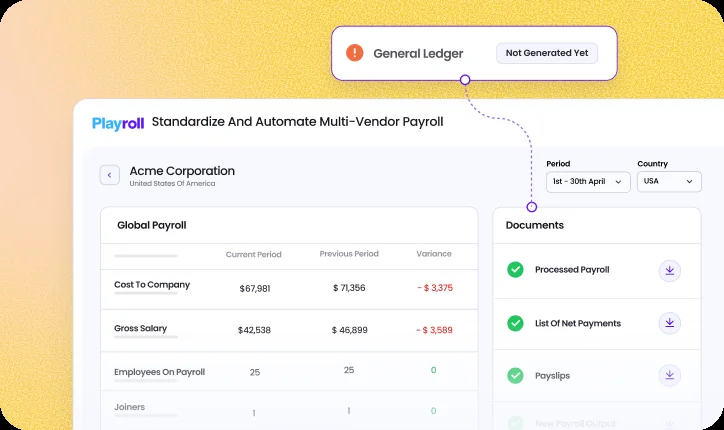
5. Stagger Payroll Funding Windows
When all global payroll payments are funded on the same day, the entire payroll cycle becomes exposed to a single exchange rate window.
Some organizations reduce this exposure by staggering payroll funding across regions. Payments might be processed a few days apart depending on country payroll schedules.
This spreads currency exposure across multiple rate windows and makes the impact of any single day’s FX movement less dramatic. It also aligns better with the natural variation in payroll cycles across different countries.
6. Use Local Payment Rails Where Possible
International wires are one of the most expensive ways to move payroll funds. Domestic clearing systems on the other hand are usually far cheaper and more predictable. Systems like SEPA in Europe, ACH in the United States, Faster Payments in the UK, or NEFT in India allow payroll payments to settle locally with minimal transaction fees.
Whenever possible, payroll payments should use these domestic rails instead of routing through international wire transfers. Local rails reduce intermediary bank deductions, improve reconciliation, and lower transaction costs.
TIER 3: Long-Term Payroll Optimization
Once payroll operations are stable, you can start focusing on improving forecasting, error detection, and cost transparency across your global payroll environment.
7. Establish a Clear FX Policy for Payroll
Foreign exchange decisions often happen reactively under payroll deadlines. Creating a simple policy helps bring structure to these decisions.
An FX policy should:
- Define when exchange rates should be locked, how currency volatility is monitored, and which approval steps apply to larger conversions.
- Clarify which payroll corridors allow rate hedging and which must use spot rates due to local compliance rules.
Having a documented approach helps finance teams make more consistent decisions when currencies move unexpectedly.
8. Detect Payroll Errors Earlier
Many FX costs come from payroll corrections. When payroll errors are discovered after payments are processed, companies often need to issue correction payments. Each correction creates another international transaction and another currency conversion.
Introducing automated variance checks before payroll runs helps catch common issues early. Examples include:
- Unexpected salary changes
- Missing bank details
- Incorrect currency assignments
- Duplicate payments.
9. Build Country-Specific Compliance Checkpoints
Global payroll operates on dozens of different compliance timelines. Tax filings, statutory contributions, and reporting requirements vary significantly by country. Missing one of these deadlines can lead to penalties or urgent correction payments.
Creating a compliance calendar by country makes these obligations easier to track. The calendar should include filing deadlines, contribution dates, reporting requirements, and audit windows.
10. Require Pricing Transparency From Payroll Vendors
Many payroll vendors advertise simple per-employee pricing, but the full cost structure often includes FX spreads, transaction fees, and corridor-specific pricing.
When evaluating providers or renewing contracts, it’s worth asking for more transparency around how international payments are priced.
This can include:
- Clear FX spread disclosure relative to mid-market rates
- Itemized transaction fees
- Reporting on currency conversions
- Benchmarking against public rate references
With better visibility into pricing, finance teams can compare providers more accurately and renegotiate terms as payroll volume grows.
11. Implement FX Hedging for Predictability
If you’re paying employees in currencies that shift frequently, exchange rate swings can distort your payroll costs from month to month. For example, companies funding payroll in USD but paying employees in currencies like ZAR, BRL, or INR can see payroll costs fluctuate simply because the exchange rate moves between funding and payout.
One way to reduce this uncertainty is through FX hedging. Hedging allows you to lock in an exchange rate ahead of time so you know exactly what your payroll will cost in your base currency.
In practice, many companies start with simple forward contracts because they’re straightforward and predictable.
For example, locking a three-month forward rate for USD→ZAR payroll could remove roughly 2–4% of exchange rate volatility during that period. Instead of a fluctuating payroll cost, you now have a known expense for that cycle.
The benefits are mostly about predictability:
- Payroll budgets become easier to forecast
- Sudden currency swings don’t disrupt monthly payroll runs
- Finance teams avoid last-minute conversions at unfavorable rates
That said, hedging isn’t always perfect. If exchange rates move in your favor, you won’t benefit from the improvement. Some hedging strategies also involve setup costs or require support from treasury teams or financial providers.
Common Mistakes That Inflate Payroll FX Fees
FX costs tend to spike because of structural habits that you build up overtime
- Funding Too Early (FX Windows Too Large): Funding payroll well in advance increases your exposure to currency fluctuations. The longer the window between funding and payout, the greater the volatility risk.
- Ignoring “Small” Corridors: Minor markets often carry higher spreads because they attract less negotiation focus. Even small headcounts can generate material FX costs over time.
- Treating Payroll as a Bank Transfer Problem: Payroll is not just a cross border payment exercise. It’s an end-to-end operational process involving payroll calculations, statutory timelines, compliance funding, and reporting.
Modern global payroll setups aim to reduce unnecessary currency conversions, surface FX methodology clearly, and minimize reconciliation friction. This is where structured global payroll services can reduce both FX costs and operational complexity.
2026 Outlook: Emerging Trends in Global Payroll FX Management
Looking ahead to 2026, several shifts are accelerating cost reduction and predictability:
- Digital Rails Expansion: Real-time systems (e.g., SEPA Instant, Faster Payments, UPI) and API-driven local networks continue displacing costly SWIFT for recurring payroll.
- AI-Powered Rate Monitoring & Alerts: Platforms now use AI to scan volatility, suggest optimal lock-in windows, and flag anomalies before payroll runs.
- Mobile Money Integration: In emerging markets (especially Africa and Southeast Asia), mobile wallets lower last-mile costs and enable near-instant local payouts with reduced spreads.
- Stablecoin & Blockchain Pilots: Early enterprise adoption for stable corridors promises near-zero FX volatility and sub-1% all-in costs (though regulatory clarity is still evolving).
These trends favor unified platforms that embed visibility, automation, and smart routing, making fragmented setups increasingly expensive by comparison.
Key Takeaways
Payroll FX fees rarely show up as one obvious charge. More often, they creep in through spreads, repeated conversions, and inefficient payment routing. But when payroll infrastructure is unified and FX methodology is transparent, finance teams gain visibility and control.
If your international payroll costs feel harder to explain than they should be, currency mismatch and unmanaged FX exposure are likely part of the picture.
Want to see what that good visibility looks like in practice? Book a demo with our team and we’ll walk you through how unified global payroll reporting and payment infrastructure can help you reduce hidden FX costs.

ABOUT THE AUTHOR
Jaime Watkins
Jaime is a content specialist at Playroll, specializing in global HR trends and compliance. With a strong background in languages and writing, she turns complex employment issues into clear insights to help employers stay ahead of the curve in an ever-changing global workforce.
Payroll FX Fees Explained & How to Cut Hidden International Payroll Costs FAQs
Payroll FX Fees FAQs

.png)
Payroll FX fees are the costs associated with converting one currency into another when paying employees, contractors, or tax authorities in different countries. If your company funds payroll in one currency but pays workers in another, a currency conversion will occur somewhere in the payroll process.
Payroll FX fees can appear as explicit transaction charges, such as international wire fees, but they are more often embedded in the exchange rate itself through a markup or spread applied by a bank or payroll provider.
What’s the difference between an FX fee and an FX spread?
The difference between an FX fee and an FX spread is how the cost is applied during a currency conversion. An FX fee is a clearly stated charge for processing a cross-border payment, such as a $20 international wire transfer fee.
An FX spread, on the other hand, is the difference between the mid-market exchange rate and the rate your provider applies when converting funds. Because the spread is built into the exchange rate rather than listed as a separate line item, it is often the largest and least visible component of payroll FX fees.
How can I calculate my implied payroll FX spread?
You can calculate your implied payroll FX spread by comparing the exchange rate your provider applied with the mid-market rate at the time of conversion. The basic formula is:
Implied spread % = (provider rate − mid-market rate) ÷ mid-market rate
For example, if the mid-market rate was 1.10 but your payroll provider converted funds at 1.07, the implied spread is approximately 2.7%. Multiplying that percentage by the total payroll amount helps finance teams estimate the real FX cost embedded in their international payroll.
Why are payroll costs sometimes higher than expected in international payments?
Payroll costs can increase due to:
- FX spreads applied during conversion
- Exchange rate timing differences
- Multiple conversion points across vendors
- Intermediary or routing-related fees
These factors impact your total cost, even when employee pay remains unchanged.
Are payroll FX fees tax-deductible?
In many jurisdictions, payroll FX fees are tax-deductible because they’re considered a normal business expense associated with paying employees or contractors internationally. This can include transaction fees, bank charges, or exchange rate losses incurred during payroll funding.
However, how payroll FX fees are recorded in financial statements may vary depending on accounting treatment and local tax rules, so companies should confirm the correct classification with their finance team or tax advisor.

Back to Top
.svg)










.svg)