.svg)
.svg)

.svg)
.svg)

Copied to Clipboard

Ready to get Started?


Key Takeaways
Most global payroll errors cluster into five categories: miscalculations, worker misclassification, tax and withholding mistakes, late runs, and compliance gaps.
AI works best as a proactive error-prevention layer, not a post-payroll audit tool.
Anomaly detection, automated reconciliation, and real-time compliance monitoring deliver the fastest ROI.
EOR-native AI handles multi-jurisdiction complexity that generic payroll tools can't match.
The strongest implementations pair AI automation with clear human escalation pathways.
At global scale, each small mistake compounds into audit risk, penalties, and erodes trust with your team. These come in the form of a missed tax code in one country, a misclassified contractor in another, a currency conversion error on a single pay run: Payroll errors have always been inevitable at scale, they're just more easily detectable and avoided with AI automation.
Aside from speeding up payroll processing, AI can help turn fragmented expertise that lives in spreadsheets, email threads, and your team members' heads into a connected system your operation can draw from. This is especially relevant in the complex context of global payroll systems that can differ widely across borders,
This guide walks through the most common payroll errors facing multi-country teams, how AI detects and prevents them, and a step-by-step framework you can apply to fix payroll processing across borders.
Common Payroll Errors That Cost Global Teams Time And Money
Before you can fix payroll with AI, you need to know exactly where your errors are coming from. Five categories cover the vast majority of payroll mistakes in multi-country operations.
- Miscalculations: These are the most common and often the most avoidable – it includes incorrect hours, pay rates, overtime, or deductions caused by manual data entry or mismatched systems. The operational consequence is usually small in isolation but significant at scale. Repeated rounding errors and missed overtime create trust issues with employees and recurring corrections for finance.
- Worker Misclassification: Contractor vs. employee distinctions vary sharply by jurisdiction, and getting it wrong exposes you to back-taxes, social security contributions, and legal claims. A contractor in the U.S. under the ABC test may be clearly an employee under IR35 in the UK – and the cost of discovering that during an audit is steep.
- Tax and Withholding Errors: Incorrect tax codes get applied when employees move countries, work across borders, or trigger double-taxation rules your payroll team didn't know existed. These errors often compound over months before anyone catches them, and the cleanup involves both your finance team and local tax authorities.
- Late or Missed Payroll Runs: Approval bottlenecks and disconnected systems are the usual culprits, particularly when payroll data has to move between an HRIS, a time-tracking tool, and a local in-country payroll provider. When payroll is late, employee trust is the first casualty.
- Compliance Gaps: Missed statutory benefit requirements, incorrect leave accruals, or outdated regulatory inputs all fall under this category. Regulations change frequently – a pension threshold shifts in one country, a parental leave policy changes in another – and manual rule sets go stale fast.
See Playroll’s AI Infrastructure in Action
Playroll's GP Manager puts AI-powered compliance checks, automated validations, and real-time jurisdiction monitoring directly into your payroll workflow – so errors get caught proactively.
Book a Demo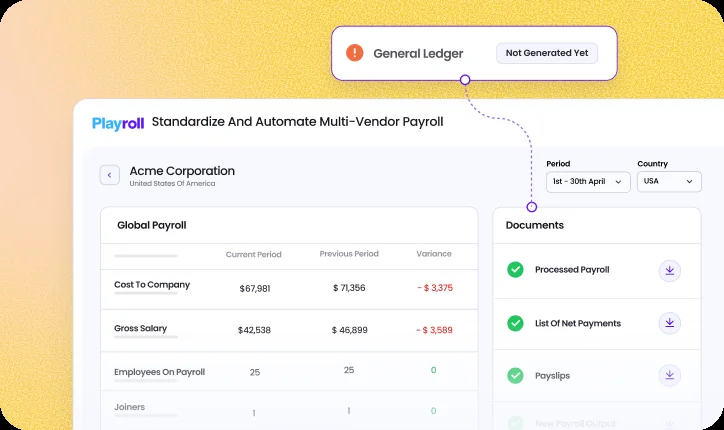
How AI Detects And Prevents Payroll Processing Mistakes
While you might think that the most valuable use of AI in payroll is cleaning up errors after the fact, it’s actually best to use it to catch jurisdictional nuances that your payroll system might not be taking into account yet. Think of AI as a continuous review layer sitting between your payroll inputs and your final pay run.
That review layer does two distinct jobs. First, it detects genuine errors like miscalculations, duplicate payments, missed deductions in real time. Second, and less obviously, it helps sophisticated payroll teams distinguish between adjusting variances (real discrepancies that need correcting) and non-adjusting variances (legitimate calculation differences driven by jurisdictional rules your calculator doesn't fully model.
- Anomaly Detection: AI models establish a baseline of what "normal" looks like for each employee, team, and country, then flag outliers. If an employee's hours spike 40% in a single pay period, or a deduction appears that hasn't shown up in the previous twelve cycles, the system flags it for human review before payment is released. You catch duplicate payments, mistyped salary changes, and fraud attempts in the same workflow.
- Automated Data Reconciliation: AI cross-checks payroll inputs against HR records, timekeeping systems, and financial ledgers in real time. If an employee's contract in your HRIS says 40 hours a week and their timesheet logs 60 with no overtime approval, the system surfaces the mismatch immediately rather than letting it slip through to processing.
- Compliance Monitoring: You could use an AI model to track regulatory changes by jurisdiction and alert your payroll team when rules affecting tax, benefits, or classification shift. This is particularly useful for teams managing payroll in countries where statutory updates happen mid-year without much public signal. You don't need a full enterprise tool to start – a scheduled task in a general-purpose AI assistant like Claude can monitor official government sites, payroll provider blogs, or Playroll's own compliance updates and email your team when something changes.
- Payroll Pro Tip: Make sure that you check with your internal team, preferably IT or Engineering, before adding any sensitive data to any AI models.
- Audit Trail Generation: Every payroll action – approvals, adjustments, exception overrides – gets logged with a timestamp and a reason code. When a regulator asks what happened in February's pay run, you can produce the record in minutes instead of days.
- Predictive Error Flagging: AI uses historical payroll data to identify patterns likely to produce errors in future cycles. If a particular country consistently generates tax reconciliation issues in the quarter after fiscal year-end, the system flags the pattern so your team addresses the root cause rather than patching symptoms each cycle.
- Variance Classification: When AI flags a difference between your calculator and your in-country provider, the best tools help your team understand whether it's a genuine error or a legitimate jurisdictional difference. Over time, as AI learns from your team's past decisions, it starts auto-classifying routine variances and escalating only the ones that actually need human judgement.
- Multi-Language Document Processing: AI extracts, translates, and restructures payroll documents from in-country providers (payslips, tax reports, benefit statements) that land in Portuguese, Mandarin, Dutch, or any other language, making them reviewable and reconcilable in your team's working language.
“As your business scales globally, you get more and more nuanced payroll situations that your system needs to handle. Before AI, that meant manually researching for hours or reading the Income Tax Act in Taiwan…in Taiwanese. Our in-house AI-tooling has completely transformed the research layer of our work, giving us instant, high-quality explanations we can trust and share with clients.”

Stop Researching Payroll Rules. Start Asking Orbit.
Playroll's HRGPT Orbit is trained on compliance data verified by our internal experts. It gives your team instant answers for any questions on tax codes, statutory benefits, and classification rules across 180+ countries.
Try Orbit Now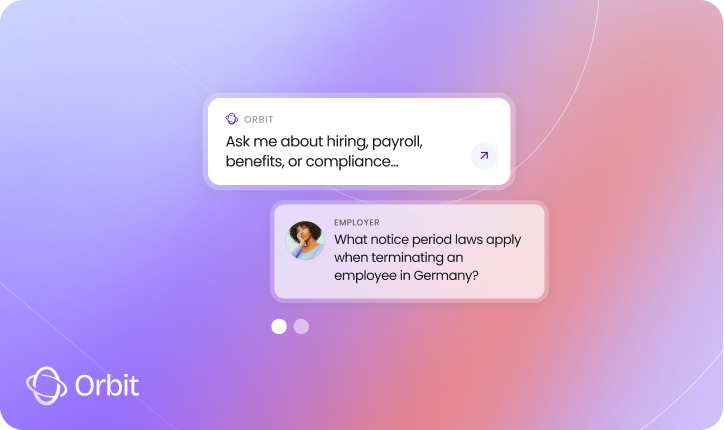
Step-By-Step Framework For Fixing Payroll Errors With AI
Here's a practical framework you can apply whether you're adopting AI for the first time or improving an existing setup.
- Audit your current payroll data: Before deploying any AI tool, find out where your errors are actually clustering. Pull at least six months of payroll data and categorize exceptions by country, error type, and frequency. You'll usually find that 70% of your issues come from 20% of your workflows – and that's where AI delivers the fastest return.
- Map your error types to AI capabilities: Not every AI tool fixes every kind of error and there are a lot of tools out there to choose from. Anomaly detection catches miscalculations and fraud. Compliance monitoring handles regulatory drift. Reconciliation engines catch input mismatches. Match the solution to the actual problem – don't buy a platform and then hunt for a use case.
- Integrate AI with your existing HR and finance systems: AI is only as accurate as the data it can access. If your HRIS, timekeeping, and payroll systems aren't connected, your AI will miss obvious errors. Prioritize integrations that feed clean, current data from every source of truth, including your payroll system.
- Run a parallel payroll cycle: Before going live, run AI outputs alongside your existing process for one or two cycles. Compare what the AI flags against what your payroll team catches manually. This surfaces false positives, data gaps, and edge cases your team will need to train the system on.
- Set threshold rules for anomaly alerts: Define clearly what triggers human review vs. what AI can resolve autonomously. A 2% variance on hours might auto-correct; a 20% variance on gross pay always routes to a payroll manager. Without clear thresholds, your team either drowns in alerts or misses the ones that matter.
- Establish a compliance update protocol: Make sure your AI tool has a documented process for ingesting regulatory changes by jurisdiction. Ask your vendor how often rules are updated, who validates them, and how you're notified. Stale compliance logic is worse than no compliance logic because it creates false confidence.
- Review and close the loop: After each payroll cycle, use the AI-generated audit trail to debrief. Which flags were accurate? Which seemed like noise? Feed that back into your threshold rules so the system improves every cycle.
AI-Powered Solutions For EOR And Multi-Country Payroll Compliance
Global payroll is where generic automation tools hit their limits. When you're running payroll across ten countries with different tax years, currencies, statutory benefits, and employment classifications, rule-based systems start to buckle. EOR-native AI – the layer of AI tech that EOR providers built into their platform or systems – is built for exactly this complexity.
- Jurisdiction-Specific Tax Treatment: AI applies the correct tax rules per country automatically rather than depending on manual rule sets that go stale. In Brazil for example, when an employee goes on leave, they receive an advanced portion of their salary before they go on leave. The amount includes their base salary pro-rated over 30 days, plus an average of variable earnings from the year, plus a one-third constitutional vacation bonus. That’s a formula no generic payroll calculator handles out of the box.
- Worker Classification at Scale: Misclassification risk varies wildly across markets. IR35 in the UK, the ABC test in California, and Brazil's CLT framework all use different criteria to distinguish employees from contractors. AI can flag misclassification risk at the point of hiring by analyzing contract terms, working hours, and control factors against the rules of the worker's jurisdiction – not yours.
- Multi-Currency Reconciliation: Cross-border payroll runs in multiple currencies create a specific error category: FX rate mismatches between when payroll was calculated, processed, and paid. AI manages FX rate application, reports on discrepancies, and reconciles across payroll runs so your finance team isn't chasing rounding errors across five currencies every month.
- Statutory Benefits Compliance: Parental leave, pension contributions, sick pay, thirteenth-month salaries: these requirements change by country and sometimes by region within a country. AI monitors changes to mandatory benefits and updates payroll accordingly, so your Dutch team gets the correct holiday allowance while your Singaporean team gets the right CPF contributions, all without separate workflows.
“Where we're heading is limited-touch territories. We’ll apply a layer of automation to the territories where we have considerable proof points. If AI can identify a pool of employees with consistent historical patterns – say, a 30% tax discount in Hungary for employees with dependents – it can auto-approve those cases because it has the historical data to back it up. That frees our team to focus on the genuinely complex variances that actually need a human eye.”
This is the layer generic payroll software misses. It's not a failure of the tools, but rather the fact that it was never built to handle the jurisdictional complexity that global hiring introduces. AI is changing that, particularly in our industry where we have masses of data that we’ve verified and collated that we can train our own tooling on.
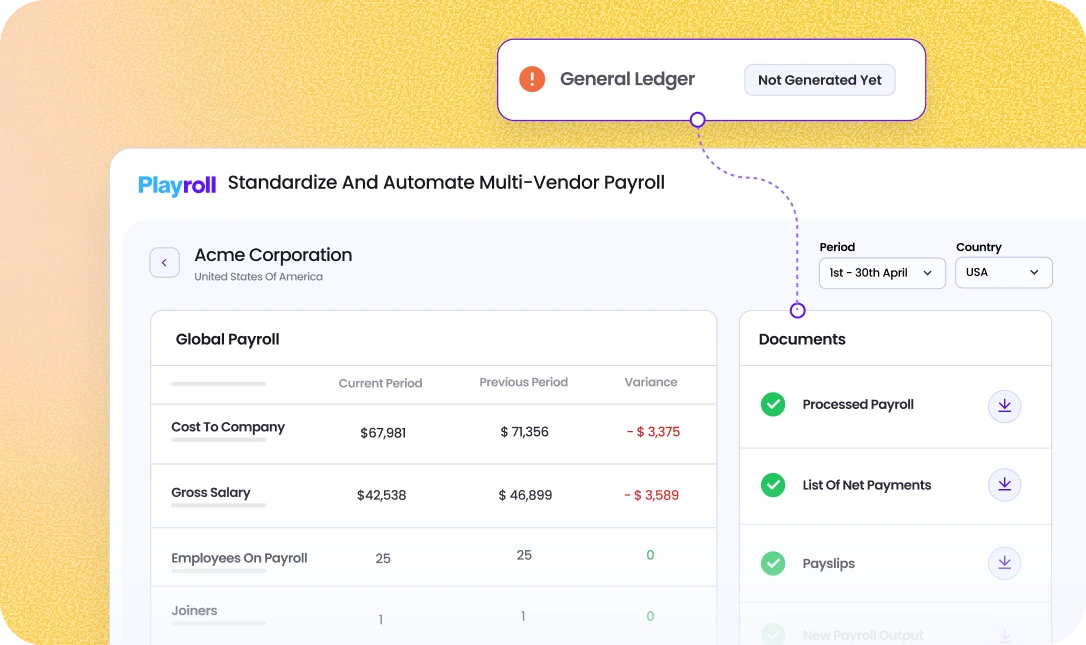
One AI-Powered Platform, No Fragmented Data
Playroll's global payroll services use AI-powered variance checking to catch anomalies in your payroll run before they happen – not after. And because everything sits in one platform, there's no fragmented data for AI to miss and no integration project to delay your timeline.
See it in Action
How To Choose The Right AI Payroll Automation Tools
Not every tool marketed as "AI payroll" will actually fix your problems. Evaluate vendors against the criteria below rather than feature checklists.
- Real-Time Compliance Coverage: Does the tool actively monitor regulatory changes across your specific jurisdictions, or does it expect you to update the rules manually? If it's the latter, you're not buying AI despite what the tool’s marketing may claim.
- HRIS and Finance System Integration: Can the platform connect to your existing stack – HRIS, time tracking, GL, ERP – without heavy custom development? A six-month integration project usually means the vendor hasn't solved the data access problem yet.
- EOR-Native vs. Bolt-On Payroll AI: Tools built for global payroll from the ground up behave differently from domestic payroll tools with international add-ons. Ask how the product handles a jurisdiction you haven't hired in yet. If the answer is "we can add it in a future release," you already have your answer.
- Audit Trail Depth and Accessibility: Can you retrieve a full, timestamped record of every payroll decision for any given period, without opening a support ticket? Regulators don't wait for vendor SLAs.
- Human Escalation Pathways: How does the tool handle edge cases it can't resolve autonomously, and how quickly does it surface them? Good AI tooling knows what it doesn't know. The best AI hands it to a human before damage is done.
- Transparency in Error Resolution: Does the tool explain why it flagged something, or does it operate as a black box? Your payroll team needs to defend decisions to auditors and employees – unexplained automation makes that more difficult when it should be making things easier.
The right choice depends on where you operate and how complex your workforce is. But the questions above will separate genuine AI-powered platforms from rebranded automation – and point you toward the partner that actually reduces payroll risk at global scale.
Important to Keep in Mind
The best AI tools are honest about what they can't do yet. Some calculations involve historical data and logic that no rules engine fully automates today. Mature platforms flag these for human review rather than forcing a wrong answer.
Fix Your Global Payroll Errors With Playroll
Payroll errors at global scale aren't a people problem, they're a systems problem, and AI is now the most effective way to solve it. The teams getting this right treat AI as an error-prevention layer rather than a replacement for payroll expertise.
“Payroll is fundamentally human. We're not just moving box A to box B like a logistics company, we're dealing with real people who have three kids, who are 47, who are going on maternity leave. AI has become an incredible enabler for the research and the numbers, but there's always a human layer stitching together the tools, the regulations, and the specific context of each employee's life.”
Playroll is the EOR platform built specifically for this challenge, not a generic payroll tool with AI features bolted on later. Our platform combines real-time compliance monitoring across 180+ countries, multi-currency payroll automation, and built-in worker classification logic in a single workflow, so your team gets accurate pay runs, current regulatory coverage, and a defensible audit trail every cycle.
Book a demo with our team today to see how Playroll helps global teams run accurate, compliant payroll across every jurisdiction.

ABOUT THE AUTHOR
Jaime Watkins
Jaime is a content specialist at Playroll, specializing in global HR trends and compliance. With a strong background in languages and writing, she turns complex employment issues into clear insights to help employers stay ahead of the curve in an ever-changing global workforce.
How to Fix Payroll With AI FAQs
How can AI fix payroll errors before they happen?

.png)
AI fixes payroll errors before they happen by acting as a proactive review layer that sits between your payroll inputs and final processing. It uses anomaly detection to flag outliers, automated reconciliation to cross-check inputs against HR and finance systems, and predictive flagging to surface patterns likely to cause errors. Each of these catches issues before payroll is released, rather than after employees have been paid incorrectly.
What are the most common payroll processing mistakes AI can detect and correct?
The most common payroll processing mistakes AI can detect and correct are miscalculations in hours and deductions, duplicate payments, sudden salary anomalies, mismatches between HR records and payroll inputs, and compliance drift when regulations change. AI is particularly strong on errors that follow detectable patterns, which account for the majority of recurring payroll issues at scale.
How does AI ensure payroll compliance across multiple countries?
AI ensures payroll compliance across multiple countries by monitoring regulatory changes by jurisdiction and updating tax codes, statutory benefits, and classification rules in real time. Instead of your team tracking changes across ten countries manually, the system applies current rules automatically and alerts you when something material shifts, reducing both compliance risk and operational overhead.
Can ChatGPT or AI tools actually run payroll for global teams?
ChatGPT and general-purpose AI tools can't run payroll for global teams on their own. They can help summarize policies, draft communications, or answer compliance questions, but they aren't built to calculate payroll, apply local tax codes, or reconcile multi-currency runs. Running global payroll needs AI embedded in a payroll platform with real integrations, jurisdiction-specific rules, and a proper audit trail.
How does AI payroll automation reduce manual processing time for HR teams?
AI payroll automation reduces manual processing time for HR teams by automating reconciliation, anomaly detection, and compliance updates – removing the repetitive review work that typically eats payroll cycles.
Teams report significant reductions in manual intervention per pay run, with errors resolved at the input stage rather than post-processing. The time saved usually gets redirected toward strategic work: workforce planning, audit prep, or expanding into new markets.

Back to Top
.svg)






.svg)