.svg)
.svg)

.svg)
.svg)

Copied to Clipboard

Ready to get Started?


Key Takeaways
Africa offers exceptional talent and scale potential, but compliance varies dramatically across 54 countries, making hiring complex without deep local insight.
EOR providers remove that complexity, helping companies hire quickly and compliantly while managing payroll, benefits, statutory filings, and ever-changing local regulations.
Choosing the right EOR depends on your priorities – local expertise, global automation and consistency, or feature-rich platforms – but the right partner ensures a safe, efficient, and confident expansion across the continent.
Africa offers one of the fastest-growing workforces in the world and an exceptional talent-to-cost ratio – but it’s also one of the most complex regions to hire in. Labor laws, payroll taxes, statutory benefits, and cultural norms vary dramatically across countries, and managing compliance across markets like South Africa, Nigeria, Kenya, Ghana, and Egypt can quickly become overwhelming.
That’s why more companies turn to Employer of Record partners to hire quickly and compliantly without setting up local entities. In this guide, I’ll break down how EORs operate across Africa, what to consider when choosing a provider, typical costs, and the leading partners for 2026 – including Africa-specialized firms like Playroll.
What Is an Employer of Record: And Why Does It Matter in Africa?
An Employer of Record, more commonly referred to as an EOR, is a third-party entity that becomes the legal employer of your team members abroad. Companies partner with EORs to handle everything when hiring across borders: generating compliant employment contracts, onboarding local talent, running payroll, administering statutory benefits, calculating country-specific taxes, and staying on top of changing labor laws.
Many companies look to Africa in particular when hiring remote talent. The continent offers cost-effective hiring, broad and highly skilled talent pools, and working hours that overlap with major European time zones.
In Africa, hiring with an EOR helps navigate extremely diverse and evolving employment landscapes. The continent is made up of 54 countries, each with its own employment acts, payroll taxes, social funds, and compliance requirements.
And those rules change fast. It’s not uncommon for tax thresholds, social-security contributions, or filing rules to shift with little public notice.
A few real-world examples HR teams often run into:
- Nigeria: Fluctuating PAYE and pension rules
- Kenya: Evolving NSSF/NHIF frameworks and levies
- South Africa: Some of the strictest dismissal and leave rules in the world
- Egypt & Morocco: Complex, tiered social-insurance systems
On top of the legal complexity, some African markets are resource-rich but politically sensitive, which can create additional hiring challenges – from currency volatility to inconsistent processing times at government offices. Digital systems may also vary widely; in some countries, filings still require in-person follow-ups or paper-based documentation.
That’s Where a High-Quality EOR Becomes Essential
In a continent as dynamic and diverse as Africa, that level of in-market expertise is the difference between safe, strategic expansion and costly compliance mistakes. You need a partner who understands how things work in practice.
A strong Africa-capable EOR brings:
- Local Fluency: Knowledge of unwritten rules, cultural expectations, and ministry processes.
- Rapid Adaptation: The ability to adjust when tax rules or benefits change unexpectedly.
- Risk Shielding: Ensuring compliant terminations, contributions, and documentation.
- On-the-Ground Insight: Knowing which authorities are slow, which require extra paperwork, and how to keep your team protected in higher-risk regions.
Want a Partner Who Understands Africa?
We’ve helped teams hire across the continent for years – and we know the real-world challenges behind the regulations.
Speak to an Expert
What Should You Consider When Choosing an Employer of Record in Africa?
So, you need to be on the lookout for local fluency, rapid adaptation, risk shielding, and on the ground insight. Let’s take a closer look at what these buzzwords translate to in practice and how to spot them when you’re vetting EORs.
- Local Compliance & Regulatory Expertise: Make sure the provider understands each country’s labor act, payroll taxes, social-security systems, and minimum statutory benefits. Expertise must be country-specific.
- Entity Ownership vs. Subcontracting: Some EORs own their entities; others use third-party partners. Direct ownership often means more control, lower risk, and faster resolution times. Make sure to ask your potential provider about the type of model they follow.
- On-the-Ground Presence: African markets rely heavily on local relationships. Prioritize providers with real in-country teams who can escalate issues with authorities when needed.
- Technology & Platform Capabilities: Assess digital onboarding, time off and expense management, document storage, automated payroll, and integrations with your HR or finance tools.
- Pricing Transparency: EOR costs vary by country. Look for clarity around base fees, FX markups, statutory contributions, and onboarding/termination fees.
- Payroll Reliability & Currency Handling: Exchange-rate volatility (KES, NGN, ZAR, EGP, GHS) can impact payroll. Ensure the EOR manages FX properly and pays employees in the correct local currency. A great way to vet these criteria is to check user reviews on platforms like G2.
- Customer Support Responsiveness: African compliance issues often require quick action. Dedicated support managers and SLA-backed support will save you pain long-term.
Estimated Cost For Hiring an African Employee Through an EOR
Across Africa, EOR services can cost anywhere between $350–$900 USD per employee per month, depending on the provider, country, and service level. Some vendors operating in more complex markets might even charge as much as $1,000/month/employee.
The exact number really depends on the country you’re hiring in, the complexity of local regulations, and the provider you’re working with. In some of the trickier markets, it’s not unusual to see fees reach around $1,000/month simply because the compliance load is heavier.
Leading Employer of Record Providers in Africa in 2026
Below is a curated list of the most relevant, reliable, and widely used Employer of Record partners for hiring across the African continent – including global platforms and African-specialized providers.
Let’s dive in.
- Playroll: A global EOR with strong coverage across 180+ countries and 48+ African markets, offering fast onboarding, transparent pricing, AI-backed compliance checks, automated payroll workflows, in-country expertise, and 24/5 dedicated support. One of the most efficient and cost-effective ways to scale teams across the continent, with a proven track record of exceptional customer support and an intuitive, user-friendly platform. We also have a strong in-person team in South Africa which gives us an edge when it comes to response time and real expertise around Africa-based hiring and labor challenges.
- Africa HR Solutions: An Africa-first EOR operating in over 40 countries, known for local compliance knowledge, extensive in-country networks, hands-on support, and reliable payroll tailored to African labor, tax, and benefits systems. One limitation is that its technology platform and self-service tooling can feel less advanced compared to global, product-led EOR providers.
- Workforce Africa: A Nigeria-based HR and EOR provider with strong regional presence across West Africa, offering compliant onboarding, local payroll expertise, risk mitigation, and sector-specific knowledge. While highly effective in Nigeria, coverage and operational depth can be more limited outside its core West African markets.
- Remote Solutions Africa: An Africa-focused EOR with coverage across East, West, and Southern Africa, providing locally fluent support, compliant contracts, real-time payroll assistance, and insight into regulatory changes. A drawback is that processes can be more manual, with fewer automated workflows than larger global platforms.
- Deel: A global EOR and payroll platform supporting many African markets through a mix of owned entities and vetted partners, offering a polished user experience, strong automations, and extensive integrations. However, country-level consistency can vary, with differences in service quality, benefits depth, and response times depending on the local partner.
- Remote.com: A global EOR with modern digital infrastructure, strong automation, employee self-service features, and owned entities in select African countries. While its workflows are transparent and standardized, coverage across Africa is uneven, and some countries offer more limited benefits or local flexibility.
- Multiplier: A tech-forward EOR available in 150+ countries, including select African markets, offering straightforward pricing, automated onboarding, and fast contract generation. A common limitation is that hands-on local HR support in Africa can be lighter, particularly for complex employee relations or regulatory edge cases.
- Safeguard Global: An enterprise-focused global EOR with good global coverage, delivering sophisticated compliance management, tailored support, and robust risk mitigation. The trade-off is that its enterprise orientation can result in higher costs and longer implementation timelines for smaller or fast-moving teams.
See How We Stack Up
Want a closer look at how Playroll stacks up against other EORs across Africa?
Compare EORs
Insights from Real Users
Here are a few verified quotes pulled from public forums:
Playroll
“I appreciate Playroll's clear and detailed explanations. The platform proactively answers questions I may not have even thought to ask, which has been extremely helpful throughout the process. I also value its responsiveness and the smooth, easy setup experience.”
- Verified G2 User
Remote:
“Remote is pretty solid, but can be pricey and more bells + whistles than you need. But it's worth taking a demo and asking questions.”
- Verified Reddit User
Why Hire in Africa
“What has stood out to me most is not just the technical ability, but the eagerness to learn and grow. You can feel the drive and it is all about unlocking an under-appreciated pool of talent that, with the right guidance, can play at global level.”
- Verified Reddit User
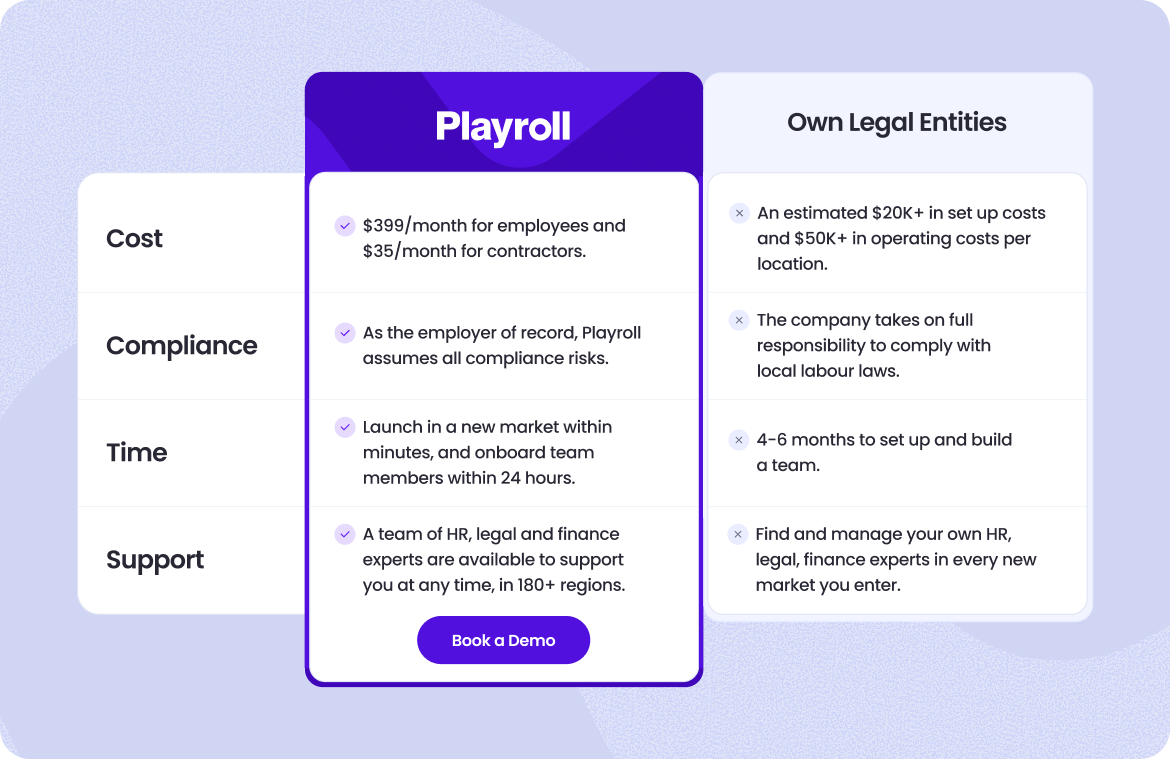
Using an EOR vs Owned Entity in Africa
If you’re hiring your first employees in Africa, the big question is whether to set up an entity or use an EOR. Here are some quick and easy considerations to help you make a decision:
Use an EOR if:
- You need to hire immediately (days instead of months).
- You don’t want to manage local payroll, tax filings, or benefits yourself.
- You’re testing the waters in a new market before committing.
- You have fewer than 20 employees in a single country.
Set up an owned entity if:
- You plan to hire 20+ employees long-term in a single market.
- You need deeper operational presence (e.g., local sales licenses).
- You want full control over IP, tax planning, and future scaling.
Costs to keep in mind:
- Entity Setup: $5,000–$50,000+ depending on the country
- Ongoing Filing, Bookkeeping, Legal Fees: $10,000–$40,000+/year
- Multi-Market Compliance: Overhead for cross-border Africa expansion
For most companies hiring their first African employees, an EOR is the more economical and less risky route.
Onboarding Process Through an EOR in Africa
When new hires are onboarded across African markets, the process is structured and fast. It starts with collecting the employee’s documents – things like national ID, tax numbers, and bank details – and drafting a locally compliant employment contract. This includes the correct clauses for labor laws, probation, leave entitlements, and (in some countries) bilingual requirements.
Depending on the country, the EOR may also run mandatory background or police checks before the employee can begin. Once the contract is signed, the EOR handles all statutory registrations. After that, the EOR sets up any required benefits, such as medical cover, transport or airtime allowances, or 13th-month bonuses where customary.
The final steps include:
- Adding the employee to payroll.
- Configuring country-specific tax and contribution rules.
- Ensuring salaries are paid accurately and on time in the correct local currency.
Most African onboarding processes are completed within 48–96 hours, depending on documentation and country requirements.
Compliance Considerations for Hiring Employees in Africa
Hiring across Africa means balancing legal requirements with local workplace norms, and both can vary significantly from one country to the next.
While every market has its own nuances, here are the most consistent cross-continent expectations to keep in mind when building a compliant and competitive employee experience.
Need Country-Specific Hiring Guidance for Africa?
If you’re expanding into Nigeria, Kenya, South Africa, Egypt, or any other African country, Playroll’s detailed hiring guides break down the exact regulations you need to follow.
Explore Guides
Key Takeaways
Hiring in Africa unlocks incredible talent, but each market comes with its own labor laws, cultural expectations, and payroll complexities – making the right EOR partner essential.
If you want fast onboarding, transparent pricing, automation, and reliable coverage across multiple African countries, Playroll brings all of that together in one unified platform. On top of that, we have entities across Africa, meaning you’ll have local experts on the ground to assist your team.
That being said, the best EOR for your team ultimately depends on whether you prioritize local insight, technology, or cost – but partnering with the right one will help you hire quickly, compliantly, and confidently across the continent.
Book a demo with our team to see why Playroll is the smartest partner for your African expansion.

ABOUT THE AUTHOR
Jaime Watkins
Jaime is a content specialist at Playroll, specializing in global HR trends and compliance. With a strong background in languages and writing, she turns complex employment issues into clear insights to help employers stay ahead of the curve in an ever-changing global workforce.
8 EOR Services in Africa for 2026: Providers & Reviews FAQs
What should be decided first in cross-border hiring?

.png)
Choose the legal hiring model first because entity hiring, EOR hiring, and contractor engagement create different tax and labor obligations.
How can teams reduce permanent-establishment risk?
Coordinate role scope, revenue activities, and managerial authority by country so local operations do not unintentionally trigger taxable presence.
What contract terms are essential for global hires?
Use locally compliant terms for pay currency, working time, leave, benefits, termination, and data-handling responsibilities.
How should onboarding be localized for compliance?
Use country-specific onboarding checklists for right-to-work, statutory registration, and payroll setup before start date.
What governance model helps global hiring scale safely?
Assign clear owners for legal, payroll, and mobility decisions and maintain a country compliance calendar with review checkpoints.

Back to Top
.svg)










.svg)