.svg)
.svg)

.svg)
.svg)

Copied to Clipboard

Ready to get Started?


In 2026, digital services are scaling fast in a hyper-connected, AI-accelerated world. If you’re building a modern digital business, you’re likely hiring globally by default. From creative studios and performance agencies to web development shops, data firms, and AI consultancies, teams are no longer tied to one office – or even one continent. With global digital ad spend set to surpass $1 trillion and AI projected to create 78 million net new jobs by 2030, digital businesses are hiring globally to access specialized creative, technical, and AI talent.
But global hiring only feels simple at first. Local labor laws, IP ownership rules, GDPR and expanded CCPA requirements, new U.S. state regulations, and the EU AI Act quickly add complexity – especially for teams handling client data or AI-generated assets. Issues such as misclassifying workers, missing payroll, or absorbing foreign exchange surprises can grind your expansion plans to a halt.
That’s why more digital services companies are turning to Employers of Record (EORs) to hire internationally without setting up local entities. In this guide, we break down what modern digital, marketing, and creative teams actually need from an EOR in 2026 – and which providers deliver based on real-world feedback from founders, operators, and growing global teams.
What Digital Services Companies Need From an Employer of Record
Whether you’re running a creative studio, scaling a performance agency, building a web or product consultancy, or delivering data and AI services, your hiring model looks nothing like a traditional business. You move fast, scale teams around client demand, hire across borders, and juggle IP protection, data privacy, and delivery timelines at the same time.
The right Employer of Record lets you hire globally without slowing down for entity setup or legal overhead. It handles local employment compliance, reduces risk around misclassification and IP ownership, and enables you to onboard talent quickly in new markets – without expanding your internal ops team.
In practice, the EOR becomes the core infrastructure for international delivery. It gives you the freedom to focus on winning clients, shipping high-quality work, and scaling confidently, while the compliance and admin run compliantly in the background.
Must-Have EOR Features for Digital Services, Marketing & Creative Teams
If you run a digital services business, your team is the product. Every hire touches client work, deadlines, and revenue almost immediately. When someone can’t start on time, gets paid late, or isn’t properly covered from a compliance or IP standpoint, it shows up in delivery, client confidence, and stress levels across the team.
An EOR helps remove that friction by putting the right employment infrastructure in place from day one. This means people can onboard quickly, get paid reliably, and work compliantly wherever they’re based. The features below are the ones you should be looking for when vetting any EOR provider for a digital services team.
- Regulatory & IP Compliance: Contracts must clearly assign IP rights in every jurisdiction. In many countries, it doesn't transfer automatically. If your teams work on client deliverables, product code, campaigns, or AI-generated assets, you also need strong GDPR/CCPA safeguards, AI disclosure clauses (per EU AI Act), SOC 2-level security for code/data handling, and alignment with client NDAs. Look for EORs with real experience supporting IP-heavy, client-facing businesses – they've seen audits before and know where things usually go wrong.
- Payment Infrastructure: You want predictable, multi-currency payroll without undeclared FX fees or last-minute surprises. Cash flow matters in project-based businesses, and delayed or inaccurate payments don't just frustrate employees – they put delivery timelines and client trust at risk.
- Equity & Incentives: If you're offering bonuses, profit share, or equity to retain senior talent (e.g., AI specialists or lead developers), your EOR needs to support that across borders. Clear local tax guidance from your EOR is essential here – unexpected tax issues are one of the fastest ways morale drops in otherwise strong teams.
- Speed & Flexibility: You need to onboard quickly – designers, developers, strategists, analysts, creatives – often in response to client demand. The best EORs scale with that reality, integrate cleanly with tools you already use (e.g., GitHub for devs, Figma/Slack for creatives, or Asana for project management), and offer AI-driven onboarding to cut setup time.
- Cybersecurity and Tech Compliance: Beyond basic privacy, require EORs with SOC 2 certification or equivalent for handling sensitive code, user data, or AI models. With 36% of tech/digital firms citing cybersecurity talent gaps, prioritize providers that vet for these skills and support secure remote workflows.
Common Global Hiring Scenarios in Digital Services
Growth across digital services tends to follow the same patterns. Talent is global and remote-first. Hiring spikes when a big client lands or funding closes, and setting up local entities usually doesn't make sense early on.
Some real-world scenarios you’ll come across fairly often:
- Building distributed teams across LATAM (Latin America), Eastern Europe, and APAC (Asia-Pacific) for design, development, content, SEO (search engine optimization), performance, and AI-assisted production (e.g., saving 50-80% on costs vs. U.S. hires while aligning time zones).
- Hiring senior specialists in high-cost markets while balancing burn by nearshoring complementary roles (e.g., U.S. strategists + LATAM devs).
- Rapid team expansion after landing enterprise clients – often adding region-specific compliance, data, or delivery roles.
- Moving long-term contributors from contractor to employee status to protect IP and improve retention.
- Offering bonuses or equity to retain scarce skills as AI reshapes digital roles (e.g., prompt engineers or ML ops specialists).
Compliance Traps Teams Often Miss
Hiring globally gives you access to incredible talent – but for digital services teams, it also introduces compliance risks that are easy to underestimate. What works in one country doesn’t always translate cleanly to another, and small gaps in contracts, classification, or data handling can quickly turn into client-facing problems.
Here are the most common compliance issues digital services, marketing, and creative teams run into when building and scaling distributed teams:
- IP not properly assigned in contracts, meaning creative work, code, or AI-generated assets don’t legally belong to your company – which can surface during client audits, due diligence, or an acquisition.
- Misclassifying contractors as employees, exposing you to fines, back taxes, benefit liabilities, and even challenges to ownership of client work – a common risk in development and creative roles.
- Gaps in data protection and AI compliance, putting client data, user insights, or AI-generated outputs at risk – especially as enforcement ramps up under GDPR and the EU AI Act.
- Incorrect terminations in Europe or LATAM, where strict notice and process requirements can lead to legal claims, unexpected payouts, or reputational damage in tight talent markets.

How I Chose These EOR Providers
This list is based on how digital services teams actually work, not on generic global hiring checklists. It comes from real conversations with founders and ops leads, digging into G2 and Trustpilot reviews, and noticing the same issues come up again and again as teams grow.
I focused on what I think is particularly important for 2026: protecting your IP, not tripping over compliance, onboarding people quickly when new work lands, and knowing exactly what everything is going to cost you each month.
What I looked at when evaluating providers:
- Coverage in key digital talent hubs. Places digital services teams commonly hire in, like LATAM for design and content, Eastern Europe for development and AI, and APAC for performance, data, and engineering roles.
- Depth of compliance for IP-heavy, client-facing work, including strong IP assignment, privacy protections, and experience supporting teams working on regulated or sensitive client projects.
- Speed of hiring and onboarding. How quickly you can bring full-time designers, developers, strategists, or analysts on board when new work arrives.
- Flexibility on payroll, benefits, and incentives, especially when you’re paying across multiple countries or offering bonuses, profit share, or equity to retain senior talent.
- Reporting and integrations, whether the platform plays nicely with the tools teams already use for finance, HR, and delivery, without creating more admin work.
- Support responsiveness, particularly when something goes wrong, a client audit pops up, or you’re scaling fast and need answers now, not in a week.
Top 10 EOR Providers for Digital Services Hiring Globally in 2026
Digital services teams benefit most from EORs that offer fast onboarding, strong IP clauses, predictable multi-currency payroll, and integrations with creative or software development tools. Here's the ranking based on real-world fit.
1. Playroll: Best Overall For Client-Driven Digital Services Teams Scaling Globally
If your business delivers client work across borders, Playroll stands out for balancing compliance with speed. It’s particularly strong for IP-heavy, project-based teams that need predictable payroll, clean and customizable contracts, and fast onboarding without adding ops headcount.
Coverage spans 180+ countries (largely via owned entities), with built-in IP assignment and payroll variance checks that catch issues before they affect delivery. On top of that, our dedicated customer and employee support teams are on hand to answer both the simple and the complex compliance questions you or your team might have.
Why digital services teams love it:
- Strong IP protection baked into local customizable contracts
- Fast onboarding for designers, developers, strategists, and analysts
- Reliable multi-currency payroll with fewer surprises
- Integrates cleanly with existing HR, finance, and delivery tools
- Strong support for employees and employers
Scale Global Delivery Without Slowing Teams or Putting Client Work at Risk
When your business runs on people and deadlines, global hiring problems hit delivery, cash flow, and client trust. Playroll’s EOR services help digital services teams hire globally, onboard fast, pay reliably, and protect IP across borders.
Speak to an Expert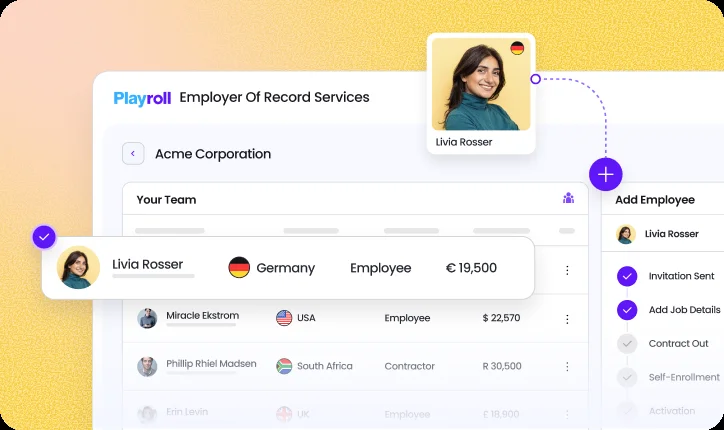
2. Remote: Best For IP-Sensitive Digital Teams Hiring Long-Term Employees
Remote tends to stand out when you’re building real, long-term teams. It’s especially attractive for digital services firms hiring engineers, designers, and senior strategists where intellectual property clarity is a core priority. In many key markets, Remote uses owned entities rather than relying entirely on third-party partners, which can make IP assignment chains cleaner and reduce legal ambiguity.
On the downside, they’re not always the fastest or most flexible option for edge cases. In countries where it doesn’t own the entity, it may still rely on partners, and highly customized scenarios can take longer to set up.
Why digital services teams love it:
- Clear, enforceable IP assignment
- Consistent employee experience
- Well suited for permanent roles
3. Deel: Best For Automation-Heavy And Api-Driven Digital Teams
Deel appeals to teams that like to build their own workflows. Its APIs and integrations work well for tech-forward agencies managing a mix of contractors and employees. As complexity increases, some teams report support depth can lag. They’re also on the pricier side in comparison to other EORs on this list.
Why digital services teams love it:
- Strong APIs and integrations
- Fast contractor-to-employee transitions
- Centralised workforce dashboard
4. Oyster: Best For Remote-First Agencies Focused On Employee Experience
Oyster HR is popular with creative and consulting teams that prioritize benefits, transparency, and a clean employee experience, particularly when it comes to global benefits and cost visibility.
That said, its EOR pricing sits at the upper end of the market and dedicated employer support comes at an additional cost and it operates largely through a ticketed system. It’s a decent option for straightforward remote hiring, but less flexible for heavily regulated fintech environments or complex compliance structures.
Why digital services teams love it:
- Intuitive platform
- Strong global benefits marketplace
- Clear pricing
5. Pebl (Formally Velocity Global): Best For Digital Services Teams Operating In Complex Jurisdictions
Pebl’s strengths are that its team is compliance-heavy and risk-aware. It’s a strong fit for fintechs hiring in tightly regulated or higher-risk jurisdictions where you’re looking for iron-clad legal certainty over speed.
Customers do, however, report that processes are considerably slower and more structured than newer, product-led platforms. And while they can handle payments and statutory contributions for your EOR employees, they don’t offer contractor or global payroll management services.
Why digital services teams love it:
- Strong risk and compliance focus
- Experience with regulated client environments
- Broad jurisdictional coverage
6. Papaya Global: Best For Finance-Led Agencies Managing Multi-Country Payroll
Papaya Global is built for payroll visibility and financial reporting. It’s a good fit for agencies tracking margins across regions, though EOR services are often delivered through partners rather than owned entities.
This introduces complicated communication layers which leads to slower issue resolution, meaning you could be waiting days for a response you needed yesterday. On top of that, they charge extra for services like misclassification support which other providers include in their EOR offering.
Why digital services teams love it:
- Consolidated payroll analytics
- Strong finance reporting
- Good for complex, multi-country operations
7. Multiplier: Best For Cost-Conscious Agencies Expanding Internationally
Multiplier is often shortlisted for affordability, particularly in APAC and emerging markets. It’s practical, efficient, and well-suited for straightforward international expansion. It works well for straightforward roles, but is less suited to complex IP or senior hires.
Users report overly complicated invoicing structure and a lack of dedicated support for employees after onboarding. While they do offer client support, it’s known to be quite slow.
Why digital services teams love it:
- Competitive pricing
- Solid emerging-market coverage
- Simple onboarding
8. Skuad: Best For Fast Hiring In Emerging Digital Talent Markets
Skuad is optimized for speed. If you’re building distributed engineering teams in emerging or high-growth markets and need to onboard quickly without heavy customization, it delivers a straightforward, predictable experience. Pricing is generally clear upfront, and deployment timelines are often faster than more compliance-heavy providers.
Where it’s less strong is in complex structuring, for example senior executive hires, nuanced IP protections, equity-heavy compensation, or highly regulated fintech environments may require deeper compliance infrastructure than Skuad is typically equipped for.
Why digital services teams love it:
- Fast onboarding
- Predictable pricing
- Broad country coverage
9. G-P (Globalization Partners): Best For Enterprise-Scale Digital Consultancies
G-P is built for companies that don’t want compliance surprises. If you’re a large digital consultancy operating across multiple regions (especially regulated or complex markets) it offers the kind of legal structure and global footprint that enterprise teams feel comfortable with.
The trade-off is weight. Pricing sits at the premium end, and the processes can feel formal and structured compared to newer, more product-led EORs. For lean or fast-moving teams, that can feel slow.
Why digital services teams love it:
- Enterprise-grade compliance
- Global reach
- High-touch support
10. RemoFirst: Best For Early-Stage Digital Agencies Hiring Their First Global Roles
For early-stage startups making their first few international hires, RemoFirst’s pricing is typically lower than most established EOR competitors, and setup is intentionally simple. It’s designed to remove friction rather than add layers of process.
However, it relies primarily on regional partners rather than owned entities, which means less direct oversight of in-country compliance operations. As hiring becomes more complex with multiple jurisdictions, advanced reporting needs, equity plans, or regulated fintech roles, you might find the platform’s automation and compliance tooling too limited.
Why digital services teams love it:
- Low starting price
- Easy setup
- Minimal overhead
11. Horizons: Best For Agencies Hiring Heavily In Asia
Horizons really stands out when Asia is the priority. If you’re hiring in China, Southeast Asia, or broader APAC markets, its regional depth and local expertise are a big part of the appeal. It leans more service-led than SaaS-led, which means you’re getting hands-on guidance rather than just a dashboard.
The trade-offs are mostly around product experience and scalability. The platform is less automation-driven than newer EORs, with fewer native integrations and API capabilities for tech-forward teams. Workflows can feel more manual, and reporting isn’t as finance-centric or real-time as payroll-first competitors. For companies managing large, multi-region hiring through centralized systems, that can create friction. It’s also less ideal if your expansion is evenly distributed globally.
Why digital services teams love it:
- Strong APAC coverage
- Local expertise
- Hands-on support
Quick Digital Services-Focused Comparison
No two digital services teams hire the same way. Some need to scale delivery fast, others prioritize IP protection or cost control, and many are juggling all three at once.
The table below maps common digital services hiring needs to the EORs that tend to work best in those scenarios, so you can quickly narrow down the right options for your team.
*Some providers (Papaya Global, Atlas, Safeguard, Horizons) vary pricing by country or services chosen, so listed pricing is approximate or based on commonly reported starting points.
Pricing & Costs For Digital Services Teams Using EORs
When it comes to cost, the big win with EORs for teams in digital services like yours, is predictability. You get payroll, taxes, benefits admin, and compliance handled without last-minute surprises or that massive upfront hit (we're talking $50k+ per country for entity setup, which kills momentum when you're moving fast in digital).
Elements That Cause Variation in Cost
Most solid providers these days go with a flat monthly fee per employee – usually in the $399–$699 range for basic plans (though it can climb to $800–$1,000+ depending on the country complexity and provider). Watch out for providers that follow a percentage of salary model, though this is less common among EOR providers. This can limit your ability to keep budgeting straightforward.
- Employee Location: EU spots (e.g., Germany or theNetherlands) often cost more due to stricter labor rules and higher statutory contributions, while LATAM or APAC (e.g., Brazil, India, Eastern Europe) tend to land on the lower end.
- Headcount: Hire more people through your EOR provider, and you often unlock better rates.
- Add-Ons That Digital Teams Care About: Things like equity management (super relevant for startups in the digital services industry), enhanced data privacy/AI compliance support, faster onboarding, or SOC 2-type audits if you're dealing with sensitive client work.
Take a real-world example for a digital services context: Say you're hiring a senior developer or strategist in Eastern Europe (salaries often €60k–€90k/year, so roughly €5,000–€7,500 gross per month).
On top of that:
- Statutory employer contributions (usually 10–30% depending on the country)
- Maybe some optional perks like private health top-ups to attract/retain top remote talent
- Plus the EOR fee itself (~$400–$600/month in many cases)
Total landed cost stays pretty forecastable month-to-month with no wild swings from entity overhead or local HR surprises. Compare that to spinning up your own entity: easily $50k+ upfront plus ongoing costs, which just isn't worth it for most digital teams testing a new market or making their first global hires.
EOR vs Alternatives for Hiring Employees in Digital Services
For digital services businesses, the way you hire globally affects far more than payroll. It shapes how quickly you can staff client work, who legally owns the output, how exposed you are during audits or client reviews, and how much operational drag your team absorbs along the way.
Here’s how using an EOR compares to the most common alternatives digital services teams consider:
- EOR vs Opening a Local Entity: An EOR is usually faster and lower risk when you’re hiring fewer than 15–20 people in a single country. You avoid the legal, tax, and administrative overhead of setting up an entity while still employing people compliantly. For many agencies and consultancies, an EOR acts as a practical bridge until demand – and headcount – justify a local presence.
- EOR vs PEO (U.S. Only): Professional Employer Organizations (PEOs) are U.S.-based co-employment partners that manage HR, payroll, and benefits on behalf of companies that already have a local legal entity. PEOs typically require you to already have a local legal entity and are largely limited to the U.S. If you’re hiring designers in LATAM, developers in Eastern Europe, or strategists in APAC, PEOs won’t get you very far. EORs give digital services teams the flexibility to hire internationally without entity setup in every country.
- EOR vs Contractors: Contractors can feel like the fastest option, especially for project-based work, but they carry real risk for digital services teams. Misclassification (treating a worker as an independent contractor when they legally qualify as an employee) is common in creative and technical roles, and poorly structured contracts can leave IP ownership unclear – which is a serious issue when client deliverables are involved. An EOR lets you hire full-time employees compliantly, protect IP, and reduce risk as teams scale.
Key Takeaways
As is true for every other industry, the best EOR for your digital services company depends on your priorities. But at the end of the day, whichever provider you partner with becomes part of how you deliver work, protect IP, stay compliant across borders, and scale without slowing down.
That’s where Playroll stands out. For agencies, studios, and consultancies that need strong compliance without sacrificing speed or flexibility, Playroll combines automated global payroll, built-in IP protections, human support, and workflows designed for fast-moving digital services teams.
If you want to see how this works in practice, book a demo and let's have a chat about how our team can help yours meet its global hiring goals.

ABOUT THE AUTHOR
Jaime Watkins
Jaime is a content specialist at Playroll, specializing in global HR trends and compliance. With a strong background in languages and writing, she turns complex employment issues into clear insights to help employers stay ahead of the curve in an ever-changing global workforce.
The Best 10 EOR Providers for Digital Services Teams in 2026 FAQs
Why do digital services companies use EOR providers?

.png)
Digital services firms use EORs to hire quickly in new countries without establishing local entities while maintaining compliant payroll administration.
How can EORs support IP and confidentiality protections for distributed teams?
EOR contracts should include clear IP assignment and confidentiality clauses aligned with local labor enforceability requirements.
What compliance checks matter most for cross-border digital roles?
Priority checks include worker classification, data-transfer controls, payroll tax setup, and local working-time compliance for remote teams.
Which security standards should buyers ask EOR providers to evidence?
Buyers should request documented access controls, incident response procedures, and third-party assurance evidence for employee-data handling.
When should a digital services team transition from EOR to owned entities?
Transition is often considered when sustained local headcount and revenue justify direct entity control over employment, tax, and operating processes.

Back to Top
.svg)










.svg)