.svg)
.svg)

.svg)
.svg)

Copied to Clipboard

Ready to get Started?


Multi-country payroll software is a centralized platform that enables businesses to pay employees across multiple countries while automatically handling local tax calculations, statutory deductions, compliance filings, reporting, and currency conversions from a single system.
In this guide, I’ll walk you through the best multi-country payroll software platforms in 2026, how they actually differ, what they tend to cost, and what to look for from a compliance perspective. Whether you’re hiring your first few international employees, consolidating a patchwork of local payroll vendors, or scaling into new markets across multiple owned entities that require centralized payroll infrastructure, this will help you make a more confident decision.
Quick Answer: What is the best multi-country payroll software in 2026?
- For enterprises with complex structures: ADP GlobalView or CloudPay for consolidation, treasury integration, and advanced analytics
- For startups scaling quickly: Playroll or Deel for speed, flexibility, and accessible pricing
- For compliance-focused organizations: Remote or Safeguard Global for owned-entity infrastructure and advisory-led support
Key Factors to Consider Before Choosing Multi-Country Payroll Software
Before diving into specific providers, evaluate these five critical criteria:
- Entity structure: Do you have existing legal entities, or do you need Employer of Record (EOR) services to hire without local infrastructure?
- Compliance depth: How does the provider monitor local tax changes, handle statutory filings, and manage compliance risk across jurisdictions?
- Scalability: Can the platform support your current headcount and grow with you without requiring system migrations?
- Pricing model: Understand the full cost structure including FX markups, filing fees, off-cycle charges, and termination processing costs.
- Integration capabilities: Does it connect with your existing HRIS, ERP, and finance systems for centralized reporting?
TL;DR Of Best Global Payroll Software For Multi-Country Operations
If you are shortlisting vendors, this table gives you a high-level comparison of country coverage, infrastructure model, pricing structure, and ideal use case.
What Is A Multi-Country Payroll Solution And When Does Your Company Need One?
A global payroll services solution allows you to pay your employees across multiple countries while automatically handling local tax calculations, statutory deductions, compliance filings, reporting, and currency conversions from a single, centralized system.
Crucially, these solutions are designed for companies that already operate through multiple legal entities and need a way to standardize, automate, and control payroll execution across those entities without relying on disconnected local vendors.
In practice, it manages:
- Cross-border payroll processing
- Local tax filing automation
- Statutory benefits and social contributions
- Multi-currency payment execution
- Consolidated payroll reporting and analytics
You likely need one when:
- You’re hiring in three or more countries
- You have acquired international teams
- You want to replace disconnected in-country payroll vendors
- You need a centralized dashboard to review global payroll
Top 10 Multi-Country Payroll Software Providers
Below is a detailed breakdown of the leading global payroll providers in 2026, including infrastructure models, strengths, and ideal use cases.
1. Playroll: Best For Multi-Country Compliance Real Human Support
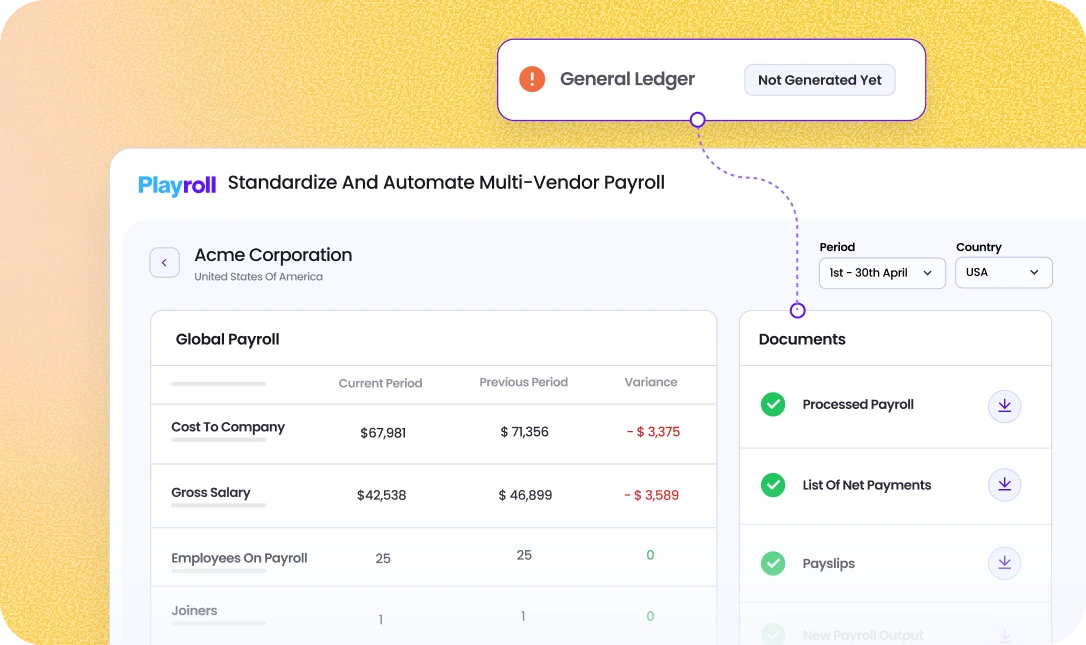
If you already have entities in multiple countries, Payroll’s global payroll services enable you to run payroll across all of them through one unified system, instead of managing separate vendors in each location.
The difference is in how it’s set up. Playroll's advanced payroll analytics software gives you better visibility into the details of every country's payroll run, in one, easy-to-use dashboard. In practice, that gives you better visibility and fewer things slipping through the cracks. There are also built-in variance checks that flag cost or compliance issues before payroll runs, so your team can catch problems early instead of fixing them after the fact.
Our dedicated Customer and Employee Success teams are also unique, ensuring you and your team have access to expert support whenever you need it. This makes Playroll a strong fit for companies with multiple entities that want more centralized oversight and consistency across countries, without losing control at the local level.
With support for multi-currency payments, automated filings, and hands-on oversight of compliance, Playroll works especially well for teams expanding across EMEA, North America, and emerging markets that care about structure, visibility, and long-term scalability.
Key Features:
- Centralized global payroll management with real-time cost visibility
- Dedicated Customer and Employee Success teams
- Built-in compliance variance detection
- Multi-currency payment engine
- Direct control over contracts and statutory processes
- Integrated payroll reporting and analytics
- Fast onboarding workflows
Countries Covered:
- United States
- South Africa
- The Netherlands
- Greece
- United Kingdom
- Germany
- Brazil
- United Arab Emirates
- + many more
Pricing:
From $10 per employee, per month
Ready To Simplify Multi-Country Payroll?
If you want centralized visibility, built-in compliance checks, and real human support behind your global payroll operations, it may be time to move to infrastructure that scales with you.
Book a Demo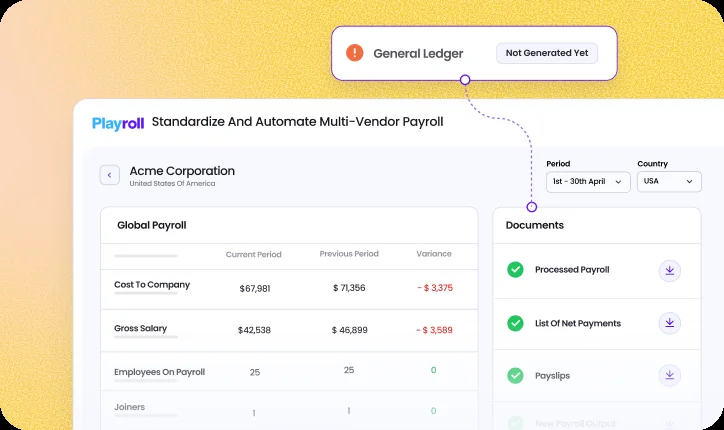
2. Omni HR: Best For Asia-Based Teams Managing Multi-Country Payroll and HR in One Platform
Omni HR is an all-in-one HRIS and multi-country payroll platform built for Asia's fastest-growing companies. With deep localization across Singapore, the Philippines, Malaysia, and broader APAC, Omni gives HR teams a single workspace to run compliant, automated payroll across 100+ countries, handling local tax calculations, statutory contributions, and country-specific regulations without the need to stitch together local vendors or disconnected systems.
Omni's pricing starts at $3 per employee per month, making it one of the most accessible options for growing teams that don't want to compromise between functionality and cost. It's a strong fit for mid-sized and scaling companies across APAC that need a platform built to grow alongside them.
Key Features:
- Multi-country payroll processing with automated tax calculations and statutory contributions
- Built-in compliance
- Multi-currency payroll runs from a single platform
- Unified payroll and HR data — no reconciliation between separate tools
- AI capabilities to reduce manual overhead and surface workforce insights
- Automated onboarding and end-to-end employee lifecycle management
- Customizable employee database with real-time reporting and analytics
Countries Covered:
- Singapore
- Philippines
- Malaysia
- Indonesia
- And 100+ more
Pricing:
From $3 per employee, per month.
3. Deel: Best For High-Growth Startups Scaling Across Multiple Markets Quickly
Deel is one of the most recognized international payroll software platforms, particularly among venture-backed startups. It supports contractor management, EOR, and payroll services in 150+ countries through a mix of owned entities and partner infrastructure.
Deel is often strongest in EOR-led expansion, but for companies already operating multiple entities, its payroll offering may still require layering over existing local processes rather than fully replacing them.
On top of that, Deel users are often surprised by hidden fees on top of an already high base fee of $29 per employee, per month for payroll processing. Reviews also suggest low response times due to a ticketing system and multiple points of contact, which in turn lead to higher costs and delays.
Key Features:
- Automated localized contracts
- Strong contractor payment workflows
- Integration marketplace
- Tax form automation
- Local benefits administration
Countries Covered:
- United States
- Canada
- United Kingdom
- And 140+ more
Pricing:
Deel’s global payroll plans start at ~$29 per employee per month.
4. Remote: Best For Companies Prioritizing IP Protection
Operating in 100+ countries, Remote highlights direct legal control in many jurisdictions, which can reduce compliance fragmentation compared to fully partner-based models. This provider integrates payroll, EOR, and contractor services into one platform, with particular strength in employment law positioning for tech companies.
That being said, their pricing is incredibly complicated and like Deel, their ticketing customer support system can create delays in response times and hiring. On top of that, they don’t over as many regions, meaning they may not support specific country expansions.
Remote’s model also arguably aligns more closely with companies that want Employer of Reord Servics, and you’ll need to carefully evaluate its payroll capabilities if you’re looking to consolidate multiple existing payroll providers into one system.
Key Features:
- Comprehensive payroll analytics software
- Built-in IP protection clauses
- Local statutory benefits administration
- Payroll tax handling
- Contractor and EOR functionality
Countries Covered:
- United States
- United Kingdom
- Spain
- And 70+ more
Pricing:
Remote’s global payroll pricing starts at $29 per employee, per month.
5. Oyster: Best For Remote-First Teams Hiring Internationally For The First Time
Oyster supports payroll and employment services in 180+ countries and is often chosen by remote-first companies entering international hiring for the first time. From a payroll perspective, its platform focuses on straightforward onboarding, localized benefits guidance, and simplified cross-border salary management.
However, Oyster relies heavily on partner infrastructure for payroll execution in many jurisdictions. That partner model can work well for early-stage teams, but companies that prioritize direct payroll control or comprehensive in-country infrastructure may want to assess how payroll is actually processed locally. Pricing also trends toward the higher end, which may impact scalability as your headcount grows. And on top of that, their partner model means you can expect considerable communication delays.
Key Features:
- Remote onboarding workflows
- Localized benefits recommendations
- Contractor and employee management
- Compensation benchmarking tools
- Global HR support
Countries Covered:
- Not publicly disclosed
Pricing:
Global payroll starts at $29 per employee per month.
6. Papaya Global: Best For Enterprise Payroll Aggregation And Enterprise Reporting
Papaya Global is positioned as a centralized multi-country payroll platform that aggregates data from in-country payroll providers into one unified reporting and payment layer. For multinational organizations already operating through local entities, Papaya can standardize workforce cost data, consolidate reporting, and manage cross-border payroll payments from a single dashboard.
That being said, Papaya typically also acts as an orchestration layer rather than a direct payroll engine in every country. Because execution often relies on local partners, coordination and cost structures can vary and communication delays are common with this structure. Pricing is enterprise-focused and not publicly transparent, making it more suitable for larger organizations than scaling startups.
Key Features:
- Payroll aggregation model
- Enterprise analytics dashboards
- Global payments engine
- API integrations
- Compliance monitoring
Countries Covered:
- United States
- Germany
- China
- And 150+ more
Pricing:
Papaya Global’s payroll pricing starts at $29 per employee, per month.
7. ADP Global: Best For Large Multinationals With Complex Global Payroll Structures
If you’re operating at true multinational scale, ADP GlobalView is built for that level of complexity. It offers standardized payroll processes across 140+ countries, regulatory monitoring, and comprehensive integration with enterprise finance systems like SAP.
On the flip side, it’s also not designed for agility. Implementation can take time, contracts are enterprise-level, and pricing isn’t transparent. For companies looking to test new markets or operating in just a few countries, it may feel heavier than necessary.
Key Features:
- Enterprise payroll engine
- Regulatory compliance tracking
- Global payroll standardization
- Advanced analytics
- SAP ecosystem integration
Countries Covered:
- United States
- United Kingdom
- Germany
- And 140+ more
Pricing:
ADP Global’s pricing isn’t transparent but reviews suggest that they follow an enterprise contract pricing model.
8. Rippling: Best For Companies That Want Payroll Connected To Everything Else
Rippling approaches global payroll as part of a broader system. HR, IT, device management, and payroll all sit under one roof. If your priority is having onboarding, app access, and payroll changes move in sync, that integration can save a lot of admin time.
Where it gets more nuanced is international payroll depth. Rippling’s direct global payroll coverage is still more limited than providers built purely for multi-country payroll. If you’re expanding into highly regulated jurisdictions, you’ll want to understand how local compliance is handled which can be difficult with this system. Pricing is modular, so costs depend heavily on which products you enable, many of which are overly complicated and clunky for teams that aren’t IT-focused.
Key Features:
- Unified HR, IT, and payroll system
- Automation workflows
- Modular product structure
- Integration ecosystem
- Expanding global payroll footprint
Countries Covered:
- Not available publicly
Pricing:
Rippling’s pricing is modular and based on which features you select, however, reviews suggest that regardless of the selection, their pricing is on the higher side.
9. Multiplier: Best For Budget-Conscious Global Payroll Expansion
Multiplier is often shortlisted by companies looking to expand internationally without committing to enterprise-level payroll costs. It supports payroll in 150+ countries and offers relatively competitive pricing compared to many global providers.
For lean teams watching cash flow, that can be appealing. However, infrastructure varies by country, and some users report complexity around invoicing or slower response times from support. If you’re expanding into highly regulated markets, it’s worth asking detailed questions about how payroll compliance is executed locally.
Key Features:
- Competitive EOR pricing
- Contractor and employee payroll
- Multi-currency payouts
- Local compliance documentation
- Benefits administration
Countries Covered:
- Limited direct payroll coverage, though the exact number is not publicly disclosed.
Pricing:
Payroll pricing isn’t transparent and you’ll be required to contact their sales team for a quote. Their EOR services start at $400 per employee per month.
10. Safeguard Global: Best For Complex, Compliance-Heavy Payroll Environments
Safeguard Global combines payroll execution with compliance advisory and workforce analytics. If you’re operating in heavily regulated industries or across complex jurisdictions, that added advisory layer can be reassuring.
The trade-off is that it’s typically positioned for enterprise clients. Pricing is custom, and implementation may be more structured compared to startup-oriented platforms. For smaller teams managing only a few countries, it may feel more robust than necessary.
Key Features:
- Payroll consolidation
- Workforce cost analytics
- Compliance advisory
- Hybrid service model
- Cross-border payments
Countries Covered:
- United States
- United Kingdom
- Germany
- And 170+ more
Pricing:
Safeguard Global’s pricing isn’t transparent but reviews suggest their cost model is custom enterprise pricing.
11. CloudPay: Best For Global Payroll And Treasury Integration
Safeguard Global combines payroll execution with compliance advisory and workforce analytics. If you’re operating in heavily regulated industries or across complex jurisdictions, that added advisory layer can be reassuring. It supports payroll in 170+ countries and is often chosen by large multinational organizations.
The trade-off is that it’s typically positioned for enterprise clients. Pricing is custom, and implementation may be more structured compared to startup-oriented platforms. For smaller teams managing only a few countries, it may feel more robust than necessary.
Key Features:
- Unified payroll and payment execution
- Global treasury integration
- Compliance monitoring
- Enterprise reporting dashboards
- Finance system integrations
Countries Covered:
- United States
- United Kingdom
- France
- And 130+ more
Pricing:
Cloudpay’s pricing isn’t transparent but reviews suggest their cost model is custom enterprise pricing.

How Much Does Multi-Country Payroll Software Cost?
The price you pay for multi-country software depends on three main factors:
- Whether you already have legal entities in each country
- Whether the provider runs payroll directly or via partners
- How much compliance, reporting, and support you need
For companies with multiple entities, the primary value isn’t replacing entity infrastructure, it’s reducing the operational overhead of running payroll separately in each jurisdiction.
Here’s what most companies see in 2026:
- Direct multi-country payroll processing (you have entities): Typically $20 to $50 per employee per month, depending on country complexity.
- EOR-enabled payroll (no entity required): Usually $400 to $700 per employee per month, since you’re paying for legal employment infrastructure, compliance liability, and benefits administration.
- Enterprise aggregation models: Custom annual contracts. Pricing depends on headcount, number of countries, integrations, and reporting depth.
But software fees are only part of the picture. In global payroll, the cheapest option isn’t always the most economical once risk and overhead are factored in. When evaluating the total cost, you’ll also need to factor in:
- Local tax filing fees
- Year-end reporting charges
- FX markups on cross-border payments
- Off-cycle payroll fees
- Termination processing costs
- Dedicated support or account management tiers
That gives you employment infrastructure, statutory compliance handling, local contracts, and payroll processing bundled together.
Using direct payroll (assuming you already have entities) at $35 per employee per month:
12 × $35 = $420 per month
On paper, that looks dramatically cheaper. But there are additional costs associated with global payroll that aren’t factored into that final figure.
Direct payroll also requires:
- Entity formation and maintenance
- Corporate tax registration
- Local accounting support
- Social security and benefits administration
- Ongoing compliance monitoring
- In-country legal guidance for terminations or disputes
But in reality, most scaling companies with entities don’t run payroll in isolation, they coordinate multiple local vendors, accountants, and compliance processes. That’s where centralized payroll platforms (like ours) create value by replacing fragmented workflows with one unified system.
How To Choose The Best Multi-Country Payroll Software
Once you start comparing platforms, it’s easy to get distracted by country counts and feature lists. But choosing the right multi-country payroll software comes down to how payroll is actually executed, how compliance risk is managed, and whether the system will still work for you two years from now.
So instead of asking “Which platform looks the most impressive?”, the better question is: “Which one aligns with how we plan to scale?”
Here’s what to look at closely before you commit:
- Local Payroll vs EOR Distinction: Be clear on what you actually need. If you already have entities, you may only need payroll processing. If you don’t, you’ll need full employment infrastructure, which changes pricing and risk exposure.
- Compliance Risk Controls: Ask how payroll compliance across jurisdictions is monitored and updated. Who tracks local tax changes? Who handles statutory filings? What happens if something goes wrong?
- Cost Structure Transparency: Look beyond the base per-employee fee. Understand FX markups, year-end filing charges, off-cycle payroll fees, and termination processing costs.
- Scalability: Can the platform support five employees today and fifty next year without forcing a system migration or restructuring your contracts?
- Integration Stack: Make sure it connects cleanly with your HRIS, ERP, and finance systems so you can maintain centralized global payroll reporting without manual reconciliation.
Key Takeaways
The best multi-country payroll software depends on your structure, scale, and risk tolerance. Enterprises may lean toward ADP, CloudPay, or Papaya for consolidation and analytics. Startups often choose Deel, Oyster, or Multiplier for speed. Remote emphasizes compliance depth.
If you are expanding internationally without building local infrastructure, platforms that combine payroll execution, compliance oversight, and centralized reporting tend to reduce fragmentation and improve visibility.
If your goal is controlled global expansion with unified oversight, Playroll’s global payroll solutions provide multi-country payroll, compliance automation, and real-time analytics in one platform. Book a chat with our team and let’s take about what that would look like in practice.

ABOUT THE AUTHOR
Jaime Watkins
Jaime is a content specialist at Playroll, specializing in global HR trends and compliance. With a strong background in languages and writing, she turns complex employment issues into clear insights to help employers stay ahead of the curve in an ever-changing global workforce.
Multi-Country Payroll Software FAQs
What is the best multi-country payroll software for small business?

.png)
The best multi-country payroll software for small businesses usually depends on how fast you’re expanding and how complex your setup is. Many startups start with providers like Playroll or Multiplier because they’re accessible and relatively easy to get up and running.
But if you’re planning structured global growth, it’s worth choosing a platform that can support both direct payroll and EOR under one system, so you don’t have to switch providers as your footprint expands.
What’s the easiest way to pay employees in multiple countries?
The easiest way to pay employees in multiple countries is to use a centralized global payroll provider. Instead of juggling separate local vendors, spreadsheets, and payment timelines, you manage everything through one system that automates cross-border payroll processing, tax calculations, filings, and multi-currency payments.
How do I ensure payroll compliance in different countries?
Ensuring payroll compliance in different countries starts with choosing a provider that actively monitors local regulations and automates statutory tax filings. The real challenge is staying aligned with changing tax rules, social contributions, and reporting deadlines across jurisdictions. A provider with in-country expertise and built-in compliance controls reduces the risk of penalties and surprises.
What software handles tax filings across countries?
Software that handles tax filings across countries typically includes enterprise-grade global payroll platforms like ADP, CloudPay, Papaya Global, and Playroll. These systems automate local tax deductions, statutory contributions, and reporting requirements as part of their multi-country payroll infrastructure.
Do I need an entity to run payroll in another country?
Yes, you generally need a legal entity to run direct payroll in another country. If you don’t have one, you can use an Employer of Record model to hire and pay employees compliantly without setting up local infrastructure. The right choice depends on your growth plans, cost structure, and how much control you want over in-country operations.

Back to Top
.svg)







.svg)