.svg)
.svg)

Thousands of global businesses can't be wrong.
Sign up for free and explore global hiring with Playroll.


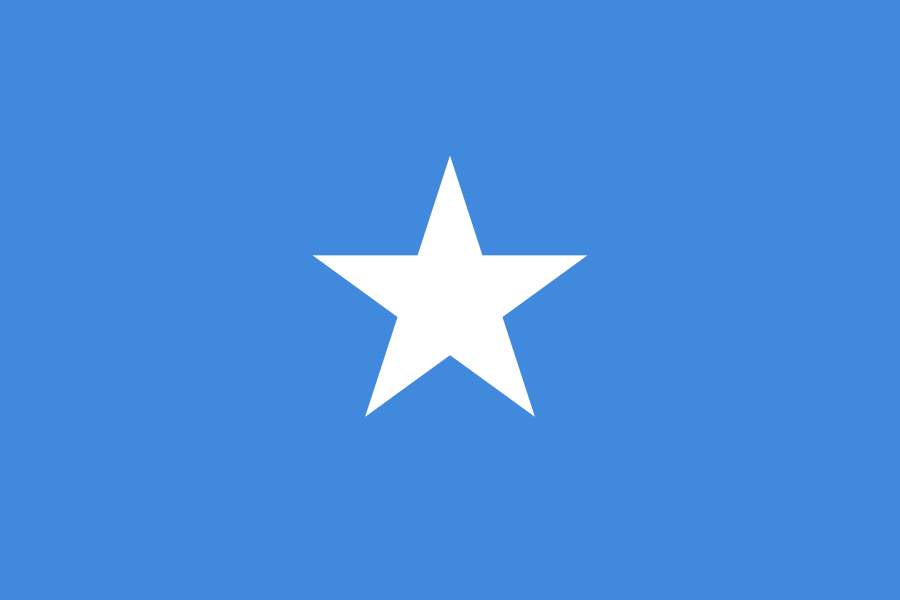

Is Severance Pay Mandatory in Somalia?
Somalia’s Labour Code (Law No. 65 of 1972) requires severance pay when an employee is dismissed without serious misconduct or when termination is for economic or organizational reasons. Severance is generally based on the employee’s length of service and last wage, subject to the minimum protections in the Labour Code and any stronger terms in contracts or collective agreements.

Thousands of global businesses can't be wrong.
Sign up for free and explore global hiring with Playroll.
Which Employees Qualify for Severance Pay?
- Employees working under an indefinite or fixed-term employment contract governed by Somalia’s Labour Code generally qualify when dismissed without serious misconduct.
- Employees terminated for economic, technological, or organizational reasons (redundancy) typically qualify for severance or redundancy compensation.
- Employees with at least a minimum continuous service period, as set in their contract or collective agreement, are more likely to benefit from severance protections.
- Employees who are dismissed without the required notice, or in breach of contract, may be entitled to severance or compensation in lieu.
- Employees covered by collective bargaining agreements or company policies that promise severance will qualify under those more favorable terms.
- Employees dismissed for proven serious misconduct after due process usually do not qualify for statutory severance.
What Are the Legal Timelines for Paying Severance?
Somalia’s Labour Code does not set a highly detailed severance payment schedule, but you are expected to pay all outstanding wages and severance promptly at the end of employment. In practice, employers should aim to calculate and pay severance on or before the employee’s final working day, or within a short, reasonable period after termination. Where notice is not worked, compensation in lieu of notice and severance should be settled together. Any longer internal approval process should be clearly documented and communicated to the employee. To stay low risk, your company should adopt a written policy to finalize and pay severance within 7 to 14 days of termination.
What Penalties Apply if Severance Is Not Paid Correctly?
If your company fails to pay severance correctly in Somalia, you risk financial, administrative, and reputational consequences. Labour authorities can treat non-payment as a breach of the Labour Code, and employees can bring claims for unpaid amounts and damages. Courts or labour bodies may also look at whether you followed fair termination procedures, not just the payment itself.
- Employees can claim unpaid severance, notice pay, and related wage arrears.
- Labour authorities may impose fines or administrative sanctions for non-compliance.
- Courts can award additional compensation or damages for unlawful dismissal.
- Persistent breaches can damage your company’s reputation and employee relations.
- Disputes may lead to legal costs and management time spent on litigation or settlement.
Does Outsourcing Employment via an EOR Change Severance Liability?
Using an Employer of Record (EOR) does not remove the need to respect Somalia’s severance rules, but it can shift day-to-day compliance tasks. In a typical EOR model, the EOR is the legal employer on paper and is responsible for calculating and paying severance under local law. Your company, as the client, still drives business decisions like termination and may be contractually required to fund any severance owed. If the EOR mishandles severance, employees or authorities may still look to your organization where you are seen as the real economic employer. Clear contracts and transparent cost-sharing are essential to manage this shared risk.
Be 100 Percent Compliant in Offering Severance with Playroll
Playroll helps your company navigate Somalia’s severance rules by combining local legal insight with practical payroll execution. Our team tracks changes to the Labour Code, typical market practice, and notice requirements so your severance offers are both compliant and competitive. We standardize documentation, from contracts to termination letters, so you can show clear, fair processes if a dispute arises.
When you hire through Playroll’s global platform or EOR service, we handle calculations for severance, notice pay, and final wages in line with Somali law and any agreed company policy. Your team stays focused on business decisions while we manage timelines, payslips, and payments, reducing the risk of penalties or employee claims. With centralized records and expert support, you can scale in Somalia knowing your offboarding practices are consistent and defensible.

Handle Terminations Smoothly and Compliantly
01
Reach out to playroll
We’ll manage compliant onboarding and offboarding for your global team.
02
Accurate Severance Pay
Our payroll experts manage severance payouts in compliance with local laws.
03
Get Hands-On Support
Employers and employees receive personalized support for any queries.
04
Stay Current With Regulations
We’ll alert you to any updates in severance pay or employment compliance.


.svg)




.svg)