.svg)
.svg)

.svg)
.svg)

Copied to Clipboard

Ready to get Started?


Payroll in the United States is more complicated than most employers expect. “Just paying” your team boils down to calculating federal tax withholdings, funding Social Security and Medicare, managing unemployment programs, and filing quarterly and annual reports. Deadlines are strict, systems don’t always talk to each other, and when something doesn’t line up, the penalties can be severe.
Part of what makes it so complicated is that there’s also no single authority overseeing everything. Federal taxes run on one schedule, states operate their own income tax and unemployment systems, and some cities add another layer on top. Expanding into a new state means new registrations, new tax rates, and new reporting requirements. For companies hiring across multiple states, payroll complexity grows fast.
In 2026, choosing a payroll provider is less about basic processing and more about staying compliant while you scale. This guide breaks down pricing, leading providers, real-world reviews, and what to look for if you want payroll that works.
Payroll Services in the United States: What They Include and Why They Matter
A credible U.S. payroll provider will understand that in the United States, payroll functions as an ongoing tax administration process layered on top of wage-and-hour compliance. That means converting gross wages to net pay using current IRS withholding tables, applying Social Security and Medicare correctly. On top of that, your provider needs to calculate federal and state unemployment taxes under separate wage bases and employer-specific rates, and ensure employee classifications align with overtime and exemption rules under federal and state law.
In the U.S., running payroll correctly matters because the system is built around making tax deposits first and reconciling them later. Federal income tax and FICA must be sent to the IRS on assigned schedules while state withholding and unemployment obligations run in parallel. Any mismatch often surfaces months later through automated notices, amended filings, or penalty assessments rather than on payday itself.

What Should You Consider When Choosing a Payroll Provider in the United States?
With that in mind, here’s what our team would look for when evaluating a payroll provider in the U.S.:
- Multi-Jurisdiction Compliance Coverage: Your provider must manage federal deposits, quarterly Form 941 filings, annual Form 940 returns, W-2 processing, state income tax registrations, state unemployment insurance rate tracking, and local tax compliance where applicable. Ask how they handle amended filings, deposit corrections, and formal responses to IRS or state agency notices.
- Entity vs No-Entity Support: If you already operate through a U.S. corporation or LLC, confirm the provider offers managed payroll under your existing federal and state accounts. If you are entering the U.S. but don’t have a local entity, ask if the provider offers Employer of Record services and whether you can transition to managed payroll later without changing systems.
- Employment Types Supported: U.S. payroll involves salaried employees, hourly non-exempt workers, tipped employees, commissioned staff, corporate officers, and independent contractors. Ensure the provider correctly configures overtime eligibility, exemption classifications, supplemental wage withholding, equity compensation reporting, and contractor payment structures.
- Funding and Deposit Timing: Federal tax deposits must follow assigned schedules. Confirm payroll cut-off deadlines, ACH funding timelines, same-day processing availability, and how off-cycle payroll is handled. State final paycheck laws in some jurisdictions require immediate wage payment upon termination, making process timing critical.
- Reporting and Audit Trail: You should have access to payroll registers, liability summaries, deposit confirmations, quarterly and annual filing archives, and general ledger exports. Multi-state employers must maintain clear reconciliation records to withstand audit scrutiny.
- Support and Notice Management: IRS and state agencies issue automated notices for discrepancies. Confirm whether your provider assists with notice response, rate adjustments, and amended return filing.
- Pricing Transparency: Clarify implementation fees, multi-state add-ons, year-end processing fees, garnishment administration charges, ACA reporting costs, and off-cycle payroll pricing. Headline per-employee rates rarely reflect total compliance cost.
Expanding Into a New State?
Adding one employee can trigger new payroll registrations, tax accounts, and filing obligations. See what running payroll looks like state by state before you scale.
View the State Payroll Guide
Estimated Cost of Payroll Services in the United States
In 2026, most U.S. payroll providers will charge a fixed monthly platform fee plus a per-employee fee. The structure is simple on paper, but total cost depends on headcount, number of states, and add-on services.
Typical pricing ranges look like this:
- 1 Employee: $30–$120 per month
- 3 Employees: $50–$180 per month
- 10 Employees: $100–$300 per month
Standard plans generally cover payroll calculations, federal and state tax filings, and digital pay statements. However, additional costs often apply for multi-state registrations, off-cycle payroll runs, contractor payments, ACA (Affordable Care Act, also known as Obamacare) reporting, benefits administration, and year-end W-2 and 1099 processing.
For larger or multi-state employers, pricing is usually quote-based. Providers will factor in total headcount, the number of states where employees are active, filing complexity, and any required integrations with accounting, HR, or time-tracking systems.
Run U.S. Payroll with Full Federal & State Compliance
Playroll manages your U.S. payroll end-to-end, including accurate wage calculations, automated federal and state tax filings, multi-state compliance, and year-end reporting. All from just $10 per employee per month.
Book a Demo
Leading Payroll Service Providers in the United States in 2026
If you spend any time in 2026 HR and finance threads, one theme is clear – there’s no universal “best” provider for any one company. The right fit depends on your size, how many states you operate in, and whether you’re hiring domestically or expanding into the U.S. from abroad. If there’s one element you shouldn’t compromise on, however, it’s managing federal and multi-state compliance without fragmentation.
Below are some of the leading U.S. payroll providers in 2026 – who they’re best for, where they stand out, how long onboarding typically takes, and how they structure pricing.
1. Playroll: Best for global companies hiring in the United States
Playroll is designed for international companies that need U.S. payroll to fit into a broader global strategy. Whether you’re hiring your first employee in the U.S. or scaling across multiple states, we support both U.S. entity payroll and Employer of Record arrangements. That means you can hire before setting up an entity and transition to direct payroll at a later stage without changing platforms.
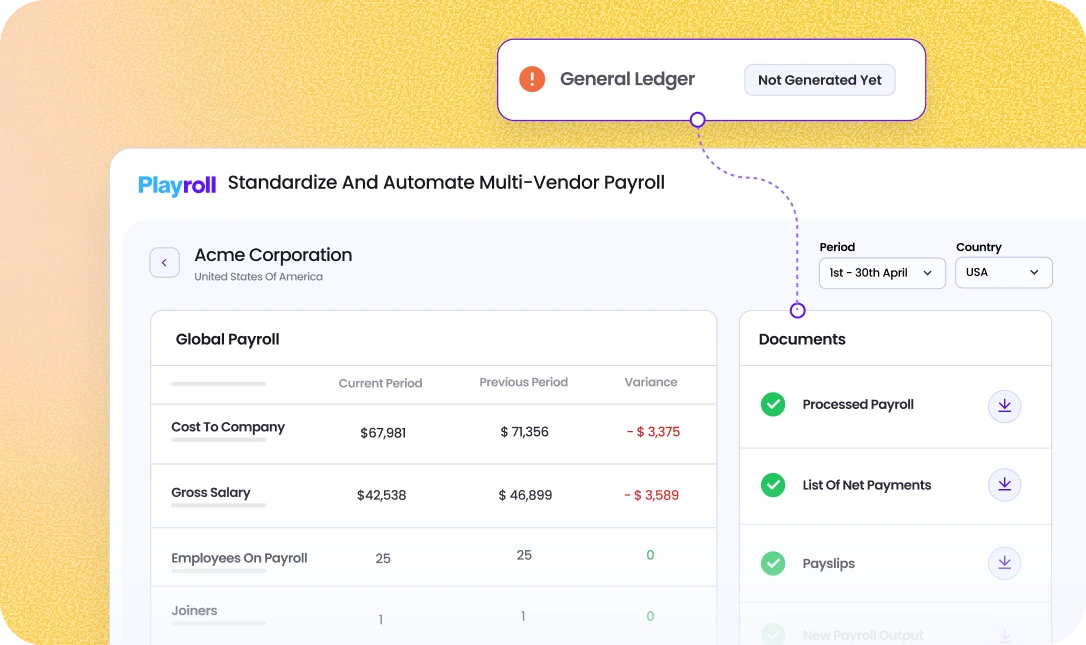
Because we operate across jurisdictions every day, our focus is practical compliance. Federal deposit schedules, multi-state registrations, reporting requirements, these are core to how we work. Your U.S. payroll sits within consolidated global reporting, so finance teams retain visibility across countries.
Behind the platform, we have in-house legal experts and dedicated customer and employee support teams. If questions come up (from tax registrations to employee payroll queries) you and your team have direct access to people who understand the regulatory landscape and can respond quickly.
- Key Strengths: Multi-country payroll infrastructure, U.S. federal and multi-state compliance support, entity + EOR flexibility, consolidated reporting, contractor management, HRIS and accounting integrations.
- Time to First Payroll: ~2–4 weeks depending on registrations and complexity.
- Pricing Model: $10 per employee, per month for global payroll services. This includes accurate and on time payroll processing, tax payments and filings, complete compliance, and dedicated support.
Hiring in the U.S.? Let’s Make Payroll Simple.
We operate within the same federal and state payroll framework our clients do. That means we understand IRS deposit schedules, multi-state registrations, and the operational realities of running payroll accurately and on time.
Speak to an Expert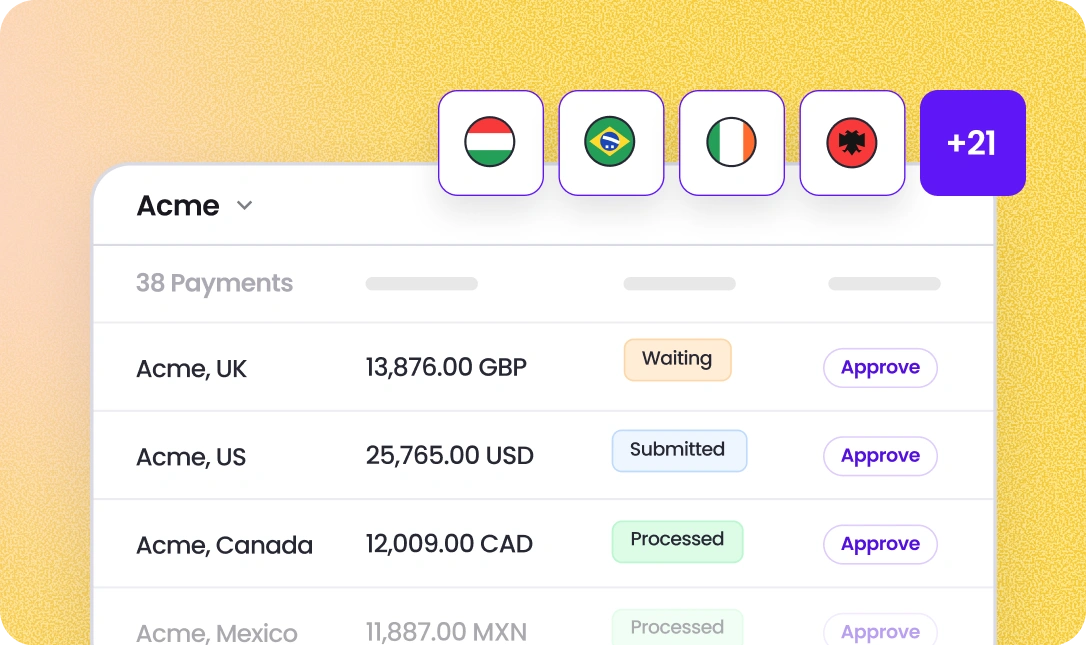
2. ADP: Best for enterprise and multi-state employers
ADP is one of the biggest names in U.S. payroll, and for many large or multi-state employers, it’s the default choice. If you’re running payroll across several states or managing high volumes, its infrastructure is built to handle that level of complexity. Federal, state, and local compliance automation is where ADP tends to feel strongest.
That said, it’s not always the most flexible option. Pricing can be hard to pin down upfront, especially if you need multiple modules or integrations. Implementation timelines can also stretch, particularly for companies connecting ADP to ERP or finance systems. Many users describe it as dependable but somewhat rigid – strong on compliance coverage, less so on user experience.
- Key Strengths: Enterprise-grade automation, strong federal and multi-state compliance coverage, advanced reporting, broad HR and workforce management suite.
- Time to First Payroll: ~2–6 weeks; longer for complex enterprise rollouts.
- Pricing Model: Quote-based, structured around headcount, operating states, and selected modules.
3. Paychex: Best for domestic small and mid-sized businesses
Paychex is a steady choice for U.S.-based SMBs that want payroll, benefits, and retirement services bundled together under one provider. Its main advantage is convenience – you can manage payroll and benefits in one place with solid compliance coverage.
The downside is that costs can climb as you add services or expand into additional states, so the bundled simplicity can become more expensive over time.
- Key Strengths: Bundled payroll and benefits, retirement administration, SMB-focused compliance support.
- Time to First Payroll: ~1–3 weeks for standard implementations.
- Pricing Model: Tiered pricing; custom quotes for expanded services.
4. Gusto: Best for startups and growing SMBs
Gusto is widely praised for its clean interface and straightforward automation, making it especially attractive for startups and small, single-state employers. It handles filings automatically and keeps payroll approachable for non-experts.
However, as teams grow or expand across multiple states, pricing increases and some companies find they outgrow its depth for more complex payroll needs. Gusto also only operates in the U.S. which can be an issue if you’re planning on expanding your payroll operations.
- Key Strengths: User-friendly interface, automated federal and state filings, integrated benefits, strong startup adoption.
- Time to First Payroll: ~1–2 weeks for straightforward setups.
- Pricing Model: Starts around $40 per month plus per-employee charges; higher tiers unlock additional HR tools.
5. Rippling: Best for integrated HR and payroll automation
Rippling stands out for connecting payroll with HR, onboarding, IT, and device management in one ecosystem, which appeals to scaling and remote-first companies. Its automation capabilities are a major strength.
The tradeoff is modular pricing that can become expensive as you add features, and some users report a steeper learning curve or occasional system issues. On top of that, their features can feel somewhat bloated and there for the sake of. This might justify the price for more tech-focused teams, but it’s not something you want to be upsold on.
- Key Strengths: Good system integrations, automation across HR and IT workflows, scalable for growing teams.
- Time to First Payroll: ~2–4 weeks; longer for heavily customized setups.
- Pricing Model: Modular pricing; base platform plus per-employee fees and add-ons.
6. OnPay: Best for cost-conscious small employers
OnPay is known for simple, transparent pricing and straightforward payroll processing, making it attractive for small businesses with uncomplicated structures. Federal and state filings are included, which helps keep budgeting predictable.
It’s less suited for fast-scaling or highly multi-state employers that need more comprehensive functionality.
- Key Strengths: Transparent pricing, simplified compliance coverage, quick setup.
- Time to First Payroll: ~1–2 weeks for simple structures.
- Pricing Model: Approximately $40 per month plus ~$6 per employee per month.
7. QuickBooks Payroll: Best for businesses using QuickBooks accounting
QuickBooks Payroll works particularly well for companies already using QuickBooks Online, thanks to its seamless accounting integration and automated tax filings. The main benefit is reduced reconciliation work.
On the flip side, it’s more accounting-centric than HR-focused, so companies looking for broader workforce management tools may find it limited.
- Key Strengths: Seamless QuickBooks integration, automated tax filings with guarantees, same-day direct deposit options, employee self-service tools.
- Time to First Payroll: ~1–3 weeks depending on setup.
- Pricing Model: Tiered plans starting around $45 per month plus per-employee charges; higher tiers include enhanced support and tax penalty protection.
8. Justworks: Best for small businesses seeking a PEO
Justworks bundles payroll, HR, compliance, and benefits into a PEO (Professional Employer Organization) model, which is appealing for small teams that want to outsource HR administration entirely. The advantage is hands-off support and bundled benefits access.
The tradeoff is higher per-employee pricing compared to standalone payroll platforms.
- Key Strengths: All-in-one payroll and HR platform, multi-state payroll support, bundled benefits, 24/7 support.
- Time to First Payroll: ~2–4 weeks depending on configuration.
- Pricing Model: Payroll-only contractor plans from ~$8 per contractor per month; PEO plans typically ~$59–$109 per employee per month depending on tier and benefits.
9. TriNet: Best for SMBs outsourcing HR and payroll
TriNet is a strong PEO option for small to mid-sized companies that want payroll fully integrated with HR outsourcing and benefits management. Its strength lies in comprehensive compliance support across multiple states.
Like most PEOs, however, it comes at a premium and may offer more infrastructure than very small teams actually need.
- Key Strengths: Comprehensive payroll and HR outsourcing, federal/state/local compliance management, benefits administration, consulting support.
- Time to First Payroll: ~2–5 weeks depending on complexity.
- Pricing Model: Quote-based; per-employee monthly fees bundling payroll and HR services.
10. Paylocity: Best for mid-sized businesses seeking unified HCM
Paylocity provides a unified payroll and HR platform aimed at mid-market companies that need more depth than startup tools but less rigidity than enterprise systems. Its strength is balanced functionality and workforce analytics.
The downside is a longer, more structured implementation process that requires planning and internal coordination. If you’re looking for a plug-and-play solution, this definitely isn’t it.
- Key Strengths: Unified HR + payroll platform, multi-state compliance automation, workforce analytics, strong employee self-service tools.
- Time to First Payroll: ~4–12 weeks depending on modules and migration complexity.
- Pricing Model: Quote-based; often ranges ~$18–$32 per employee per month depending on modules and headcount.
Insights from Real Users
Playroll
Playroll has made managing our global workforce remarkably seamless. The platform’s intuitive interface allows our HR and finance teams to navigate payroll, compliance, and reporting with ease. Their competitive pricing provides excellent value without compromising on service quality, and the built-in support for local taxes and labor regulations has eliminated a significant administrative burden for our international operations.
- Verified G2 User
ADP
I like ADP because it provides reliable payroll, an easy-to-use system, strong customer support, and mobile access, helping save time and simplify payroll management. We’ve experienced some software navigation issues, and problems with payroll accuracy or timely corrections.
- Verified G2 User
What the Onboarding Process Looks Like With a Payroll Provider in the United States
Setting up U.S. payroll is about putting the right compliance framework in place before the first paycheck goes out. Unlike some countries, there’s no single registration that covers everything. You’re aligning federal systems, state tax accounts, unemployment programs, insurance coverage, and wage classifications.
Here’s what a well-managed onboarding process should look like.
Step 1: Federal and State Registrations
Everything starts with registrations. You’ll need a federal Employer Identification Number and enrollment in the Electronic Federal Tax Payment System. On top of that, every state where you have employees requires separate income tax and unemployment insurance accounts.
Without these accounts active, payroll cannot legally run.
- Your responsibility as the employer: Provide your EIN, federal enrollment details, state account numbers, entity structure, and confirmation of operating states.
- Your payroll provider’s role: Configure federal deposit schedules correctly (monthly or semiweekly) set up state tax accounts in their system, and align reporting calendars so filings and payments match.
Step 2: Setting Up Employees Correctly
Once all of the relevant registrations have been made, attention shifts to employee setup. Accuracy matters here because federal and state withholding is calculated based on the data collected at onboarding. Employees must complete Form W-4 for federal tax withholding and Form I-9 for work authorization. Many states also require separate withholding certificates.
- Your responsibility as the employer: Provide correct wage rates, employee classifications (exempt or non-exempt) banking details, work locations, and completed tax forms.
- Your payroll provider’s role: Configure withholding elections, exemption status, overtime eligibility, local taxes where applicable, and validate that classifications comply with wage-and-hour laws.
Pro Tip: If you’re transitioning from another provider, year-to-date payroll data must also be imported accurately to prevent tax discrepancies later in the year.
Step 3: Workers’ Compensation and Insurance Alignment
This step is often overlooked, but it directly affects audit exposure. Most states require active workers’ compensation coverage before payroll begins. Some states also require disability insurance or other state-mandated programs.
- Your responsibility as the employer: Secure appropriate insurance policies and provide policy numbers and carrier details.
- Your payroll provider’s role: Map workers’ compensation codes correctly and ensure wage reporting aligns with insurance requirements.
Step 4: Your First Live Payroll
Once registrations, employee data, and insurance details are validated, your first payroll goes live.
During this run, direct deposits are processed, pay statements are issued, federal and state withholdings are calculated, and tax deposits are initiated according to your assigned federal schedule. Reporting cycles officially begin.
From this point forward, payroll operates within a recurring compliance rhythm: federal tax deposits, quarterly filings, state unemployment reports, and year-end reconciliations.
Checklist for Compliantly Running Payroll in the United States
Running payroll in the U.S. means managing recurring tax deposits, filings, wage compliance rules, and insurance obligations. Below is what must happen consistently to stay compliant.
1. Payroll Tax Withholding and Deposits
Every pay cycle requires accurate calculation and timely deposit of payroll taxes.
- Withhold federal income tax based on Form W-4 elections
- Withhold employee Social Security and Medicare (FICA)
- Match employer portions of Social Security and Medicare
- Deposit federal taxes according to your assigned IRS schedule – monthly or semiweekly
- Withhold and remit state income tax where applicable
- Withhold and remit local payroll taxes where required
2. Federal and State Reporting Requirements
Payroll reporting operates on quarterly and annual cycles.
- File Form 941 quarterly for federal income tax and FICA reporting
- File Form 940 annually for federal unemployment tax (FUTA)
- Submit state unemployment wage reports quarterly
- Submit state income tax reconciliations as required
- Issue W-2 forms to employees by January 31
- Issue 1099-NEC forms to contractors by January 31
- File copies of W-2s and 1099s with the appropriate agencies
3. Wage and Hour Compliance
- Pay at least the applicable minimum wage – federal, state, or local (whichever is higher)
- Calculate overtime at one and one-half times the regular rate for non-exempt employees
- Apply state-specific overtime rules where stricter than federal law
- Comply with final paycheck timing laws when employees terminate
- Maintain accurate timekeeping records
4. Unemployment and Insurance Contributions
- Pay federal unemployment tax (FUTA)
- Pay state unemployment tax (SUTA) based on assigned state rates
- Maintain active workers’ compensation coverage
- Comply with any required state disability insurance programs
5. New Hire and Ongoing Administrative Requirements
- Report new hires to state agencies within required deadlines
- Maintain payroll records for required retention periods (often 3–4 years federally, longer in some states)
- Update employee withholding when new W-4 forms are submitted
- Reconcile year-to-date payroll totals before year-end reporting
6. Common Pitfalls: Especially for Foreign Employers
- Misunderstanding state-by-state registration requirements
- Failing to register in states where remote employees work
- Misclassifying contractors under IRS common law standards
- Missing deposit deadlines due to IRS lookback misinterpretation
- Assuming payroll reporting is centralized under one authority
Key Takeaways
Running payroll in the United States means working within a system where federal tax deposits, state reporting, and wage laws all operate at the same time – and rarely in sync. It’s structured and highly regulated, but not centralized. The right payroll partner doesn’t just process paychecks; they help you stay aligned with deposit schedules, filings, and worker classifications as your team grows.
That’s where Playroll comes in. We support both U.S. entity payroll and Employer of Record transitions, so whether you’re entering the market or scaling across states, your payroll sits within a compliance framework that’s built for multi-jurisdiction operations.
If you’re planning to hire in the United States, book a chat with our team and let’s streamline your payroll operations in the U.S.

ABOUT THE AUTHOR
Jaime Watkins
Jaime is a content specialist at Playroll, specializing in global HR trends and compliance. With a strong background in languages and writing, she turns complex employment issues into clear insights to help employers stay ahead of the curve in an ever-changing global workforce.
10 Payroll Services in the U.S. for 2026: Pricing & Reviews FAQs
Which federal filings should a U.S. payroll provider support?

.png)
A strong U.S. payroll provider should support core filings like Forms 941 or 944, 940, and annual W-2 and W-3 reporting so deadlines are met.
How can I check worker-classification support in payroll software?
Ask whether the system includes controls for employee versus contractor setup and overtime treatment to reduce wage and tax compliance risk.
Do providers handle payroll tax deposits as well as returns?
Many providers submit deposits and returns, but employers should confirm legal responsibility and keep filing confirmations for each period.
What security controls matter most for payroll data?
Prioritize role-based access, multi-factor authentication, and immutable audit logs for pay, bank, and tax-setting changes.
What should be validated before switching payroll providers?
Reconcile year-to-date wages and taxes, map all filing obligations, and confirm historical report access before migration.

Back to Top
.svg)








.svg)