.svg)
.svg)

.svg)
.svg)

Copied to Clipboard

Ready to get Started?


Key Takeaways
Switching EORs affects payroll, tax reporting, benefits, contracts, and compliance from day one, so it must be treated as a structured transition rather than an operational handover.
A successful EOR switch should feel invisible to employees: Pay schedules, take-home pay, benefits coverage, and job security should remain consistent to maintain trust and avoid unnecessary disruption.
Planning around payroll, data, and local laws is what prevents risk: Clear timelines, clean data migration & country-specific continuity decisions are essential to avoiding errors.
The global Employer of Record (EOR) market is projected to be worth around USD 4.7 billion in 2026, reflecting strong demand as companies hire across borders without setting up local entities. But with so many EOR providers out there, you might find yourself bumping into the same frustrating challenges – poor support, recurring payroll errors, and rising costs – issues no team should have to put up with.
It’s exactly this combo of pain points that pushes many companies to start thinking seriously about switching providers. That being said, even when you know you need better service, the idea of changing EOR partners can feel overwhelming – it can seem like a lot of risk and effort for your team. But with the right support and setup, a switch doesn’t need to be chaotic or stressful – strong processes, reliable infrastructure, and experienced guidance make all the difference.
We spoke to our own team of EOR experts – people who’ve handled dozens of migrations smoothly and successfully – to pull together the most practical, real-world advice you’ll need for the process, which we’ll cover below.
What “Switching an EOR” Actually Means
Switching EOR providers is a significant legal and operational transition that touches employment law, payroll processes, benefits administration, and employee trust. Because the legal employment relationship changes, the new EOR becomes embedded in the core legal and financial infrastructure of employment.
As a result, the transition creates downstream effects: payroll calendars must be realigned, benefit providers may shift, and statutory filings transfer to a new legal entity.
What Changes When You Switch EOR Providers
A change in EOR formally establishes a new legal employer for your team. Even when roles, reporting lines, and day-to-day responsibilities remain unchanged, the foundation supporting employment is reset.
In practice, this shift introduces changes across:
- How payroll is run and funded: Who calculates payroll, when funds need to be submitted, and how payments are released to employees can change. Even small differences in timing or approval windows matter when payroll cycles are tight.
- Who withholds and reports taxes: The responsibility for calculating, withholding, and filing employee taxes moves to a new legal entity. This includes monthly, quarterly, and annual statutory reporting, which needs to be aligned from the first payroll onward.
- How benefits are administered: Benefits may be issued under new plans or carriers, even when coverage remains equivalent. Enrollment processes, documentation, and employee access to benefit portals often change as part of the transition.
- Which employment contracts are in force: Existing agreements are replaced with new new contracts that must ensure compliance with local employment and tax regulations from day one. While terms may look similar, the legal counterparty and governing framework are different.
- Who holds compliance responsibility locally: Obligations under local labor laws – including leave tracking, terminations, and regulatory updates – shift to the new EOR. This affects how issues are handled and who is accountable if something goes wrong.
What Shouldn’t Change When You Switch EOR Providers
No transition is completely frictionless. There will always be one or two challenges that you and your provider need to navigate together, particularly when it comes to managing your team’s expectations.
That being said, there are a few things that shouldn’t change when you switch EOR providers. The following should remain consistent:
- Employees are paid on the same schedule as before
- Take-home pay looks as expected, without unexplained changes
- Benefits continue without coverage gaps or last-minute surprises
- Employees feel confident their role and job security are unchanged
Let’s take a look at how you should ideally go about considering switching EOR providers.
Step 1: Decide Whether You Should Switch (Or Fix What You Have)
Changing EOR providers is a major undertaking so it’s worth taking the time to work out if it’s a move your company actually needs. Are the issues you’re experiencing structural and unlikely to improve, or can they realistically be resolved without changing providers?
This step helps avoid change for change’s sake while also preventing teams from normalising friction that introduces long-term risk.
Clear Signals It’s Time To Change Your EOR Provider
Most EOR switches don’t happen because of a single catastrophic mistake, but rather because of 1000 tiny cuts. Small issues that are repeated, accumulate and compound over time.
Common, measurable signals include:
- Payroll errors recurring across multiple cycles, even after corrections
- SLAs being missed or defined so loosely they are effectively unenforceable
- Slow onboarding that delays start dates or causes candidates to reconsider
- Conflicting answers on local tax, labour law, or termination requirements
- Country coverage gaps that block expansion plans or force workarounds
- Fees appearing that were not clearly disclosed or forecasted
- Support routed through ticket queues with no clear owner or escalation path
- Employees escalating payroll or benefits issues internally
- Limited global coverage can be a blocker for international expansion and long-term hiring plans
When Not To Make The Switch
There are moments when switching introduces more risk than staying, even if the long-term decision to move is clear. Waiting to switch gives you time to plan and cut ties with a provider immediately after the risk window closes.
If it’s not possible to wait and a migration has to happen during one of these periods, understanding how prospective EOR partners carry out the process is really important.
Common timing risk windows include:
- Year-end payroll, tax filings, and statutory reporting
- Open benefit renewals or carrier transitions
- Active immigration processes or upcoming permit milestones
“We handle EOR migrations end to end – from planning around your busiest periods to managing contracts, payroll setup, and employee communication – so your team only steps in where approval is needed.”

Define Success Criteria of your Ideal EOR Partner
Defining success upfront gives everyone a shared point of reference – and makes it much easier to tell whether a switch is actually worth it. Without that clarity, it’s easy to get distracted by coverage maps or long feature lists that don’t really solve the problems you’re trying to fix.
This simple checklist can help build that definition out:
- How long does it take to onboard a new hire, by country?: How long is the gap between offer acceptance and a compliant, payroll-ready start date? In most cases, this should be one to two weeks once all documents are complete.
- How accurate is payroll across consecutive cycles?: You’re not just looking for a clean first run – you want consistent accuracy month after month, with corrections being rare rather than routine.
- How responsive is support, and how clear are escalation paths?: How quickly are questions acknowledged – ideally within one business day – and who owns the issue when something goes wrong? A user-friendly platform and responsive support team help keep your employees calm and confident throughout the migration.
- How confident are you in the provider’s local compliance guidance?: Your EOR should give clear, country-specific answers that reference local requirements and edge cases, rather than generic or templated responses.
- How satisfied are employees with payroll and benefits support?: Fewer issues should be escalated internally, resolutions should be faster for employees, and trust should steadily grow that things will work as expected long term.
Defining success this way makes it much easier to compare providers – and to validate later whether switching actually solved the problems you set out to fix.
Considering an EOR Switch?
From planning and deadlines to employee communication and support, dedicated Playroll teams guide both you and your employees through the entire transition.
Learn More
Step 2: Read Your Current EOR Contract
Your current contract largely determines how clean or complicated the exit will be. Before setting timelines or communicating internally, it’s important to understand what you are actually committing to when you leave.
Notice Periods, Termination Windows, and Fees
When reviewing notice periods, termination windows, and fees, start by translating the legal language into a simple, practical timeline your team can actually follow. Laying this out clearly helps you avoid surprises later – especially when payroll cycles and funding deadlines are involved.
At a minimum, you should be able to identify the latest date notice can be served, the final payroll date under your current EOR, the formal termination date of the relationship, and any exit, wind-down, or termination fees that may apply.
Data Exit Rights
Confirm exactly what data you are entitled to receive and when. This will help ensure the data is comprehensive and usable by payroll, finance, HR, and legal teams after the exit.
At a minimum, we suggest requesting the following data:
- Payroll History in CSV Format: Gross to net breakdowns, employer costs, payment dates, currencies, and funding amounts that finance and payroll teams can reconcile.
- Current Employee Profiles: Legal names, start dates, job titles, compensation details, work locations, tax status, and bank information.
- Compensation Components: Base pay, bonuses, allowances, overtime rules, equity related withholding, and any recurring deductions.
- Employment Contracts and Amendments: Signed agreements, addenda, and any country specific employment terms.
- Benefits records: Enrollment details, coverage dates, dependents where applicable, and provider information.
- Statutory Filings And Compliance Records: Tax filings, social security submissions, confirmations, and correspondence with local authorities.
- Leave and PTO Records: Balances, accrual rules, and historical usage where required by law.
It is also important to confirm who retains legally required records after exit. Some documents must be accessible years later for audits, inspections, or employee requests, regardless of which provider originally issued them.
Step 3: Pick a Transition Strategy
How you switch often matters more than when. A clear EOR transition plan reduces risk, sets expectations early, and makes it much easier to keep payroll, compliance, and employee experience aligned throughout the move.
This step is about choosing an approach that fits where your teams are in the world, your operational complexity, and how much change your team can realistically manage.
Choose a Cutover Model
Most EOR migrations follow one of two approaches.
- Big Bang = all countries and employees move at the same time
- Phased = countries or employee groups move in planned waves
A big bang cutover can be faster and simpler to manage from a coordination perspective. It works best when countries have similar payroll rules, benefits structures are relatively uniform, and overall headcount is modest.
Phased migrations on the other hand, take longer but come with less risk. They allow teams to focus on a smaller set of countries at a time, absorb learnings from early phases, and avoid compounding issues across payroll cycles.
As a general rule of thumb, a phased approach is usually the safer choice when the countries you’re operating in have very difficult labor laws and regulations.
Country-by-Country Employment Continuity Decision Tree
Employment continuity is country-specific, and assumptions rarely hold across borders. Before setting timelines or communicating with employees, your executive and management team should work through a basic decision framework for each country involved.
Key questions include:
- Can tenure be recognised under local law?
- Are formal resignations required, or can employment transfer directly?
- Do benefits carry forward, or do they reset under the new employer?
The answers affect everything from contract language to employee communication and benefit timing. In some countries, continuity can be preserved with minimal employee action. In others, a formal termination and rehire process is required even when roles and compensation remain unchanged.
Payroll Pro Tip: Local advice is essential here – ask your EOR to provide a clear, country-by-country breakdown of whether continuity can be preserved or if termination and rehire is required, along with practical legal guidance on how each option affects contracts, benefits, and employee communication. Having this framework early helps teams surface risks sooner and avoid last-minute surprises.
Immigration and Right To Work Dependencies
Immigration timelines are often outside the control of either provider and can vary significantly by country. Never finalise migration dates or communicate commitments to employees until this step is cleared.
Before finalising cutover dates, always confirm:
- Whether work permits or visas are tied to the current legal employer
- Whether sponsorship must transfer to the new entity
- Whether approvals are required before employment can legally move

Step 4: Build the Switching Timeline Around Payroll Cycles (A Realistic 6–10 Week Timeline)
Payroll calendars should anchor the entire migration plan. While it can be tempting to set dates based on internal availability alone, payroll deadlines are fixed and unforgiving, which makes them the most reliable structure to plan around.
A realistic timeline allows enough room for data validation, configuration, and testing without rushing critical steps. In practice, most EOR migrations fall within a 6-10 week window.
A typical timeline often looks like:
- Week 1: Contract signed and migration kickoff, with roles, scope, and target payroll cycles confirmed.
- Week 2: Employee data collection and validation, with gaps and inconsistencies resolved early.
- Week 3: Payroll and benefits configuration, aligned to local requirements and existing policies.
- Week 4: Contract drafting and review, with employment terms finalised and employee communication prepared.
- Week 5: Data freeze and parallel payroll setup, locking inputs to prevent last minute changes.
- Week 6: Parallel payroll run, comparing results line by line to identify and resolve discrepancies.
- Week 7: Go live payroll, with funding and approvals closely monitored.
- Weeks 8–10: Monitoring and stabilisation, ensuring consistency across subsequent cycles.
Step 5: Run A Clean Data Migration (And Don’t Move Junk)
A clean data migration is what makes the rest of the transition work. The goal isn’t to move every record you’ve ever created, but to make sure the employee data that does move is accurate, complete, and usable in the new EOR system.
What Your Business Needs To Do
Start by deciding which employee data actually needs to be transferred and grouping it by use. This makes it easier to review and confirm ownership before anything is shared. In most cases, this includes payroll details like compensation, deductions, bank information, and pay rules, compliance information such as tax IDs and employment dates, and benefits data like enrollments and coverage levels.
It’s also important to double-check items that are often missed, including allowances, garnishments, expense rules, and variable pay. These are common sources of payroll issues if they’re left out.
Essential employee data checklist
At a minimum, confirm you have the following for each employee before migration:
- Full legal name (matching official documents)
- Job title and role
- Country of employment
- Employment start date and contract type
- Compensation details – base salary, currency, pay frequency
- Variable pay, allowances, and bonuses (if applicable)
- Bank account details for payroll
- Tax identification numbers and local tax status
- Statutory deductions and garnishments (if applicable)
- Benefits enrollment and coverage details
- Working hours and leave entitlements
Pro Tip: Before sending any data, agree on a data freeze date and stick to one source of truth. Your team should check that required fields are filled in, bank details are correct, tax IDs are accurate, names match legal documents, and start dates match signed contracts.
What The New EOR Needs To Do
The new EOR should clearly outline what data they need, how it should be formatted, and when it must be provided. Once received, they should review the information, flag anything missing or unclear, and confirm when each employee record is ready for payroll and compliance.
What You Both Need To Align On
Employee data should be shared securely and only with people directly involved in the migration. Agree early on how data will be transferred, who can access it, how it will be tracked, and when it will be deleted after the move. Security and privacy checks should be completed early so they don’t slow things down later.
Step 6: Rebuild Compensation, Benefits, And Policies Without Accidental Pay Cuts
Employees might not notice changes to contracts or systems right away, but they’ll notice if their net pay looks different, a deduction is missing, or a benefit doesn’t show up when expected. The goal here is simple – make sure the switch feels invisible to employees, with continuity in pay and benefits rather than surprises after going live.
If you don't get it right, it can have a major impact on your team's trust in the business and overall happiness. For them, it involves all their data and sensitive payroll info. This is part of the reason why it's so important to choose a reliable EOR provider that will work hand in hand with your team during the transition.
Compensation Mapping
Map every compensation line item, not just base salary. This includes bonuses, allowances, overtime rules, stipends, and equity related withholding all affect net pay. A single misconfiguration can materially change take home pay, even if base compensation looks correct.
Benefits Continuity Plan
The goal is straightforward – your employees should not experience any gaps in benefits coverage during the transition. To make that happen, set clear timelines for when employees will be enrolled in the new benefits plans and give them simple, step-by-step instructions on what they need to do.
Confirm the following with both your previous benefits provider your new EOR who will likely have their own preferred benefits partner:
- Coverage end and start dates
- Enrollment windows and deadlines
- Any actions employees need to take
Paid Time Off (PTO) and Accrual Handling
Paid time off or leave is one of the first things employees worry about during an EOR switch. People want to know whether the leave they’ve already earned is safe and how time off will accrue once the new employer is in place.
That means being clear about how existing balances transfer and what accrual rules will look like going forward. When this isn’t explained early, employees tend to assume the worst, even if nothing is actually changing.
Pro Tip: A short written explanation and proactive communication can remove uncertainty before it turns into concern and help maintain trust throughout the transition.
Need visibility into payroll variances before going live?
Playroll runs parallel payroll with automated variance reporting so differences are flagged, categorised, and explained before they reach employees.
See How Today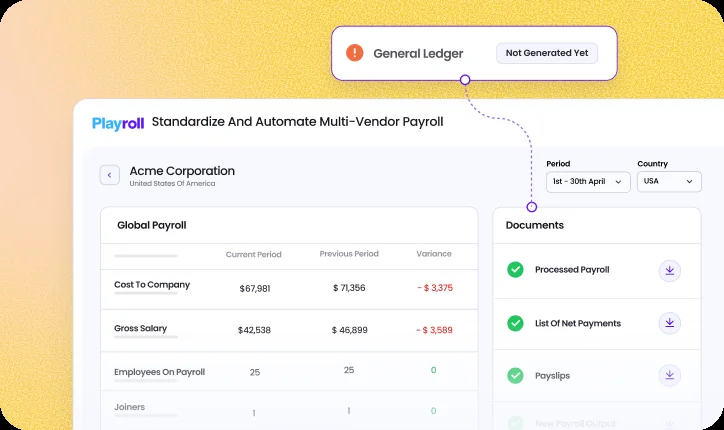
Step 7: Execute Cutover Week
Cutover week is the moment when responsibility officially shifts from the old EOR to the new one. Payroll is about to run under a new legal employer, new systems are live, and employees are expecting everything to work as usual.
By this stage, the hard decisions and setup work should already be behind you. It calls for careful coordination, clear ownership, and making sure each step happens at the right time.
Cutover Runbook
Putting together a runbook is a great way to make sure that everyone involved in the migration knows exactly what needs to happen and when, without last minute interpretation. It lays out the sequence of actions required to move from the old EOR to the new one, along with clear ownership at each step.
Keep the runbook operational and easy to follow:
- Daily tasks and checkpoints
- Clear owners for each action
- Employee sign offs where required
- System access and configuration checks
Funding and Payment Rails
Even when payroll is calculated correctly, it can fail if your business doesn’t fund payroll to the EOR provider on time. In an EOR setup, the EOR pays employees and local authorities on your behalf – which means your company must first transfer the required payroll funds from your business bank account to the EOR before each pay cycle.
These funds typically include gross employee salaries, employer taxes and social contributions, statutory payments, benefits premiums, and the EOR’s service fees – often prefunded several days in advance, depending on the country. During an EOR switch, timing becomes especially important, so build buffer days into your cutover week to account for banking delays, approvals, or currency settlement without impacting employee pay.
Before cutover, confirm the following with your finance team and the EOR provider:
- Banking cut-off times and settlement timelines.
- Prefunding requirements by country – including how many days in advance funds must be received.
- Approval flows for releasing funds, with named backup approvers in case the primary contact is unavailable.
First Live Payroll Monitoring
The first payroll runs under a new EOR area where all the planning becomes something real. This is the point when employees are paid by the new legal employer for the first time, and small issues can surface that were not visible earlier.
Giving the first two payroll cycles extra attention will help your team catch and resolve problems quickly, before they affect trust or become repeat issues.
Monitor closely for:
- Failed or delayed payments
- Net pay drift compared to parallel runs
- Missing deductions or contributions
- Benefit confirmation or enrollment issues
Pro Tip: A dedicated incident channel and documented triage steps help teams resolve issues quickly and consistently without unnecessary escalation.
Step 9: Close Out The Old EOR Properly
Closing out the old EOR is what actually brings the migration to an end. Until this step is done, there is still compliance risk sitting in the background – even if payroll has already gone live with the new provider.
There is also a human side to this moment. Closing out the old EOR properly will give teams a sense of closure. It’s the point where you stop looking back and fully move forward with confidence in the new partnership.
Complete All Final Invoices, Reconciliations, and Statutory Filings
From a legal and compliance perspective, an incomplete closeout can cause problems long after the transition is finished. Missing statutory filings, unclear record ownership, or unresolved payroll items often resurface months or even years later during audits, inspections, or employee requests. These issues rarely feel urgent at the time of the switch, which is exactly why they’re so easy to overlook.
Confirm Access is Removed and Data is Deleted
And finally, make sure that user accounts have been disabled, admin access has been revoked, and confirm when employee and company data will be deleted. These steps reduce the risk of unauthorised access and make it clear which systems should no longer be used.
Always ask for written confirmation that data has been handled correctly and in line with contractual and regulatory obligations. This creates a clear record if questions come up later.
A Successful EOR Switch Should Feel Uneventful
Playroll makes switching EOR providers simple, flexible, and low-risk. With hundreds of successful migrations behind us, we combine hands-on transition support with dedicated human service for both employers and employees, so payroll, benefits, and compliance stay on track throughout the move.
Backed by over 25 years of global compliance expertise and in-house legal and payroll teams across 180+ regions, we provide clear guidance without relying on automation alone. Our flexible, region-by-region approach, transparent pricing, and easy integration into your existing tools mean you can adopt Playroll in the way that works best for your business – without disruption, hidden costs, or long-term lock-ins.
If you’re in the head space where you’re ready to make the move, book a demo with our team and let’s talk about how we can help support your team through a migration.

ABOUT THE AUTHOR
Jaime Watkins
Jaime is a content specialist at Playroll, specializing in global HR trends and compliance. With a strong background in languages and writing, she turns complex employment issues into clear insights to help employers stay ahead of the curve in an ever-changing global workforce.
Switching EOR Providers FAQs
How long does it take to migrate EORs?

.png)
Most EOR migrations take six to ten weeks from contract signature to first live payroll. Timelines vary based on the number of countries, payroll complexity, benefits alignment, and immigration considerations. Clear milestones and early planning matter more than moving quickly.
Do employees need to sign new contracts?
In most cases, yes, employees do need to sign new contracts because the legal employer changes, new employment agreements are typically required. Where local law allows, tenure and seniority can often be recognised and should be clearly communicated upfront.
Can we switch without changing pay dates?
Yes, you can usually switch EOR providers without changing pay dates. Migrations are typically structured to maintain existing pay schedules. Any local banking or payroll constraints should be identified early to avoid surprises at cutover.
What happens to PTO and benefits?
PTO and benefits depend on local law and how continuity is handled. In many cases, PTO balances and accrual rules can carry forward. Benefits are planned to avoid coverage gaps, with healthcare prioritised and employee actions communicated clearly.

Back to Top
.svg)






.svg)