.svg)
.svg)

.svg)
.svg)

Copied to Clipboard

Ready to get Started?


Key Takeaways
Ireland offers a genuinely strong talent pool across tech, pharma, and financial services, but its written-terms requirements and redundancy formula catch out employers who assume "English-speaking and EU-aligned" means simple.
The right EOR partner matters here specifically because of that gap: look for an owned Irish entity, not a partner arrangement, and genuine day-to-day expertise in Revenue and PRSI filings.
If you're ready to hire in Ireland without the compliance guesswork, talk to Playroll about setting up your first employee.
Ireland looks deceptively simple to hire in. It's English-speaking, EU-aligned, and packed with tech, pharma, and financial services talent drawn in by the same low corporate tax rate that put Dublin on every expansion shortlist. The catch shows up fast once you actually run payroll here.
You need to document employment terms almost immediately. Under Irish law, updated in 2022 to align with EU transparency rules, new hires must get five core terms in writing within five days of starting (known as the "Day 5 statement") with the full contract following within a month.
If you miss that window, or get a redundancy calculation wrong, and you're dealing with the Workplace Relations Commission (WRC), Ireland's independent body for resolving employment disputes. Add Revenue Commissioners' real-time PAYE reporting on top, and it's clear why so many foreign employers hire through an Employer of Record (EOR) here instead of setting up an entity on day one. In this guide, we'll walk you through how EORs function in Ireland, what to look for in a provider, typical costs, and the leading options for 2026.
What Is an Employer of Record and Why Does It Matter in Ireland?
An Employer of Record is a third-party organization that legally employs your staff in Ireland on your behalf, while you keep control over their day-to-day work. It exists specifically so you can hire compliantly without registering a local company first.
Here's what a good EOR handles for you:
- Drafting Ireland-compliant employment contracts, including the Day 5 statement
- Running monthly payroll and remitting PAYE, USC, and PRSI to Revenue Commissioners
- Registering the employee with Revenue and managing ongoing filings
- Administering statutory benefits: annual leave, public holidays, and sick pay
- Managing terminations, notice periods, and redundancy calculations
- Handling local pension auto-enrolment obligations as they roll out
Already have an entity in Ireland? Use global payroll outsourcing, not an EOR. An EOR becomes the legal employer and takes on the compliance risk; payroll outsourcing just processes payroll through an entity you already own.
2026 Tax & Contribution Snapshot in Ireland
Payroll accuracy in Ireland depends on getting three separate systems right at once: income tax, the Universal Social Charge (USC), and Pay Related Social Insurance (PRSI).
Here are the numbers you need to know for 2026.
- Income tax: 20% up to the standard rate cut-off, then 40% above it. Cut-offs vary by status: €44,000 for a single person, €53,000 for a married couple on one income, €88,000 for a married couple on two incomes, and €48,000 for a one-parent or widowed parent.
- USC tiers: 0.5% on income up to €12,012, 2% on €12,012.01 to €28,700, 3% on €28,700.01 to €70,044, and 8% on everything above €70,044. Self-employed individuals also pay an extra 3% surcharge on self-employment income above €100,000 – a combined 11% on that portion. Anyone with total income up to €13,000 is exempt entirely.
- Employee PRSI (Class A1): 4.20% of gross pay, rising to 4.35% from 1 October 2026, with no upper earnings limit. Employees earning €352 or less a week are exempt.
- Employer PRSI: 11.25% standard rate, rising to 11.40% from 1 October 2026. A reduced rate – 9.00% rising to 9.15% from 1 October 2026 – applies where weekly income is €552 or below.
- Small Benefit Exemption: Employers can give up to five non-cash benefits a year, worth a combined €1,500, completely tax-free. It can't be split as cash and unused allowance doesn't carry over.
- Net summary: Employer costs run roughly 11.3% above gross salary once PRSI is added. Employees typically lose 26% to 42% of gross pay to combined income tax, USC, and PRSI, depending on salary level.
Know What You'll Actually Pay in Ireland
You can model the full employer cost of a hire, including PRSI and benefits, using Playroll's employer payroll tax calculator.
Calculate Costs
What Should You Consider When Choosing an EOR in Ireland?
Not every EOR that lists Ireland on its country map actually has deep local expertise here. Before you sign a contract, weigh these factors against your specific hiring plan.
- Local Compliance & Regulatory Expertise: Ireland's Day 5 statement requirement and redundancy formula trip up providers whose Ireland coverage is a partner add-on rather than a core market. Ask how many active employees a provider currently manages in Ireland specifically.
- Wholly-Owned vs Partner Models: A provider with its own registered Irish entity controls payroll timing, Revenue registration, and dispute handling directly. Partner-model providers route everything through a third party, which adds a layer between you and the actual employer of record.
- On-the-Ground Presence: A local team understands Irish workplace norms, public holiday timing, and how the WRC actually handles disputes in practice. Remote-only support teams often lag on nuanced questions.
- Technology & Platform Capabilities: You want visibility into contracts, payslips, leave balances, and expense claims in one dashboard, not a string of email threads. Self-service portals matter more once you're managing five or more employees.
- Pricing Transparency: Look for a flat per-employee monthly fee with no hidden setup costs, currency conversion markups, or mandatory annual contracts. Ask what happens to pricing if headcount drops.
- Payroll Reliability & Accuracy: Late or miscalculated PRSI remittances create real friction with Revenue Commissioners. Ask for references from other Ireland clients, not just a general uptime statistic.
- Customer Support Responsiveness: When an employee has a sick pay question or a termination needs handling correctly, you need a same-day response. Confirm whether you get a named account manager or a shared support inbox.
Hiring Your First Employee in Ireland?
Playroll handles the employment contract, payroll, PRSI and USC filings, and statutory benefits, so your first Irish hire is compliant from day one.
Get a Hiring Quote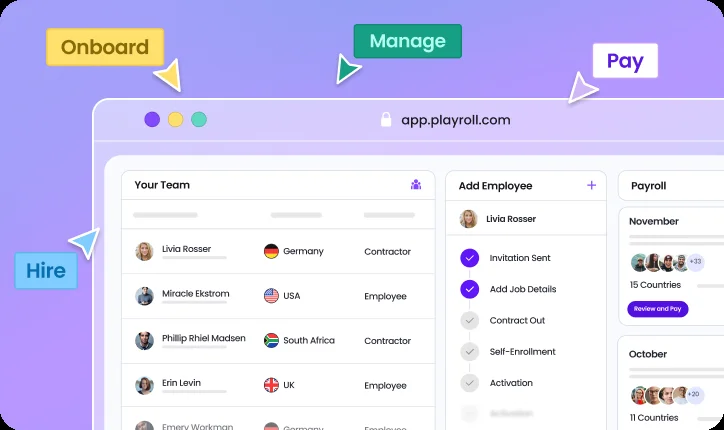
What Does It Cost to Hire Through an EOR in Ireland?
EOR fees in Ireland typically run from $199 to $699 per employee per month (roughly €175 to €620), depending on the provider and how much support is bundled in.
To Put That Into Context: Hiring three employees through a mid-tier EOR at around $400 per employee per month costs roughly $1,200 a month. That typically covers compliant contracts, monthly payroll, Revenue and PRSI filings, statutory benefits administration, and ongoing support.
What pushes the cost higher is complexity: senior hires with equity components, custom benefits packages beyond the statutory minimum, or employees who need visa sponsorship support. A straightforward individual contributor role rarely needs the top pricing tier.
The 12 Best Employer of Record Providers in Ireland for 2026
Twelve providers show up consistently as genuinely active in the Irish market, rather than just listing Ireland on a country page. Here's how they compare:
1. Playroll
Playroll suits employers who want direct compliance ownership without handling multiple vendors. Because it runs on its own entity network rather than local partners, you're dealing with one company end to end for contracts, payroll, and benefits alike. You also get a dedicated Customer Success Manager plus an Employee Success Manager for each hire, so support doesn't disappear after you've signed. Pricing stays flat and transparent, with no surprise onboarding fees. It's less an Ireland specialist and more a steady option if you're hiring across several markets at once.
2. Boundless
Boundless is an Irish-owned provider headquartered in Dublin, now backed by Payoneer, and it leans hard into that local depth. It offers dedicated account managers and transparent pricing around €175 per employee per month. Its narrower international footprint means it suits Ireland-focused hiring better than a global rollout spanning dozens of countries.
3. Remote
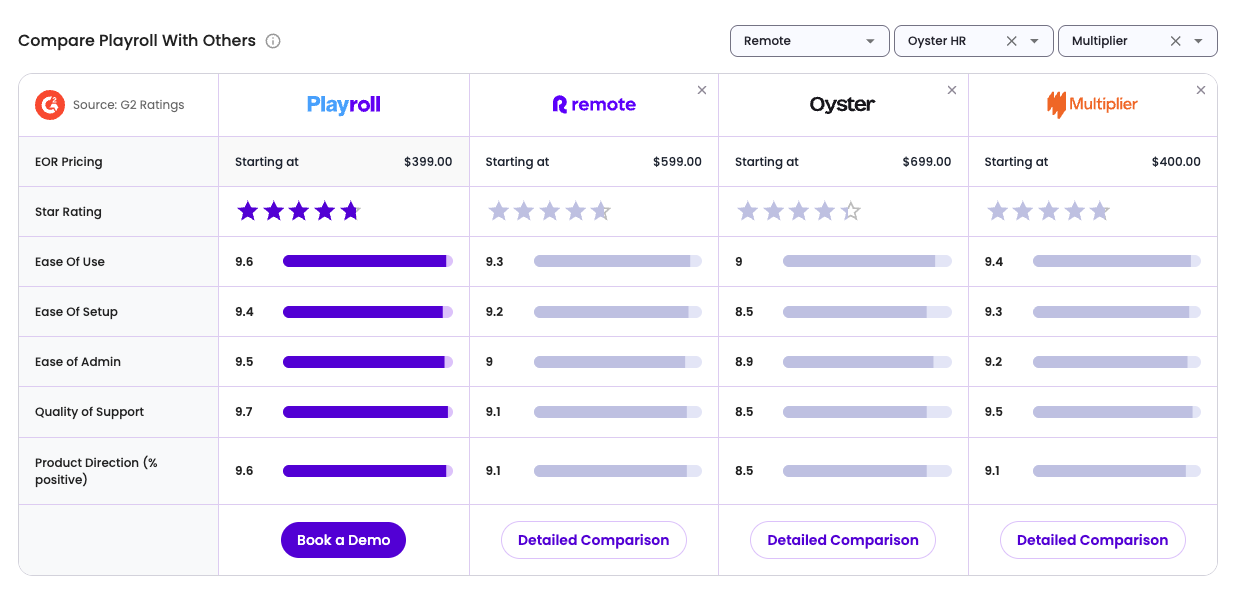
Remote operates wholly-owned entities in over 90 countries, including Ireland, and markets itself on intellectual property protection for tech hires. Pricing sits around $599 per employee per month. The self-serve platform model means hands-on account support is lighter than fully managed competitors.
4. Oyster HR
Oyster HR runs on a partner-based model and puts real weight behind employee experience tools like development stipends and wellbeing perks. Base pricing is roughly $599 per employee per month. Costs climb quickly once you add the premium feature tiers many Ireland hires end up needing.
5. Multiplier
Multiplier offers competitive pricing around $400 per employee per month through a partner network, with particular strength in Asia-Pacific alongside its European coverage. It's a newer entrant, founded in 2020, so its Ireland-specific track record is shorter than more established rivals.
6. G-P (Globalization Partners)
G-P runs owned entities in its key markets and positions itself for enterprise clients with heavy compliance needs. Pricing runs around $699 per employee per month, usually tied to a 12-month minimum contract. That commitment structure suits sustained headcount plans better than short-term or trial hires.
7. Deel
Deel operates a wholly-owned Irish entity and bundles free contractor management alongside its EOR service, useful if you're hiring a mix of employees and contractors. Pricing is around $599 per employee per month. Support quality varies by pricing tier, so confirm what's included before you commit.
8. Papaya Global
Papaya Global works through a partner-based model and leans into payroll analytics and payment infrastructure rather than a pure EOR play. Quoted pricing starts around $599 per employee per month but custom quotes often land higher. It suits finance teams that want deep payroll data over a lighter-touch hiring tool.
9. Velocity Global (Pebl)
Velocity Global (Pebl) covers more than 185 countries through a partner network and adds immigration support alongside its EOR service. Promotional pricing around $399 per employee per month is common, though it's worth confirming what the rate reverts to after the introductory period. Breadth of coverage is its main draw over Ireland-specific depth.
10. Atlas HXM
Atlas HXM runs fully owned entities across its markets, including Ireland, and focuses on consistent service quality for mid-market and enterprise clients. Pricing sits around $599 per employee per month. Its direct ownership model appeals to companies wary of partner-based providers passing risk down the chain.
11. Skuad
Skuad is part of the Payoneer group and prices aggressively at around $199 per employee per month. Its real strength is Asia-Pacific coverage, so treat its Ireland service as solid rather than a specialist offering.
12. Rippling
Rippling bundles EOR with a broader HR, IT, and finance platform, which suits companies that want payroll and device management in one system. Pricing starts around $499 per employee per month. Its EOR coverage spans roughly 50 countries, narrower than dedicated global EOR competitors, and support leans platform-driven over relationship-driven.
How Does Playroll Compare?
See exactly how Playroll stacks up against other EOR providers before you choose one.
Compare EOR Providers
Insights from Real Users
Across G2, Trustpilot, and HR forums, feedback on Ireland-focused EOR providers clusters around a few consistent themes. Users commonly report that onboarding speed varies more than pricing does, with some providers issuing compliant contracts within days and others taking two to three weeks to finalize paperwork.
Compliance accuracy draws the most attention in reviews, particularly around PRSI calculations and statutory sick pay administration. A verified G2 reviewer noted that providers with an owned Irish entity tend to resolve payroll discrepancies faster than partner-model competitors routing queries through a third party.
Support responsiveness is the other recurring theme. Companies managing fewer than five Ireland employees report the most friction with providers that route them into a general support queue rather than a named account contact.
Using an EOR vs Setting Up an Entity in Ireland
The right choice depends mostly on how many people you're hiring and how long you plan to stay. Here's how to think about it.
Use an EOR if:
- You're hiring one to five employees and don't yet need a permanent Irish presence
- You want to be operational within days rather than waiting on company registration
- You're testing the Irish market before committing to long-term headcount
- You want to avoid registering directly with Revenue Commissioners and the Companies Registration Office (CRO)
- Your hiring plan could scale up or down quickly and you need that flexibility
Set up an Ireland entity if:
- You're planning to hire 20 or more employees within the next year or two
- You need a permanent registered presence for banking, contracts, or client relationships
- You want full control over benefits design beyond statutory minimums
- You're establishing Ireland as a regional headquarters or holding company base
- You need direct control over tax planning and corporate structure
Entity setup costs
Basic incorporation through the CRO starts around €50 to €300 for the filing fee itself, though most companies spend closer to €1,000 to €3,000 once legal and formation support are included. Standard registration takes about 10 working days. Ongoing annual compliance, covering financial statements, company secretary services, and CRO annual returns, typically runs €800 to €1,800 a year.
For a first hire or two in Ireland, an EOR gets you compliant and paying staff correctly within days, without the entity setup bill or the year-long commitment that comes with it.
Onboarding Through an EOR in Ireland
Onboarding through an EOR splits responsibilities cleanly between you and the provider. You handle the parts that are yours to decide.
You agree the role, compensation, start date, and any benefits beyond the statutory minimum with the candidate directly. The EOR then takes over the compliance-heavy work: collecting employee documents, drafting the Day 5 statement and full contract, registering the employee with Revenue Commissioners, and configuring payroll and statutory benefits.
A realistic timeline from signed offer to first day runs about one to two weeks with an established provider, faster if the employee's documentation is already in order. Providers with an owned Irish entity tend to move faster than partner-model competitors, since there's no third party in the registration chain.
Compliance Considerations for Hiring Employees in Ireland
Ireland's employment protections are detailed and specific, and getting them wrong shows up quickly through the WRC. Here's what to expect across the areas that matter most:
Redundancy pay under the Redundancy Payments Act 1967 follows a set formula: two weeks' pay per year of service, plus one bonus week, capped at €600 in weekly gross pay. It only applies after two years of continuous service.

Key Takeaways
Ireland gives you access to deep tech, pharma, and financial services talent in an English-speaking, EU-aligned market. But between the Day 5 statement, the Workplace Relations Commission, and Revenue's real-time PAYE reporting, the compliance obligations quickly gets complicated. A strong EOR partner handles all of it, letting you focus on building your team.
If you're after fast onboarding, accurate payroll, transparent pricing, and support that doesn't leave you in the dark, Playroll stands out with Ireland-specific expertise and a platform that keeps contracts, payroll, and benefits in one place.
Curious to see if we're as good as we say we are? Book a demo and see why teams choose us for their Ireland expansion.

ABOUT THE AUTHOR
Milani Notshe
Milani is a seasoned research and content specialist at Playroll, a leading Employer Of Record (EOR) provider. Backed by a strong background in Politics, Philosophy and Economics, she specializes in identifying emerging compliance and global HR trends to keep employers up to date on the global employment landscape.

.png)

Back to Top
.svg)






.svg)