.svg)
.svg)

.svg)
.svg)

Copied to Clipboard

Ready to get Started?


South Africa is one of the most compelling hiring markets in Africa – strong English-speaking talent, a developed financial infrastructure, and a cost base that's genuinely competitive against equivalent roles in Europe or North America. If you're looking to hire across fintech, engineering, professional services, or operations, South Africa has the pipeline.
That said, hiring here is not as straightforward as it might look on paper. South Africa's employment system is employee-protective, actively enforced, and governed by multiple overlapping statutes. You're navigating Pay-As-You-Earn (PAYE) filings with the South African Revenue Service (SARS), monthly Unemployment Insurance Fund (UIF) declarations, the Skills Development Levy (SDL), and a termination framework that sits under the Labour Relations Act (LRA). Get any of these wrong, and you're looking at penalties, audit exposure, or a trip to the Commission for Conciliation, Mediation and Arbitration (CCMA).
An Employer of Record (EOR) takes that complexity off your plate. This guide covers how EORs work in South Africa, what to look for when choosing one, what you'll pay, and which providers are worth considering in 2026.
What Is an Employer of Record, And Why Does It Matter in South Africa?
An EOR legally employs your South Africa-based team on your behalf. You still control the work – the day-to-day tasks, performance, goals, and how the role fits into your business. The EOR operates in the background as the legal employer, handling everything that needs a registered South African entity.
In South Africa, that matters a lot. The employment framework doesn't just require compliance, it actively tests it. Employees have well-established rights under the Basic Conditions of Employment Act (BCEA), and disputes can be referred to the CCMA free of charge. A poorly drafted contract or a mishandled termination can turn into a formal dispute faster than most foreign employers expect.
Here's what your EOR handles on the ground:
• Drafting and issuing a BCEA-compliant employment contract
• Running payroll and paying salaries on time in ZAR
• Filing monthly PAYE returns with SARS via the EMP201 submission
• Managing UIF and SDL contributions accurately each payroll cycle
• Administering statutory and supplementary benefits, including medical aid and retirement fund contributions
• Handling leave, sick pay, and BCEA entitlements correctly from day one
• Managing compliant terminations and offboarding processes
What to Look for When Choosing an EOR in South Africa
Not every global EOR is built equally for South Africa. The combination of SARS reporting requirements, the CCMA framework, and the nuances of competitive benefit structures means local expertise makes a genuine difference.
- Local Compliance & Regulatory Expertise: Your provider should know South African labour law in depth – the LRA, BCEA, and Employment Equity Act (EEA) – not just at a surface level. Ask specifically about their CCMA experience and how they handle contested terminations.
- Wholly-Owned vs Partner Models: Providers with their own South African entity have more direct control over payroll, contracts, and compliance outcomes. Partner-reliant models add coordination layers that can slow things down when you need answers fast.
- On-the-Ground Presence: Real local expertise means knowing what competitive benefits look like in the Cape Town vs Johannesburg markets, how SARS audits actually play out, and how to structure a retrenchment process correctly. You can't get that from a global ops centre.
- Technology & Platform Capabilities: Look for clean onboarding flows, leave tracking, automated PAYE and EMP201 submissions, and integrations with your existing HR stack. SARS eFiling compatibility isn't optional.
- Pricing Transparency: Understand exactly what's in the fee – EOR monthly costs, UIF and SDL employer contributions, benefit administration charges, and any onboarding or offboarding fees. Medical aid and retirement fund contributions can add meaningfully to your total employment cost.
- Payroll Reliability: PAYE calculations are progressive and require accurate fringe benefit valuations. Errors in payslips create employee relations problems and SARS year-end reconciliation issues that are slow and expensive to fix.
- Support Quality: You want a dedicated contact who can walk you through a CCMA referral or an urgent payroll query, not a generic ticketing system. Ask how they handle complex situations before you sign.
What Does It Cost to Hire Through an EOR in South Africa?
EOR services in South Africa typically run between $299 and $599 USD (roughly ZAR5,500 – ZAR11,000) per employee per month. South Africa sits toward the more accessible end of the global EOR pricing range, reflecting a mature HR and legal infrastructure and a competitive provider market.
To give that context: three employees through an EOR would typically cost $900 – $1,800/month, covering:
• BCEA-compliant employment contracts
• Monthly PAYE payroll processing and SARS EMP201 filings
• UIF and SDL employer contributions
• Statutory leave administration
• Ongoing HR and employee support
Senior roles or packages that include medical aid and provident fund contributions will push costs higher, since these are administered separately and come with fringe benefit tax treatment that needs to be applied accurately.

12 Best Employer of Record Providers in South Africa for 2026
Here's an honest look at the providers worth considering for South African hiring, including pricing and where the limitations are.
Playroll
Price: Starts art $399 p/employee/month
The clearest choice for companies that want a South African EOR built around actual in-country infrastructure rather than partner coordination. Playroll operates through its own South African entity, with offices in both Johannesburg and Cape Town – which means PAYE, UIF, SDL, and BCEA-compliant employment contracts are handled in-house, not routed through a third party. Onboarding typically takes 2–5 business days, dedicated Customer Success and Employee Success Managers are included on every account, and SARS reporting is handled without any additional coordination layer slowing things down.
Pricing starts at $399 per employee per month – notably lower than most global competitors at this service tier – with no onboarding or offboarding fees and a fully refundable security deposit. For South Africa specifically, Playroll's on-the-ground team adds practical depth that providers without local presence simply can't replicate: CCMA process guidance, locally competitive provident fund and medical aid structures, and support that draws on real in-country experience. A strong fit for first hires and scaling teams alike.
Deel
Price: Starting from $599/employee/month
Deel runs through its own South African entity and is one of the most widely recognised EOR providers in the market. PAYE filings and UIF administration are handled reliably, and the platform is among the cleaner interfaces you'll find at scale. It's popular with tech and SaaS teams that want speed, automation, and consistent global processes across multiple countries.
The main friction points for South Africa hiring are cost – EOR pricing starts at $599 per employee per month, among the higher end of published rates in the category. Combinations of provident fund and medical aid that local employees expect often require more manual coordination than the platform handles by default.
Remote
Price: Starting from $599/employee/month
A solid option for distributed teams that prioritise process consistency and strong IP protection across multiple markets. The platform is well-documented, onboarding flows are clean, and the $599 per employee per month price point is in line with the broader market. Where it falls short for South Africa-specific needs is local depth: guidance on CCMA processes or BCEA leave nuances can feel more generic than what you'd get from providers with in-country teams.
Response times on complex queries can also vary, particularly for edge cases that don't map neatly to the platform's standard workflows.
Papaya Global
Price: Starting from $499/employee/month
Built for large organisations that need multi-country payroll visibility and finance-facing analytics dashboards. The centralised oversight and reporting layer is genuinely useful for global HR and finance teams managing headcount across 10 or more markets. South Africa compliance is handled through local partners rather than an owned entity, which works in most cases but can add delays when nuanced questions arise.
Pricing is at the higher end of the market and is quote-based rather than published; for teams with simpler South African hiring needs, the platform's complexity may exceed what's actually required.
Rippling
Price: Not publicly disclosed (comparable to Deel)
A strong fit for companies already embedded in the Rippling ecosystem who want HR, IT, and payroll unified on a single platform. The HRIS automation layer reduces manual work significantly, and for teams managing a mix of domestic and international headcount, the consolidated stack can justify the cost. In South Africa, core payroll and compliance requirements are covered, but medical aid and retirement fund structures can feel less flexible than locally specialised providers.
EOR pricing is not public though reportedly high compared to other providers on this list, and the platform depth – with modules beyond core EOR – may be more than smaller or South Africa-focused teams actually need.
Multiplier
Price: Starting from $400/employee/month
Offers a flat-rate EOR model with a straightforward onboarding experience that suits mid-sized teams expanding into new markets across several countries at once. Setup is quick and the interface is accessible.
The trade-off is depth: CCMA process guidance and locally competitive benefit structures aren't where this platform shines, and support on more complex South African employment situations can slow down compared to providers with on-the-ground teams. A reasonable option for standard, low-complexity hires.
Oyster HR
Price: Starting from $699/employee/month
Oyster is well-regarded for transparent pricing and a genuine focus on employee experience. The onboarding process is clearly documented, the interface is clean, and Oyster has built a reputation for ethical employment standards that resonates with certain organizations.
EOR pricing is typically around $499–$699 per employee per month depending on plan and volume. South Africa isn't among its deepest markets, though, and some benefit administration relies on partner coordination – which can introduce processing delays on locally complex structures like provident fund and medical aid combinations.
Skuad
Price: Starting from $199/employee/month
A budget-friendly option for startups or smaller teams making first hires in South Africa. Core PAYE, UIF, and BCEA requirements are covered, and setup is fast.
The limitation is depth: more complex benefit structures or employment situations requiring local expertise can stretch what the platform handles confidently. Worth considering if cost is the primary constraint and the hiring need is straightforward.
Remofirst
Price: Starting from $199/employee/month
Remofirst is competitive on price and quick to get running – EOR pricing typically starts around $199 per employee per month, making it one of the more affordable options in the category.
Remofirst suits cost-conscious teams with standard hiring needs. Core South African payroll and UIF requirements are handled, but they fully rely on third-party partners to deliver services – this can limit service quality and depth in more complex areas. Fewer native integrations may also be a factor for teams with more mature HR stacks.
Globalization Partners (G-P)
Price: Not publicly disclosed
A well-established enterprise option with strong compliance infrastructure and global risk management maturity. For large or regulated organizations running South African headcount as part of a broader international footprint, the platform is reliable and proven. The trade-offs are cost – pricing is at the premium end of the market and is quote-based – and their processes are rigid.
For smaller teams making their first South African hire, the overhead and implementation timeline will likely be more than what's needed.
Atlas HXM
Price: Starting from $599/employee/month
Atlas HXM operates through owned entities, including in South Africa, and tends to appeal to mid-market companies that want compliance depth paired with a more personalised service model. The platform is less polished than some alternatives, and pricing transparency upfront can be limited – it's worth requesting a detailed cost breakdown before committing.
A reasonable choice for teams that want owned-entity infrastructure without going to the enterprise tier.
Pebl (formerly Velocity Global)
Price: Starting from $399/employee/month
The compliance infrastructure is mature and well-regarded, and the platform suits enterprise organisations managing complex, multi-country workforce footprints. Where Pebl draws more mixed feedback is support: Trustpilot ratings sit notably lower than G2, with reviewers pointing to inconsistent communication, onboarding delays, and variability in resolution quality across regions.
For teams that need reliable, responsive support on day-to-day South African employment questions, that inconsistency is worth considering before you commit.
See How Providers Stack Up
See how Playroll’s offering differs from other globally recognised EOR providers and find the right fit for your company.
Compare Now
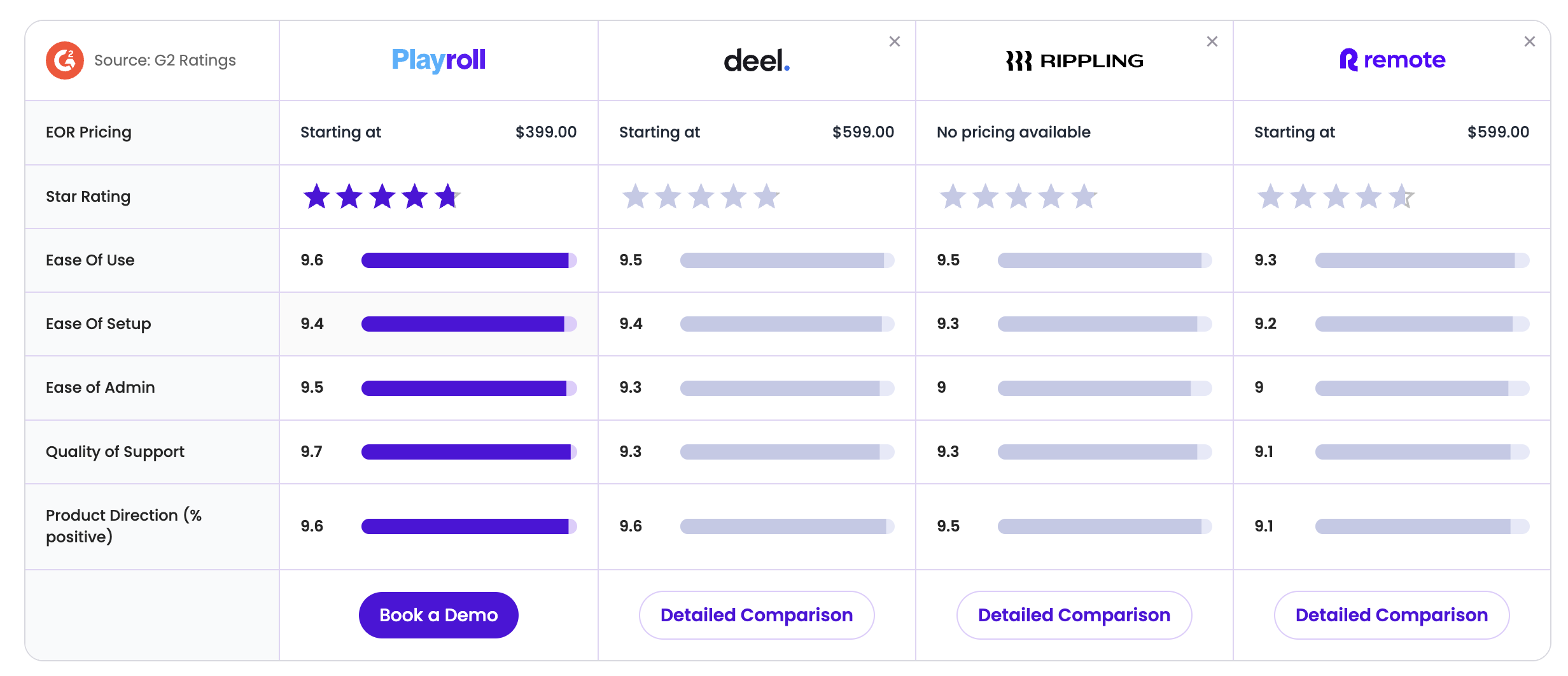
What Real Users Say
Across G2, Trustpilot, and HR practitioner forums, a few consistent themes come up when people evaluate EOR providers for South Africa.
Onboarding speed matters. Most teams want their South African hire live within a week, and providers with owned local entities consistently deliver on this better than those relying on partners. The ability to issue a compliant contract and register with SARS quickly – without waiting on a third party – makes a noticeable difference.
PAYE accuracy is a genuine differentiator. Errors in SARS submissions cause year-end reconciliation problems that take time and money to fix. Reviewers specifically call out providers who catch issues proactively, before they hit the payslip, as significantly better to work with. Playroll users in particular highlight the responsiveness of the support team when navigating complex situations – including CCMA-adjacent terminations where clear guidance matters.
On benefits: South African employees notice when medical aid and retirement fund contributions are handled well. Accurate fringe benefit tax treatment, timely employer contributions, and benefit admin that doesn't require the employee to chase anyone – these details drive retention in a way that employers sometimes underestimate until they see the churn.
On the Playroll side, compliance depth and the quality of human support are common differentiators mentioned:
Playroll
“I appreciate Playroll’s excellent and responsive customer service. Their team is willing to go the extra mile, offering detailed expertise in country-specific compliance, which is incredibly beneficial for hiring a global workforce. The people I work with at Playroll are not just helpful and understanding but also take the time to develop genuine relationships, providing personalized support.”
- Verified G2 User
EOR vs Setting Up Your Own Entity in South Africa
If you're making first hires in South Africa, you'll eventually ask: Should we use an EOR or register a local entity? Both options work. The right answer depends on your headcount, timeline, and how much administrative overhead you want to carry.
For a fuller breakdown, see Playroll's EOR vs legal entity guide.
Use an EOR if:
• You need people hired quickly, without waiting for entity registration
• You'd rather not deal with SARS registrations, EMP201 filings, and UIF declarations
• You're testing the South African market before committing long-term
• Your initial team is under 15–20 employees
• You want to avoid maintaining a local accounting and legal function
Set up a South African entity if:
• You're scaling past 20–30 employees, and the per-head EOR fee starts to outweigh entity costs
• You need a permanent operational or commercial presence in South Africa
• Full control over your employment structure, tax strategy, and B-BBEE positioning matters
• You operate in a regulated sector requiring a registered local entity
• You need to contract directly with South African clients or public sector bodies
Entity Setup Costs to Factor In:
• Private company (Pty Ltd) registration: typically R2,000 – R8,000 including CIPC fees
• Ongoing accounting, payroll, and compliance: R80,000 – R200,000/year depending on headcount
• SARS tax clearance, UIF employer registration, SDL registration: additional time and admin overhead
For most companies making their first South African hires, an EOR is the faster, lower-risk path. Entity setup in South Africa is relatively straightforward compared to other African markets – but it still takes time, involves multiple registrations, and requires ongoing local compliance support. An EOR lets you skip that groundwork and start compliantly from day one.
The key is choosing a provider with its own South African entity.
How Onboarding Works Through an EOR in South Africa
Onboarding through an EOR follows a clear split of responsibilities. Your job is to confirm the terms of the hire – the role, compensation, working hours, start date, and any supplementary benefits like medical aid or a provident fund contribution. You stay in control of day-to-day management, performance, and how the person fits into your team. Once you've signed off on the terms, the EOR takes over the in-country execution.
That means collecting the employee's documentation (SA ID or passport, tax number, banking details), drafting and issuing a BCEA-compliant employment contract, registering the employee with SARS for PAYE, and setting up UIF and SDL contributions. If medical aid or retirement fund enrollment is included, those are configured and the fringe benefit tax treatment applied before the first payslip runs.
Most South African employees are fully onboarded and ready to start within 3–5 business days. Senior roles with equity components or more complex benefit packages may take a few extra days to finalize.
Key Takeaways
South Africa is a genuinely strong hiring market – skilled, English-speaking talent at a cost that works for most international budgets. But the employment system has teeth. SARS PAYE obligations, CCMA termination processes, BCEA leave entitlements, and UIF declarations all need to be handled correctly from the start.
Every provider on this list has something to offer, but if you're hiring in South Africa specifically, the case for Playroll is straightforward: a wholly-owned South African entity, offices in Johannesburg and Cape Town, onboarding in 2–5 business days, and a support team with real in-country expertise. That combination is harder to find than the market makes it look.
Ready to see it in practice? Book a demo with the Playroll team – we'll walk you through exactly what hiring in South Africa looks like end-to-end.

ABOUT THE AUTHOR
Milani Notshe
Milani is a seasoned research and content specialist at Playroll, a leading Employer Of Record (EOR) provider. Backed by a strong background in Politics, Philosophy and Economics, she specializes in identifying emerging compliance and global HR trends to keep employers up to date on the global employment landscape.
12 Best EOR Services in South Africa for 2026: Providers & Trade-Offs FAQs
What does an EOR legally handle in South Africa?

.png)
An employer of record in South Africa typically becomes the local legal employer for payroll, statutory contributions, and employment contracts, while your company directs day-to-day work and performance.
Can I hire in South Africa through an EOR without opening a local entity?
Yes, many companies use an EOR to hire in South Africa without first incorporating locally, but commercial activities, permanent establishment risk, and sector licenses still need legal and tax review.
Which statutory payments should an EOR manage in South Africa?
A compliant EOR should calculate and remit mandatory items in South Africa, including wage tax withholding and required social insurance or pension-related employer and employee contributions under local law.
How are terminations handled when using an EOR in South Africa?
Terminations in South Africa must follow local notice, procedure, and final-pay rules, so EORs should document reason, process, and timelines before ending employment to reduce reinstatement or penalty risk.
What should I verify before signing an EOR agreement in South Africa?
Before signing, confirm who bears liability for tax filings, social contributions, data protection, and employment claims, and ensure service-level terms define response times for payroll errors and labor inspections.

Back to Top
.svg)









.svg)