.svg)
.svg)

.svg)
.svg)

Copied to Clipboard

Ready to get Started?


Hiring globally is a powerful way to build a competitive workforce, but figuring out how to pay international employees across different countries is where things get complicated. Paying international employees means compensating workers located in foreign countries while ensuring compliance with local tax laws, labor regulations, and payroll requirements in each jurisdiction. From navigating offshore employees taxes to complying with local labor laws, your payroll setup needs to be precise, scalable, and risk-proof.
Whether you're building a global team from scratch or expanding into new markets, here are five compliant, proven ways to pay international employees without unnecessary cost, delays, or legal headaches:
- Establish a legal entity abroad: Full control but requires 3-6 months setup and $15,000-$100,000+ investment
- Set up offshore payroll: Keep employees on home-country payroll with local compliance support
- Hire through an Employer of Record: Fastest route (2-4 weeks) with full compliance handled by the EOR
- Lease the employee: Third-party local company employs the worker and leases services to you
- Use a PEO: HR and payroll support when you already have a local entity
In this guide, we'll provide a detailed breakdown of each option so you can decide on the best approach for your business.
How to Pay Employees in Another Country
Paying an employee in another country involves more than sending a salary payment. You need to follow the labor laws, tax rules, and payroll requirements in the country where the employee works. Here's a simple framework to guide you.
- Classify your workers correctly: Confirm whether the worker is an employee or contractor to avoid misclassification penalties; studies show up to 30% of companies face audits related to worker classification issues.
- Establish compliant employment documentation: Put a compliant local contract in place, agree on salary and currency, and clarify who is responsible for tax withholdings and statutory benefits.
- Determine your compliance obligations: Understand local payroll tax rates, mandatory benefits, and reporting requirements in the employee's country.
- Select your legal payroll route: Decide whether to use an Employer of Record, set up a local entity, work with a global payroll provider, or hire a contractor for short-term, independent work.
- Configure your payroll workflow: Align with local pay schedules, ensure correct tax deductions and social contributions, and pay in local currency where possible.
- Maintain proper records: Keep contracts, payslips, tax filings, and payroll reports in line with local recordkeeping requirements.
For most companies hiring internationally for the first time, partnering with an Employer of Record is the fastest and lowest risk way to get started.
5 Best Ways to Pay International Employees, Legally and Compliantly
Once you hire internationally, the big question becomes: what payroll methods can you use to pay global employees? The answer isn’t one-size-fits-all. It depends on your company’s size, how quickly you’re expanding, your budget, and how much compliance responsibility you’re prepared to take on.
Whether you choose to set up a local entity, run payroll through your home country, partner with a global payroll provider, or hire contractors, each option comes with its own benefits and trade-offs. Below, we’ll walk through the most common ways businesses pay international employees and what you should consider before choosing the right approach.
Payment Methods Comparison
| Method | Setup Time | Compliance Responsibility | Cost Considerations | Ideal Use Case |
|---|---|---|---|---|
| Local Entity | 3-6 months | Fully on your company | $15,000-$100,000+ setup; ongoing admin costs | 10+ employees in one country with long-term plans |
| Employer of Record (EOR) | 2-4 weeks | Handled by EOR provider | 5-15% of payroll or flat monthly fee | Testing new markets; scaling quickly; 1-50 employees |
| PEO | 2-4 weeks | Shared; you remain legal employer | Monthly per-employee fee | Already have local entity; need HR support |
| Contractors | Days | On the contractor | Contract rate only | Short-term, clearly independent projects |
1. Set Up a Legal Entity to Pay International Employees
Setting up local entities gives you full control over hiring, operations, and payroll. Formally establishing your business on foreign soil, you can rest easy knowing your international employees are getting paid without all the hassles of nonregistered payrolls.
However, it’s resource-intensive and requires in-depth knowledge of local labor laws, payroll taxes, and employment standards in each foreign country. If you do decide to establish your business overseas, you’ll need to do the following:
- Register a subsidiary and open bank accounts
- Set up a local payroll system
- Understand and comply with local tax codes to avoid double taxation
- Regularly update your payroll strategy as laws evolve
Establishing a legal entity can streamline the payroll process for a large international team, but for smaller or early-stage global expansion, it may not be the most cost effective method. If you’re employing only one or two international employees, opening a foreign subsidiary is probably not your most cost-effective option.
2. Setup Offshore Payroll
For companies hiring one or two international employees, managing payroll through your home-country entity may seem simpler. This method, known as offshore payroll, keeps the employee on your domestic payroll system.
However, the risks around offshore employees taxes, employee classification, and local compliance can’t be ignored. Payment must align with host-country payroll taxes, benefits, and labor laws – or you risk fines and employee dissatisfaction. Fortunately, there are three main ways to stay compliant while keeping an employee on an offshore payroll:
Partner with a Reputable Payroll Partner
Similar to a subsidiary, a shadow partner handles the payroll for an international employee. However, unlike a subsidiary company, the shadow partner isn’t affiliated with the parent company.
Partnering with a global payroll solution offers many benefits that include:
- Compliance Assurance: Ensures adherence to local laws, tax regulations, and benefits, reducing legal risks.
- Local Expertise: Partners with in-country experts to navigate regional payroll challenges and legal requirements.
- Cost Efficiency: Avoids the cost of establishing legal entities in multiple countries, lowering overhead.
- Streamlined Operations: Centralizes payroll processes, improving efficiency and allowing HR teams to focus on more strategic work.
- Risk Mitigation: Minimizes errors and ensures compliance to reduce risks in global payroll management.
- Enhanced Employee Satisfaction: Ensures timely, accurate payments, which in turn boosts employee satisfaction and retention.
🌍 Ready to Pay Global Employees Without the Hassle?
Learn how Playroll’s global payroll manager can help Optimize pay cycle workflows, minimize inefficiencies, and integrate seamlessly with your providers to unify global payroll services in one platform.
Book a Demo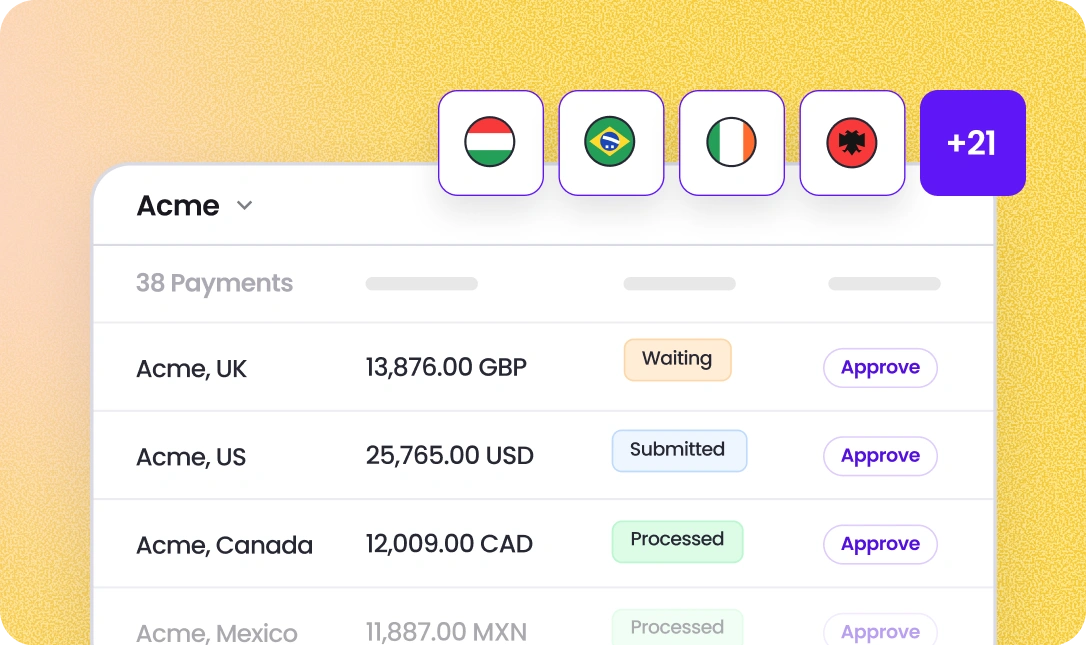
3. Use an Employer of Record: Fastest and Lowest-Risk Way to Pay International Employees
Partnering with an Employer of Record (EOR) is one of the fastest, most reliable ways to pay international employees. An EOR acts as the legal employer on your behalf, managing everything from tax filings and benefits to onboarding and local contracts.
This approach is ideal for companies entering new markets or scaling quickly, offering a complete global payroll solution without needing to establish local entities at great time and cost.
The top benefits of using an EOR like Playroll include:
- Full, guaranteed compliance with local employment laws and payroll regulations.
- Seamless onboarding and payment in local currencies.
- Centralized management of international payroll and reporting.
- Reduced exposure to misclassification or compliance risks.
- Real-time support navigating exchange rates and tax changes.
While many EORs exist, not all are capable of meeting the increasingly complex demands of global payrolls. Playroll's EOR services simplify the complexities of managing international payroll by handling payroll, tax compliance, and HR functions in over 180 countries, freeing you up to focus on your core business activities.
“Playroll simplified our expansion into new markets by providing a comprehensive understanding of local regulations. Through this partnership, we could immediately tick the box on compliance, at no risk to BET Software.”

Playroll's Features:
Paying your international employees compliantly using Playroll is easy. Playroll's Employer of Record (EOR) services offer several standout features to streamline how you manage and pay international employees:
- Seamless Multi-Country Payroll: Playroll consolidates payroll across various countries and local providers into a single, unified view, allowing payments in your preferred currency and simplifying currency conversions.
- Locally Relevant Tax Compliance: The platform ensures accurate tax deductions and filings tailored to each country's regulations, mitigating compliance risks.
- Tailored Compensation and Benefits: Playroll assists in offering competitive statutory benefits and guides you through country-specific compensation practices, boosting employee satisfaction.
- Advanced Reporting and Analytics: The technology-backed platform provides comprehensive reporting tools, offering insights into total costs, bonuses, and contributions to improve operational efficiency.
Once your employees are onboarded via Playroll, you’ll have the ability to manage all aspects of multinational payroll right from your dashboard.
4. Use an Employee Leasing Model for International Hiring
In some cases, you can “lease” an international employee through a host-country company. The local company legally employs the worker, handles payroll and taxes, and leases their services back to your business.
This setup allows the employee to be classified as a local worker, keeping your company out of direct compliance requirements. It’s similar to a shadow payroll model but with a formal employment relationship managed through a third party.
It can work when:
- You need in-country presence without full entity setup
- You want a short-term or lower-risk engagement
- You’re navigating particularly complex payroll processes or labor laws
This method still requires close coordination to ensure employees receive timely, accurate compensation and benefits.
5. Use a PEOs for American Payroll Processing
A Professional Employer Organization (PEO) is another route to manage payroll for international employees if you already have a legal presence in the country. While you remain the legal employer, the PEO supports HR functions, local compliance, and payroll process management.
Key services include:
- Payroll Management: Timely salary payments, including withholding and remitting payroll taxes.
- Benefits Administration: Administering local benefit plans that meet legal standards.
- Human Resources Support: Guiding you through onboarding and termination processes.
- Risk Mitigation and Compliance: Aligning your payroll strategy with local expectations.
By partnering with a PEO, companies can effectively manage the complexities of international payroll and employment, ensuring their global workforce is compensated accurately and in full compliance with local regulations.
Cost Comparison: Entity vs EOR vs PEO vs Contractors
When deciding how to pay international employees, cost is usually the first question, especially for CFOs. But the real cost is not just the monthly payroll fee. It also includes setup expenses, legal exposure, internal admin time, and how flexible the model is as you scale. Here is how the main options compare.
Establishing a Legal Entity
Setting up your own entity gives you full control, but it is the most capital-intensive route. You are essentially building infrastructure in another country, and that comes with both upfront investment and ongoing compliance obligations. While it can become cost-efficient at scale, it requires long-term commitment to justify the spend.
Typical costs include:
- $15,000 to $100,000 or more in setup fees depending on the country
- Ongoing accounting, tax filings, and local payroll administration
- Legal support and statutory compliance maintenance
- Internal HR and finance oversight
This option is best suited for companies hiring at scale, often 10 or more employees in one country, with long-term expansion plans.
Employer of Record
An EOR removes the need to open a local entity and combines employment, payroll, tax, and compliance into one predictable service fee. The per-employee cost may look higher than running your own entity at scale, but it eliminates setup costs, reduces compliance exposure, and significantly lowers internal overhead, especially in the early stages of expansion.
Typical cost structure:
- 5 to 15 percent of payroll or a flat monthly fee per employee
- No entity setup fees
- No separate local accounting infrastructure required
- Payroll, contracts, tax filings, and benefits administration included
This model works well for testing new markets, hiring small international teams, or scaling quickly without legal complexity.
Professional Employer Organization
A PEO helps reduce HR and payroll administration burden, but you must already have a registered entity in the country. It supports your operations, but you remain the legal employer. Costs are generally lower than an EOR at scale, though you still carry full compliance responsibility.
Typical costs include:
- Monthly per-employee fee or percentage of payroll
- Ongoing entity maintenance costs
- Continued local compliance obligations
A PEO is best for companies that already have an entity and want operational support rather than legal infrastructure.
Hiring Contractors
At first glance, contractors appear to be the lowest-cost option. There is no entity setup and minimal payroll administration. However, the risk comes later if a contractor is found to be misclassified. Back taxes, social contributions, penalties, and retroactive benefits can quickly outweigh any initial savings.
Upfront costs:
- Agreed contract rate
- Minimal payroll processing
Potential hidden costs:
- Misclassification fines
- Retroactive tax and benefit payments
- Intellectual property ownership disputes
- Audit and reputational risk
This option is best for short-term, clearly independent engagements rather than long-term roles that function like employment.
Navigate Global Hiring with Confidence
Gain comprehensive insights on employment regulations, payroll and compliance in 180+ regions, to navigate global employment with ease.
Explore Global Hiring Guides
Scaling International Payroll with a Unified Global Platform
Playroll is a full-service global payroll solution that simplifies how to pay international employees across 180+ countries.
With Playroll, you get:
- Seamless multi-country payroll with real-time cost visibility.
- Automated, compliant payment methods in local currency.
- Native exchange rate management.
- Tools like an employee cost calculator to forecast your hiring spend.
- Transparent reporting on bonuses, deductions, and total compensation.
Whether you're figuring out how to pay foreign employees in a new market or scaling your international payroll operation, book a chat with our experts to find out how we can help simplify your payroll operations.

ABOUT THE AUTHOR
Milani Notshe
Milani is a seasoned research and content specialist at Playroll, a leading Employer Of Record (EOR) provider. Backed by a strong background in Politics, Philosophy and Economics, she specializes in identifying emerging compliance and global HR trends to keep employers up to date on the global employment landscape.
Frequently Asked Questions
What is the fastest way to pay international employees compliantly?

.png)
Using an Employer of Record (EOR) like Playroll is the fastest and lowest-risk option, with onboarding typically completed in 2 to 4 weeks. An EOR handles payroll, taxes, benefits, and local compliance on your behalf, without requiring you to set up a local entity.
What are the five main methods for paying international employees?
The five compliant methods are: establishing a legal entity abroad, setting up offshore payroll, using an Employer of Record, leasing an employee through a local third-party company, and partnering with a Professional Employer Organization (PEO). Each option varies in setup time, cost, and compliance responsibility.
When does it make sense to set up a local legal entity?
Setting up a local entity is best suited for companies hiring at scale, typically 10 or more employees in one country, with long-term expansion plans. Setup costs range from $15,000 to $100,000 or more and can take 3 to 6 months, making it less practical for early-stage or small-scale international hiring.
What are the risks of paying international workers as contractors?
The primary risk is worker misclassification, which can result in back taxes, retroactive benefits payments, fines, and potential legal action from tax authorities. Hidden costs from misclassification can quickly outweigh any initial savings from using a contractor arrangement.
How can employers reduce foreign exchange costs when paying international employees?
Employers can lower FX leakage by funding payroll in local currency, consolidating payment runs, and using regulated payment rails with transparent fee schedules, while keeping contracts and payslips aligned to local pay-frequency rules.

Back to Top
.svg)








.svg)