.svg)
.svg)

.svg)
.svg)

Copied to Clipboard

Ready to get Started?


Key Takeaways
Nearly every Austrian employment contract includes Urlaubsgeld (holiday pay) and Weihnachtsgeld (Christmas bonus) under standard collective agreements, so budget for roughly two extra months of salary a year beyond base pay.
Employer costs run about 21% above gross salary in 2026, capped at the €6,930 monthly Höchstbeitragsgrundlage, so contributions stop scaling once an employee's salary crosses that ceiling.
Termination notice periods scale with tenure, from 6 weeks to 5 months under the Angestelltengesetz, and getting the calculation wrong means owing the employee the full notice period's pay regardless of their actual last day.
Providers with their own registered Austrian entity and German-speaking staff tend to handle nuances like Abfertigung Neu contributions and collective agreement details more reliably than partner-model or generalist platforms.
If you're hiring your first employee in Austria, the fastest, lowest-risk route is almost always an Employer of Record. An EOR employs the person on your behalf, runs payroll, and handles every filing with Austrian authorities, so you skip registering a local entity just to onboard one hire. The twelve providers below all have real, documented coverage in Austria for 2026.
Here's why this matters more in Austria than in a lot of other EU markets: nearly every Austrian employment contract includes a 13th and 14th month salary. Urlaubsgeld (holiday pay) and Weihnachtsgeld (Christmas bonus) aren't perks here, they're standard under most collective agreements. Miss that in your budgeting and you've underestimated annual cost by roughly two months' salary.
Austria's Angestelltengesetz (Salaried Employees Act) sets the rules for notice periods, sick pay, and termination for white-collar staff. The Allgemeines Sozialversicherungsgesetz (ASVG, General Social Insurance Act) governs contributions, and the Finanzamt Österreich, part of the Bundesministerium für Finanzen (BMF, Federal Ministry of Finance), collects payroll tax through the FinanzOnline portal. Get any of that wrong and you're the one who owns the fix, not some abstract "compliance risk."
What Does an Employer of Record Actually Do in Austria?
An Employer of Record legally employs someone in Austria on your behalf, while you manage what they actually work on day to day. Playroll is one example of how this works in practice: the EOR drafts the contract, registers the employee, runs payroll, and handles the paperwork, so you don't need a Firmenbuch-registered entity just to make one hire.
In Austria specifically, that typically covers:
- Drafting an Angestelltengesetz-compliant contract, including the mandatory 13th and 14th month salary terms
- Running monthly payroll and withholding income tax plus ASVG contributions
- Registering the employee with the Finanzamt Österreich and the Österreichische Gesundheitskasse (ÖGK, Austrian Health Insurance Fund)
- Managing statutory benefits: annual leave, sick pay, and Abfertigung Neu severance contributions
- Handling terminations according to tenure-based notice periods and works council rules
- Filing payroll tax and social security reports with the right authorities, on time
Austria's labor code leans further toward protecting employees than most first-time employers expect. For example, if you terminate someone without the correct Angestelltengesetz notice period, you'll owe the full notice period's pay, even if their last working day comes sooner. Miss an ASVG deadline and the ÖGK applies late-payment surcharges.
What Will Payroll Actually Cost You in Austria in 2026?
Austrian payroll math has more moving parts than a single tax rate. Here's what applies for 2026 under the Einkommensteuergesetz (EStG, Income Tax Act) and the ASVG.
- Personal income tax is progressive: 0% up to €13,539, then 20% up to €21,992, 30% up to €36,458, 40% up to €70,365, 48% up to €104,859, 50% up to €1,000,000, and 55% above that – a temporary top rate in place through 2029, after which it reverts to 50%. A flat €496 annual employee tax credit trims the final bill for salaried staff, on top of any family bonuses claimed.
- Employees pay roughly 18.12% of gross salary into social contributions: pension insurance (10.25%), health insurance (3.87%), unemployment insurance (2.95%, though this steps down to as low as 0.95%–1% for lower monthly earners), and smaller housing and chamber levies (roughly 1.05%). Employers add around 21% in core social insurance contributions on top: pension insurance (12.55%), health insurance (3.78%), accident insurance (1.1%), and unemployment insurance (2.95%).
- Layer on the Familienlastenausgleichsfonds (family burden equalization fund, 3.7%), municipal tax (3%), the mandatory severance fund contribution (1.53%), the insolvency remuneration fund levy (0.1%), and Chamber of Commerce dues (0.32%–0.42%), and total employer on-costs typically land in the 28%–31% range.
There's a ceiling on all of this. The Höchstbeitragsgrundlage caps monthly social contributions at €6,930 in gross salary for 2026. If you pay someone above that, the extra salary isn't subject to further social security deductions on regular pay.
There's also a separate annual cap of €13,860 that applies to 13th/14th-month special payments, so an employee receiving Austria's standard special payments has a total annual contribution base closer to €97,020, rather than a simple €6,930 × 12.
Budget for total employer cost at roughly 28%–31% above gross salary, and remember employees see close to 18% deducted from gross before income tax brackets apply.
What Should You Look For in an Austrian EOR?
Not every provider that lists Austria on its coverage map runs payroll here the same way. Here's what to actually check before you sign.
- Austrian law knowledge, not just "European compliance": A provider that can name the Angestelltengesetz and ASVG specifically, and explain Abfertigung Neu without prompting, has probably run Austrian payroll at real volume.
- Owned entity vs. partner model: Providers with their own registered Austrian entity tend to move faster on contract changes and take direct responsibility when a filing goes wrong. Partner-model providers can still work fine, just confirm who's actually accountable if any issues crop up.
- German-speaking, on-the-ground staff: This matters most in sectors with heavy collective agreement coverage, like manufacturing and hospitality, where nuance in the Kollektivvertrag can change what an employee is actually owed.
- Automatic 13th and 14th month pay handling: Check whether this is built into the payroll calendar or something your team has to flag manually every year. The second option is where mistakes happen.
- All-in pricing: Confirm whether Abfertigung Neu contributions and statutory benefits administration are included in the fee you're quoted, or billed separately once you're already onboarded.
- Payroll accuracy: A provider that miscalculates the Höchstbeitragsgrundlage cap, or gets a departing employee's final Abfertigung balance wrong, creates a real liability for you. Ask for references from other clients hiring in Austria.
- Responsive, knowledgeable support: Confirm the support team's time zone overlap with yours, and whether an escalation actually reaches someone who knows Austrian employment law, rather than a generalist ticket queue.
The 12 Best Employer of Record Providers in Austria for 2026
1. Playroll
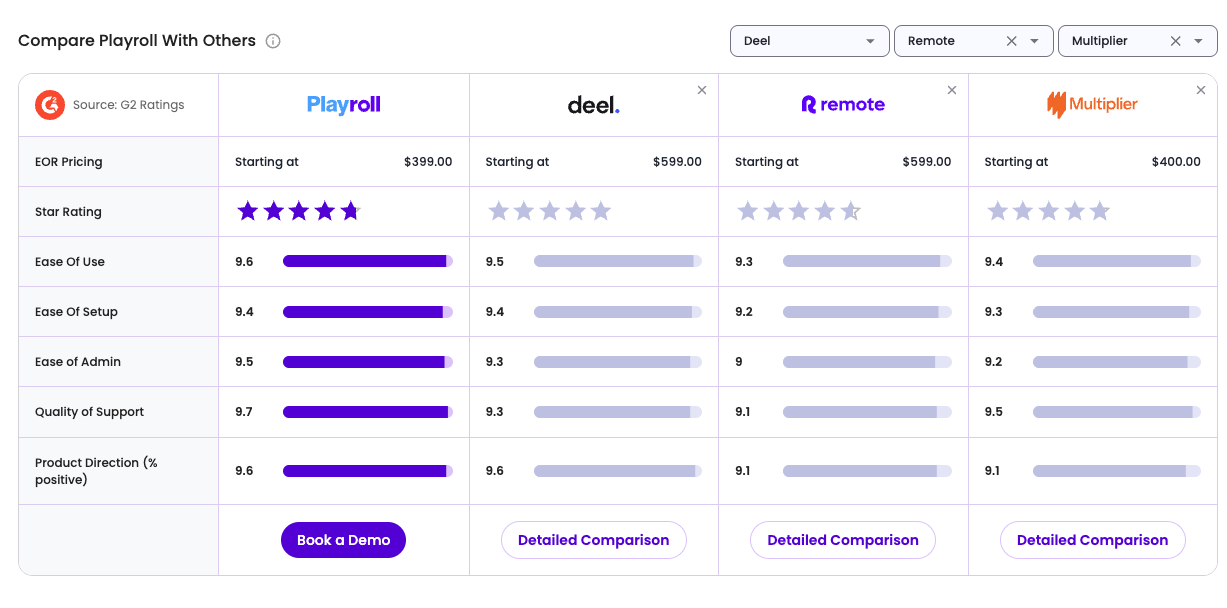
Playroll employs your Austrian hire through its own wholly-owned local entity, so the company holding the contract is the same one carrying the ASVG and payroll obligations directly, with no third-party partner in the middle. Contracts are drawn up under the Angestelltengesetz, employees are registered with the ÖGK before their first day, and the 13th and 14th salaries set by most Kollektivverträge are calculated and taxed at the reduced Jahressechstel rate automatically, which removes the calculation foreign employers most often get wrong in year one. Pricing starts at $399 per employee per month with no setup, onboarding, or offboarding fees, and FX is charged at a fixed rate rather than a variable markup buried in the invoice.
What reviewers single out most, though, is the support. You get a named account manager for your team and a dedicated contact for each employee, with replies usually within a couple of hours. Onboarding can run in as little as two days, and the same platform covers 180-plus other countries if Austria is one of several markets you're hiring in. As a trade-off, Playroll has less native HRIS integrations on offer than others.
2. Deel
Deel runs Austria through a partner network and covers 150+ countries, with one platform for payroll, benefits, and contractor management. Its multi-currency payments and unified compliance dashboard work well if you're managing several countries at once. Pricing sits at a premium, and benefits customization for Austria specifically is thinner than in Deel's larger markets.
3. Remote
Remote employs Austrian staff through its own owned entity, giving it direct control over contract changes and filing accuracy. Its equity management and benefits tools suit companies planning to scale a team here. A 12-month minimum commitment is worth knowing about if your hiring plans are still short-term or uncertain.
4. Multiplier
Multiplier runs Austria through an entity it registered in 2023, and treats 13th and 14th month payments as a built-in platform feature rather than something you calculate yourself. Its ESOP support is useful for startups offering equity to Austrian hires. Onboarding usually takes 24 to 72 hours, though a few users mention a learning curve with the fuller feature set.
5. G-P (Globalization Partners)
G-P (Globalization Partners) mixes owned entities and partner arrangements depending on the country, with enterprise-level support and compliance monitoring. It suits larger organizations that want a dedicated account manager over the cheapest possible price. The 12-month minimum and higher fees put it out of reach for a smaller first hire.
6. Oyster HR
Oyster HR serves Austria through a local partner rather than an owned entity, but still onboards fast, often within 48 hours. Its self-service platform and B-Corp status appeal to mission-driven companies. The partner model means slightly less direct control over Austria-specific contract terms than a wholly-owned setup gives you.
7. Omnipresent
Omnipresent leans heavily into European coverage, Austria included, with automated compliance workflows and more than 20 HRIS integrations. It's a solid fit if you're already standardized on tools like Workday or BambooHR. Support runs mostly through email, which can slow you down when something's genuinely urgent.
8. RemoFirst
RemoFirst positions itself as the budget option, with included health insurance and 24-hour onboarding claims across 180-plus countries. It's a reasonable fit for an early-stage company making its first Austria hire on a tight budget. The trade-off is that it relies fully on a local partner network in Austria rather than its own entities, so the company legally employing your hire and carrying the ASVG and payroll obligations is a third party RemoFirst selects. Its HR system integrations are also more limited than the established players.
9. Atlas HXM
Atlas HXM brings visa sponsorship expertise across 100-plus countries, plus learning and development tools built into its HXM platform. That combination suits companies relocating talent into Austria rather than hiring purely local staff. The broader feature set can feel like more than you need for one straightforward Austrian hire.
10. WorkMotion
WorkMotion markets itself specifically for the DACH region, with a German-speaking compliance team that knows Austrian collective agreements in real depth. That regional focus makes it worth a look if Austria is one of several German-speaking markets on your roadmap. Mandatory deposits on some plans add an upfront cost worth budgeting for early.
11. Velocity Global
Velocity Global offers custom-quoted pricing and strong compliance ratings across 175 countries, backed by more than 20 HRIS integrations. It works well for larger organizations that want compliance assurance more than self-service speed. The lack of published pricing makes it harder to compare quickly against the rest of this list.
12. Rippling
Rippling pulls HR, IT, and finance into one platform, and extends into Austria through a partner arrangement. If you're already using Rippling for device management or IT provisioning, the efficiency gains are real. The tradeoff is a longer onboarding process than you'd get from a pure-play EOR.

What Are Users Actually Saying About These Providers?
Across G2, Trustpilot, and HR forums, the feedback on Austria-focused EOR providers clusters around a few consistent points. Onboarding speed varies a lot: some providers confirm a new hire's contract within 48 hours, others take closer to two weeks once Austrian-specific clauses need extra legal review.
Compliance accuracy gets the most detailed comments, good and bad. A verified G2 reviewer noted that a provider with its own Austrian entity handled a mid-year Abfertigung Neu contribution correction faster than a partner-model competitor managing the same request through an intermediary.
Support responsiveness and local benefit handling come up again and again. Reviewers consistently rate providers higher when support staff can answer a question about the 13th and 14th month payment schedule directly, instead of escalating it to a specialist team first.
Should You Use an EOR or Set Up Your Own Entity in Austria?
This comes down to headcount, timeline, and how permanent your Austrian presence needs to be.
An EOR makes sense if:
- You're hiring your first one to five people in Austria and don't yet know if the market will scale
- You need someone employed and paid within weeks, not the months a GmbH registration takes
- You're testing the Austrian market before committing to an office or entity
- You'd rather not register directly with the Finanzamt Österreich and ÖGK for a small team
- You don't have in-house expertise in Austrian collective agreements or works council rules
Setting up your own entity makes more sense if:
- You're planning to employ more than 15 to 20 people in Austria within the next year or two
- You need full control over local tax planning and intercompany transfer pricing
- You're establishing a permanent office, warehouse, or manufacturing presence
- Your business needs an Austrian trade license (Gewerbeberechtigung) tied to a registered local entity
- You want to negotiate directly with a works council
How Long Does Onboarding Through an EOR Actually Take?
Onboarding through an EOR splits cleanly into what you handle and what the provider handles. You agree on the role, compensation, start date, and any extra benefits directly with your candidate. From there, the EOR collects the employee's documents, drafts a contract with the correct 13th and 14th month terms, registers them with the Finanzamt Österreich and ÖGK, and sets up payroll ahead of the first pay run.
A realistic timeline is one to three weeks from signed agreement to start date, depending on how fast documentation clears and whether the role needs a specific collective agreement classification.
Compliance Basics You Need to Know Before You Hire
A single missed notice period calculation can turn into months of disputed pay, so this is worth double-checking before you finalize any offer letter.
How Playroll Helps You Hire in Austria
Playroll handles the parts of hiring in Austria that trip most companies up: the 13th and 14th month salary calculation, ASVG registration, and Abfertigung Neu contributions, all built into standard payroll runs rather than treated as afterthoughts. You get a compliant, Angestelltengesetz-aligned contract for your hire, payroll that accounts for Austria's contribution ceiling automatically, and a support team that can actually answer a question about Austrian sick pay tiers without escalating it.
That means you can make an offer to someone in Vienna or Graz this month, not after a GmbH registration clears in three to four weeks. Playroll employs the person on your behalf across 180-plus countries, so if your next hire is somewhere other than Austria, the same setup carries over.
Austria's talent pool is genuinely strong, and the compliance rules around it are complex. Book a chat with our team to find out how we can make your Austrian expansion plans truly simple.

ABOUT THE AUTHOR
Milani Notshe
Milani is a seasoned research and content specialist at Playroll, a leading Employer Of Record (EOR) provider. Backed by a strong background in Politics, Philosophy and Economics, she specializes in identifying emerging compliance and global HR trends to keep employers up to date on the global employment landscape.

.png)

Back to Top
.svg)








.svg)