.svg)
.svg)

.svg)
.svg)

Copied to Clipboard

Ready to get Started?


Asia-Pacific is having a moment. From India's booming tech scene and the Philippines' world-class outsourcing talent to Singapore's status as a global financial hub and Australia's highly skilled professional workforce, the region has become one of the most exciting places in the world to build a team.
But hiring across APAC is not simple. The region spans more than 20 countries, each with its own employment laws, social contribution systems, payroll rules, and cultural expectations around work. Asia-Pacific is the fastest-growing region in the global EOR market, with an expected 10% CAGR through 2034, supported by rapid hiring activity in India, China, and Southeast Asia. That growth is happening precisely because companies are waking up to how complex it is to hire here and how much easier an Employer of Record makes the whole process.
There’s no question that the talent is there. But getting it onto your payroll, compliantly, without setting up a legal entity in every country you hire in? That's where things get complicated.
In this guide, you'll find everything you need to know about hiring across Asia-Pacific using an Employer of Record. We’ll get into what to look for, what it costs, and honest reviews of the top providers operating in the region right now.
What Is an Employer of Record — And Why Does It Matter in APAC?
An Employer of Record (EOR) is a third-party company that legally employs workers on your behalf in another country. While you manage the day-to-day work (the tasks, projects, and performance), the EOR takes care of everything on the legal employment side: locally compliant contracts, payroll processing, tax withholding, statutory benefits, and all the filings that go along with it. In a nutshell, an EOR is a tool that allows you hire talent without having to set up an entity locally.
In APAC, hiring with an EOR helps you navigate one of the most legally fragmented employment landscapes in the world. This complexity and nuance apply in different ways from country to country. For example, India has state-specific labour variations and a layered social security system (EPF, ESI) that changes depending on where your employee is based. On the other hand, Japan has strict worker protection laws, social insurance obligations that can exceed 16% of salary, and a cultural emphasis on long-term employment that makes terminations particularly sensitive. Australia's Fair Work Act comes with minimum entitlements around leave, termination notice, and unfair dismissal that aren't optional. Singapore, meanwhile, introduced its first dedicated anti-discrimination legislation, the Workplace Fairness Act, in 2025, adding new employer obligations around hiring practices and grievance procedures.
The consequences of getting any of this wrong are very real and could result in penalties, audits, employee disputes, and back-pay liability. The numbers show that experienced APAC employers understand the value of having proper compliance infrastructure in place: in Australia and Singapore, EOR adoption is especially high, with many organisations in this region reporting strong use of EOR services.
Thinking About Expanding Into APAC?
Payroll, compliance, and labor laws across APAC are complex. Playroll supports hiring in 180+ countries, including all major APAC markets, with local experts from day one.
Speak to an Expert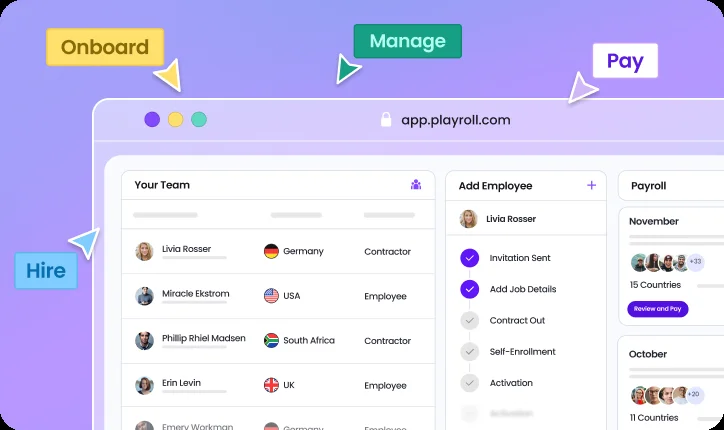
What Should You Consider When Choosing An Employer Of Record in APAC?
- Local Compliance Expertise (Country by Country): Broad "global coverage" claims aren't enough. Your EOR needs granular, current knowledge of labor codes, social contribution requirements, mandatory benefits, and termination rules for each specific market you're hiring in. Ask directly: do they have in-country legal and HR professionals in India, Japan, Australia, Indonesia? Or are they managing these markets through local third-party partners?
- Owned Entities vs. Partner Networks: Providers that operate through their own legal entities in APAC markets offer faster issue resolution, clearer compliance accountability, and more consistent service than those relying on local intermediaries. With a partner-based model, you're often one communication gap away from a missed filing or a compliance error.
- Breadth and Depth of Regional Coverage: If you're building a multi-country APAC team, you don't want to manage five different EOR providers for five different countries. Look for a provider with meaningful, well-supported coverage across the markets you care about.
- Payroll Accuracy and Reliability: APAC payroll doesn't forgive errors. Social insurance contributions, provident fund deductions, mandatory bonuses, and country-specific tax withholding all need to be applied correctly, every cycle. Mistakes can mean employee disputes, government fines, and audits, particularly in markets like India, Australia, and South Korea, where regulators are most active.
- Technology and Integrations: A strong EOR platform should handle digital onboarding, automated payroll, leave tracking, expense management, and integrations with your HRIS and finance tools. Given the number of countries often involved in APAC hiring, having everything in a single dashboard makes a genuine operational difference.
- Pricing Transparency: Get the full picture upfront: EOR service fee, statutory contribution costs (which vary dramatically by country), onboarding and offboarding charges. Hidden costs are a recurring complaint across the EOR industry. You want a provider who gives you an honest, detailed pricing breakdown from the start.
- Responsive, Human Support: Let’s keep it real, when a payroll issue surfaces in Tokyo on a Friday morning, you need a person, not a ticket queue. Fast, knowledgeable support that understands local regulatory context is what separates genuinely great EOR providers from ones that look good on paper. Both your organization and your employees should have dedicated contacts, not just a shared help portal.
Estimated Cost for Hiring an APAC Employee Through an EOR
EOR pricing across Asia-Pacific typically ranges from $299–$800 USD per employee per month, depending on the provider model, country, seniority level, and benefits required. For three employees hired through a mid-range EOR, you're looking at roughly $1,200–$2,400/month in EOR fees alone (and that’s before statutory costs). Developed markets like Australia, Japan, Singapore, and South Korea tend to sit at the higher end of that range, while markets like India, the Philippines, Vietnam, and Indonesia are generally more affordable.
Entry-level platforms like Multiplier start around $400/month, while premium providers like Oyster can reach $699–$1,500+/month per employee. Playroll sits competitively within this range with flat-fee, transparent pricing, and no additional charges for onboarding or offboarding.
On top of the EOR fee, you'll need to factor in employer statutory costs, which can range from 11-17% of gross salary in this region. These are in addition to gross salary and need to be accounted for in your total employment cost from the start.
💡Use Playroll's free Employment Cost Calculator to get a market-by-market picture before you commit.

10 Leading Employer of Record Providers in APAC in 2026
We’ve curated a list of reliable, widely used EOR providers for hiring across Asia-Pacific. This list includes both global platforms and APAC-focused specialists:
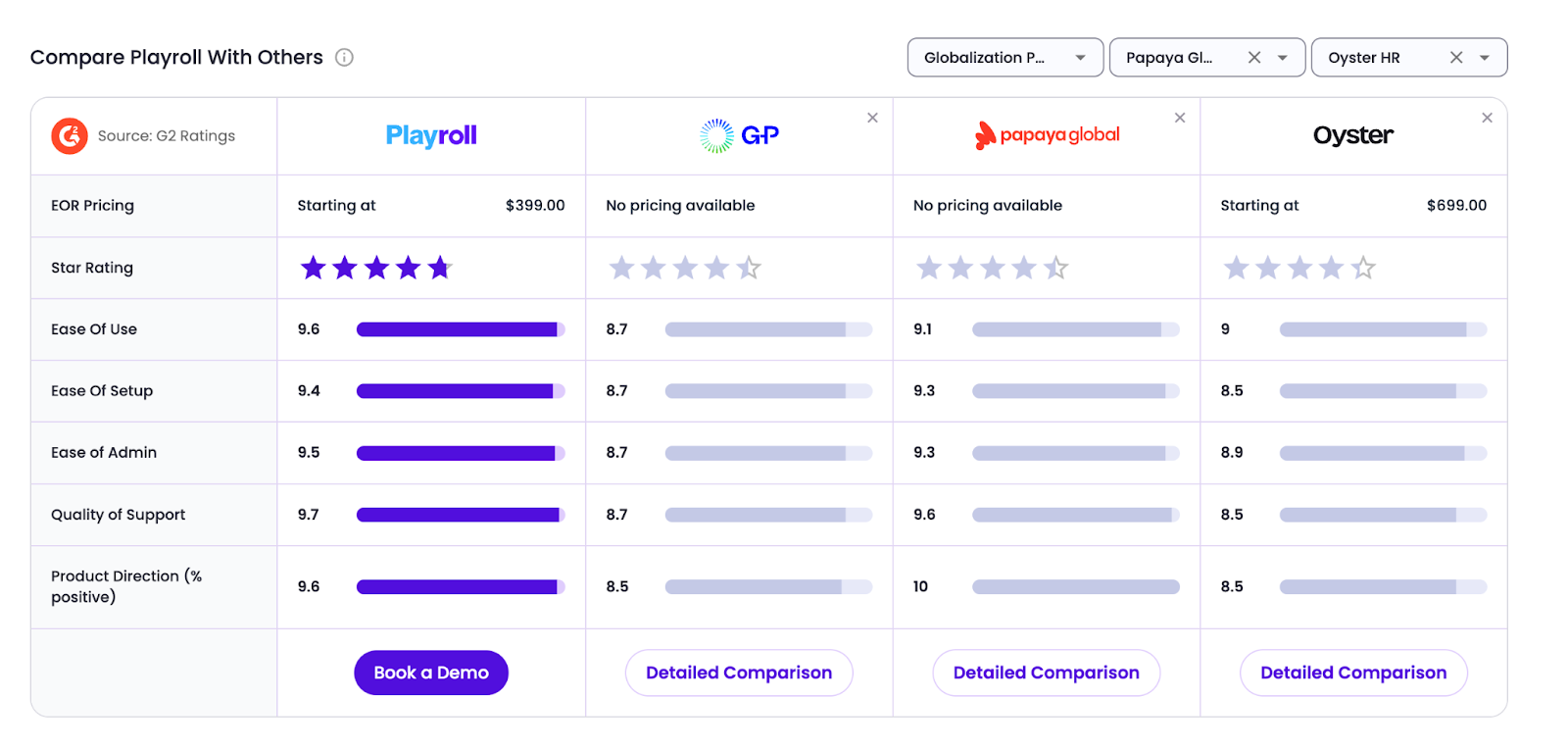
- Playroll: Stands out in Asia-Pacific for its combination of owned local entities, in-country compliance expertise, and a genuine commitment to human-first support across all major APAC markets such as India, Singapore, Australia, Japan, the Philippines, South Korea, Malaysia, Indonesia and New Zealand. Rather than relying on third-party intermediaries, Playroll's "boots on the ground" approach gives it direct oversight of fast-moving local labor laws. The platform combines fast onboarding, transparent flat-fee pricing, automated payroll workflows, and AI-backed compliance monitoring with dedicated success managers for both employers and employees.
- Deel: One of the most widely used global EOR platforms, Deel offers broad APAC coverage through a mix of owned entities and local partners. Its platform is intuitive, with strong automation, localized contracts, and integrated payroll. It performs especially well in mature markets like Singapore and Australia. That said, in countries with complex or rapidly changing labor frameworks (such as Indonesia or Vietnam), service consistency and benefits depth can depend on the local partner model.
- Remote: A global EOR with a strong reputation for compliance, transparency and employee experience. Remote owns entities in several APAC countries, which can improve consistency in areas like statutory benefits, IP protection, and tax handling. It’s particularly strong in markets with clearer employment frameworks, but coverage in emerging APAC regions can be more limited or require partner support.
- Multiplier: Headquartered in Singapore, Multiplier has built a strong reputation as an APAC-focused EOR with competitive pricing and fast onboarding. It supports hiring across 150+ countries and is particularly well-suited for companies expanding into Southeast Asia and India. With countries like India continuing to refine labor codes and compliance requirements, Multiplier’s localized expertise is a key advantage. However, for more complex employee relations or edge-case compliance scenarios, support can be less hands-on.
- Papaya Global: A global payroll and EOR platform known for its strong analytics, reporting, and enterprise-grade infrastructure. Papaya supports many APAC markets and is often chosen by larger organizations that need centralized visibility across multiple regions. It’s particularly useful if you’re managing compliance across jurisdictions with very different tax regimes, like Japan versus the Philippines. The trade-off is a more complex implementation process and higher cost compared to more agile providers.
- Velocity Global: A well-established global EOR with reliable APAC coverage and a strong compliance track record. It’s known for personalized support and experience in handling complex hiring scenarios across multiple jurisdictions. While dependable, its platform is less product-driven, and some workflows can feel more manual compared to newer, tech-enabled competitors.
- Safeguard Global: An enterprise-focused EOR with extensive experience navigating complex labor laws across APAC, including highly regulated markets like China and South Korea. Safeguard offers tailored compliance solutions and strong risk mitigation, which is valuable as governments across the region continue tightening employment regulations. However, its enterprise orientation means longer onboarding timelines and higher costs, which may not suit smaller teams.
- Asia Payroll & HR (APHR): A regionally focused provider specializing in Southeast Asia, including Singapore, Malaysia, Thailand, and Vietnam. APHR brings strong local knowledge and hands-on compliance support – particularly useful in countries where labor laws are frequently updated or less standardized. The trade-off is a more traditional service model with fewer automated workflows and integrations.
- Elements Global Services: A global EOR that leverages a network of in-country partners to deliver coverage across APAC. This model provides flexibility and local expertise, which can help emerging markets with evolving regulations. However, as with most partner-based approaches, service quality and employee experience can vary between countries.
- NNRoad: An EOR provider with a strong footprint in Asia, particularly in China, Southeast Asia, and frontier APAC markets. It’s often chosen for its cost-effectiveness and ability to onboard quickly in less accessible jurisdictions. However, its platform maturity and consistency of support may not match more established global providers.
Insights from Real Users
Playroll
“There is nothing to dislike. It does take a while to get used to having to run everything through another party in regards to team performance, PIP meetings, etc., but they are so supportive it soon becomes part of the solution.”
- Verified G2 User
Deel
“Support is fine, but slower if you’re not in US time zones.”
- Verified Reddit User
Asia Payroll & HR
Asia Payroll & HR has limited visibility in global HR communities like Reddit, which can make peer benchmarking more difficult. This is typical of regionally focused providers that prioritize in-country expertise and service delivery over product-led growth.
Using an EOR vs Owned Entity in APAC
When you’re hiring your first employees in APAC, deciding between an EOR and setting up your own entity comes down to speed, cost, and how long you plan to operate in that market. An EOR lets you hire quickly without establishing a legal entity, which can take months in countries like Japan, Indonesia, or China due to registration, banking, and tax requirements. It also shifts the burden of navigating complex local labor laws onto the provider. That matters in APAC, where regulations are constantly evolving. With an EOR, you avoid upfront setup costs, ongoing compliance management, and the risk of getting local employment law wrong.
Setting up your own entity makes more sense if you’re planning a long-term, scaled presence in a specific country. While upfront costs can range from $10,000–$50,000+ depending on the market, your per-employee costs will be lower over time, and you’ll have full control over employment terms, benefits, and operations. The trade-off is complexitY, you’ll need to manage payroll, tax filings, statutory benefits (like CPF in Singapore or superannuation in Australia), and stay on top of regulatory changes yourself.
If you’re unsure, a common approach is to start with an EOR to test the market, then transition to your own entity once you’ve validated demand and built a local team. Alternatives like hiring contractors can work short-term, but misclassification risk is rising across APAC – especially in countries tightening enforcement – so it’s not a reliable long-term strategy.
Onboarding Process Through an EOR in APAC
Onboarding through an EOR in APAC is designed to be fast, compliant, and tailored to local labor laws. Here’s what the process typically looks like:
- Offer & contract creation: The EOR drafts a locally compliant employment contract aligned with country-specific labor laws, including notice periods, statutory benefits, and tax requirements.
- Background checks: Conducted where legally permitted, typically covering identity verification, employment history, and (depending on the country), education or criminal checks.
- Employee registration: The EOR registers the hire with local tax and social security authorities, such as CPF in Singapore, EPF in Malaysia, or superannuation in Australia.
- Benefits setup: Mandatory benefits are enrolled (pensions, social security, insurance), with optional benefits like private healthcare added based on market norms and your company’s offering.
- Payroll configuration: Payroll is set up in line with local pay cycles (typically monthly across APAC), including tax withholding, contributions, and compliance reporting.
- Time to onboard: In most cases, the full process – from signed offer to first payroll – takes anywhere from a few days to a couple of weeks, depending on the country and complexity.
Compliance Considerations for Hiring Employees in APAC
Hiring in APAC is primarily about understanding local expectations that shape how employees evaluate your offer and experience your company. Factors like work hours, for example, vary widely, but there are some commonalities across the region:
| Category | What to Expect Across APAC Markets |
|---|---|
| Work Hours | Typically 38–40 hours per week, with stricter enforcement in Australia and New Zealand, and longer working norms still common in parts of Asia despite increasing regulation. |
| Paid Leave | Annual leave generally ranges from 10 to 20 days plus public holidays, with statutory sick leave and parental leave requirements varying by country. |
| 13th-Month Pay | Mandatory in some markets like the Philippines and widely expected as a bonus in parts of Southeast Asia. |
| Probation Periods | Commonly, 3–6 months, allowing more flexibility in termination while still subject to local labor laws. |
| Medical Insurance Expectations | Private health insurance is often expected alongside public systems, especially in competitive hiring markets. |
| Termination Rules | Typically, they require valid cause, notice periods, and statutory severance, with strict enforcement in many countries. |
| Cultural Expectations | Employees often value stability, clear career progression, and benefits beyond statutory minimums, with varying expectations around hierarchy and negotiation. |
Key Takeaways
Hiring in APAC opens the door to some of the world’s most dynamic talent markets, but each country comes with its own legal frameworks, payroll requirements, and cultural expectations. This makes choosing the right EOR partner critical to get right.
If you want to move quickly, stay compliant, and avoid the complexity of setting up entities across multiple countries, an EOR gives you a fast, low-risk way to scale, handling everything from contracts and payroll to tax and benefits. Providers like Playroll stand out by combining strong in-country expertise, transparent pricing, and automation, so you’re not just compliant, but operationally efficient from day one.
That said, the best choice depends on your hiring strategy – whether you prioritize speed, cost, local expertise, or long-term presence – but with the right EOR partner, you can confidently build and manage teams across APAC without getting caught up in regulatory complexity.

ABOUT THE AUTHOR
Milani Notshe
Milani is a seasoned research and content specialist at Playroll, a leading Employer Of Record (EOR) provider. Backed by a strong background in Politics, Philosophy and Economics, she specializes in identifying emerging compliance and global HR trends to keep employers up to date on the global employment landscape.
10 EOR Services in APAC for 2026: Providers & Reviews FAQs
What checks matter most when choosing an APAC EOR provider?

.png)
Prioritize country-level checks on worker classification, payroll filing obligations, termination rules, and in-country legal coverage before signing.
How do leave and holiday rules in APAC affect hiring budgets?
Budgeting must include country-specific paid leave, public holiday practices, and statutory benefits because these rules materially change total employment cost.
Can one EOR agreement cover multiple APAC countries?
Many providers use one commercial framework, but employment terms and compliance obligations are still localized by country and must be reviewed separately.
What data-transfer controls are needed for APAC hiring?
Employers should confirm where employee data is stored, how cross-border transfers are protected, and which contractual safeguards apply in each jurisdiction.
Which service-level metrics should be tracked with an APAC EOR?
Track payroll accuracy, on-time payment rates, onboarding cycle time, and response times for compliance cases to measure provider performance.

Back to Top
.svg)









.svg)