.svg)
.svg)

.svg)
.svg)

Copied to Clipboard

Ready to get Started?


Hiring great talent has never been easier (or riskier) for fintech, SaaS, and software companies. As someone who works closely with the team helping global tech teams, I see the same challenge play out repeatedly. Founders want to hire fast, stay competitive, and expand internationally – but employment compliance quickly becomes a major blocker once you move beyond your home market.
That risk is dialed-up in fintech, where employment law intersects with financial regulation, data protection, and IP (intellectual property) ownership. Think PSD2 in Europe, AML/KYC obligations, or SEC rules for crypto-related fintechs – one wrong move in contracts or payroll can trigger audits or costly penalties. SaaS and software companies deal with similar headaches when building distributed engineering and product teams across Europe, LATAM, and APAC, especially as AI talent pools explode in places like Eastern Europe and India.
This guide explores why fintech, SaaS, and software companies rely on Employers of Record (EORs), what they need from them in 2026 amid AI-driven workflows, and which providers actually deliver. It draws on real-world insights from founders, operators, and finance teams, plus consistent patterns seen in forums, reviews, and client experience beyond the marketing.
What Fintech, SaaS & Software Companies Need From an Employer of Record
Whether you're bootstrapping a fintech from scratch, scaling a SaaS product post-Series B, or pushing AI features in software, your hiring looks nothing like a traditional business. You typically need to move faster, hire across borders to find the best talent, and you might face intense regulatory and investor scrutiny.
Partnering with the right EOR lets you hire globally without grinding to a halt on entity setup. It handles local employment laws, cuts risks around worker classification and contracts, and gets you into new markets without bloating your operation team.
The EOR becomes the foundation for international growth so you can stay focused on product, speed, and beating the competition.
Must-Have EOR Features For Fintech, SaaS & Software Teams
Fintech, SaaS, and software teams usually expect more from an EOR than most industries. Beyond basic payroll, you're safeguarding core IP (code, algorithms, models), navigating heavy regulation, and scaling distributed teams at warp speed. "Good enough" EORs crumble fast once headcount hits 20+ or you add regulated markets.
Here are the features that actually matter for product-led, globally distributed tech teams in 2026.
- Regulatory & IP Compliance: Employment contracts must explicitly assign IP rights in every jurisdiction – it doesn't happen automatically in places like Brazil (moral rights) or parts of Europe. For fintech, add GDPR/CCPA compliance for handling sensitive financial data, plus AML/KYC alignment in payroll processes. Look for EORs with proven experience in regulated/IP-heavy spaces – they've seen the audits and know the traps.
- Payment Infrastructure: Payroll in multiple currencies without hefty FX markups or surprise fees. Transparent, predictable employer costs month-to-month. Reliability is non-negotiable – delayed payroll kills trust in engineering teams, and for fintech, it can flag compliance issues.
- Equity & Incentives: If RSUs (Restricted Stock Units), stock options, or token incentives form part of your compensation (common in SaaS and fintech), the EOR needs to support them cross-border. Employees deserve clear local tax treatment explanations – no nasty surprises at tax time that could tank retention.
- Speed & Flexibility: New hires (especially senior devs or AI specialists) should onboard in days, not weeks. As teams grow, payroll, benefits, and compliance must scale without admin overload – think API integrations with tools like Carta for equity or Stripe for fintech payouts.
Common Hiring Scenarios in Fintech, SaaS & Software
Fintech, SaaS, and software growth follows a predictable pattern: top talent isn't always local, scaling happens post-funding, and entities everywhere aren't realistic early. Over 75% of fintech and SaaS scale-ups run distributed teams across more than five countries.
Real examples I've seen:
- Building distributed engineering teams across Europe (Poland, Ukraine for AI/ML), LATAM (Argentina, Brazil for cost-effective devs), and India (backend talent).
- Hiring senior backend, mobile, infra, or AI engineers in high-cost markets while keeping burn low.
- Rapid scaling after Series A/B without entity headaches – e.g., a fintech adding compliance roles in Singapore or a SaaS team grabbing EU product managers via EOR.
- Long-term core contributors (not short-term contractors) with equity packages.
- Comp often includes equity/RSUs or long-term incentives tied to milestones.
Compliance Traps Hiring Teams Often Miss
Hiring globally opens up huge opportunities – but it also comes with a few easy-to-miss compliance traps. What works in one country doesn’t always translate cleanly to another, and small oversights can turn into costly issues later.
The points below highlight some of the most common risks teams run into when building distributed engineering teams.
- IP doesn't auto-vest with the employer in many places without tailored contract language, for example, code ownership disputes derailing due diligence.
- Misclassifying engineers as contractors risks fines, back taxes, and IP claims – especially risky in fintech where regulators scrutinize worker status.
- Fintech data protection is stricter for sensitive financial info – GDPR violations or local privacy breaches can halt product launches.
- Terminating in Europe often needs formal processes, notice periods, and documentation – abrupt cuts can lead to unfair dismissal claims.

How We Chose These EOR Providers
I built this list around providers handling real fintech, SaaS, and software scenarios – not just broad coverage. I dug into customer feedback, Reddit threads, G2/Trustpilot reviews, and firsthand experiences from founders and ops teams. The focus: what works in practice for tech scale-ups.
Evaluation criteria:
- Coverage in hot tech hiring spots (e.g., Poland for AI, India for devs, Singapore for fintech)
- Compliance depth for regulated/IP-heavy work (e.g., fintech AML alignment, strong IP clauses)
- Hiring speed and onboarding for full-time tech roles
- Flexibility on payroll, benefits, equity in multiple jurisdictions
- Integrations/reporting for finance/HR stacks (e.g., API hooks to Carta, BambooHR, or Stripe)
- Support responsiveness – especially during audits or scale spikes
10 Best EORs for Fintech, SaaS & Software Companies Hiring Globally in 2026
There’s no one-size-fits-all here. What works for a Series A SaaS team might bog down an enterprise fintech. These are the providers I see fintech, SaaS, and software teams actually using and recommending in 2026, ranked by real fit for tech needs.
1. Playroll: Best for high-growth fintech and SaaS teams that need strong compliance with flexibility
Best for high-growth fintech and SaaS teams that need strong compliance with flexibility.
If you're scaling fast in regulated spaces or IP-heavy software, Playroll takes the operational load off. With coverage in 180+ countries (mostly owned entities), automated payroll with variance checks, and built-in IP assignment in contracts that can be easily customized (at no extra cost), it's built for tech teams that need to move fast in a highly regulated environment. It integrates seamlessly with your HR/finance stack – you don’t need to rip out tools that already work. I've seen fintech clients catch payroll issues early and software teams onboard engineers in days. Our dedicated support teams and internal legal experts are on hand to answer any and all compliance questions your team might have.
Pricing typically starts around $399 per employee per month.
Why fintech, SaaS & software teams love it:
- Automated payroll with variance checks reduces payroll errors as headcount scales
- Country-specific IP assignment is built directly into employment contracts
- Fast onboarding for engineers and product roles without legal back-and-forth
- Integrates with your existing HR and finance tech stack, so you don’t need to overhaul tools or migrate data
Protect Your IP & Stay Compliant As You Scale Globally
Playroll’s EOR services are built for IP-heavy, regulated fintech and SaaS companies, with in-country experts on the ground and a platform that integrates seamlessly with your existing HR tech stack.
Speak to an Expert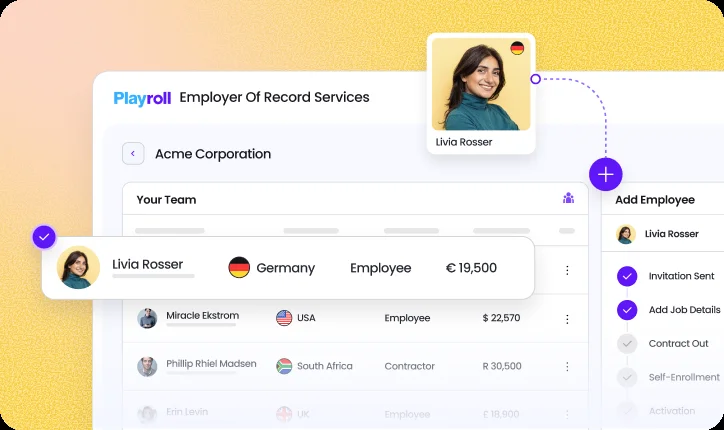
2. Deel: Best for API-driven teams and automation-heavy workflows
Developer-led teams love Deel's APIs and integrations – their product is perfect for embedding into modern stacks. They also have wide coverage, fast contractor-to-employee switches, and centralized dashboards. That said, as teams scale across more countries, some users find support and compliance depth is lacking. In addition to that, they’re definitely on the pricer side compared to others on this list.
Pricing typically starts around $599 per employee per month.
Why fintech, SaaS & software teams love it:
- Strong APIs and integrations with HR, payroll, and finance tools
- Fast onboarding and contractor-to-employee transitions
- Centralised dashboard for managing a mixed global workforce
3. Remote: Best for IP-sensitive software teams hiring long-term employees
Compliance-first with owned entities in many countries – great for core engineering/product roles where IP protection is paramount. Slightly higher pricing and less flexibility for rapid changes.
Why fintech, SaaS & software teams love it:
- Strong, enforceable IP assignment built into local contracts
- Consistent employee experience across countries
- Well suited for permanent, long-term hires
4. Papaya Global: Best for finance-led SaaS teams managing complex payroll
If your biggest challenge is global payroll visibility, Papaya Global is designed with finance teams in mind. It offers consolidated payroll reporting and analytics across multiple countries, but because EOR services are delivered through local partners, teams may have less hands-on control at the local level. Because they always have to deal with the middle man, users also report considerable communication delays.
Why fintech, SaaS & software teams love it:
- Deep payroll analytics and consolidated reporting
- Strong visibility into global payroll costs
- Well suited for large, multi-country finance operations
5. Oyster: Best for remote-first SaaS teams focused on employee experience
This is a popular choice for remote-first SaaS companies. It offers transparent pricing and a strong benefits marketplace across regions, though it’s less flexible for heavily regulated fintech use cases or complex compliance scenarios.
Why fintech, SaaS & software teams love it:
- Clean, intuitive platform
- Strong global benefits offering
- Transparent pricing without surprises
6. Pebl: Best for regulated fintechs operating in complex markets
If you’re hiring in difficult or highly regulated jurisdictions, Pebl (formerly Velocity Global) brings in-depth experience and a risk-first mindset. It performs well in complex markets, but onboarding and changes can be slower compared to newer, more product-led platforms.
Why fintech, SaaS & software teams love it:
- Strong compliance support in complex jurisdictions
- Experience working with regulated industries
- Reliable option for higher-risk markets
7. G-P (Globalization Partners): Best for enterprise fintechs with compliance-first priorities
On the plus side, you get enterprise-grade legal coverage and high-touch support worldwide (which does, however, come at an extra cost). It offers comprehensive compliance infrastructure, though the pricing and processes can feel heavy for smaller or fast-moving teams.
Why fintech, SaaS & software teams love it:
- Very strong legal and compliance coverage
- Global reach across mature and complex markets
- Enterprise-grade service model
8. Multiplier: Best for cost-conscious SaaS startups expanding internationally
Multiplier is often shortlisted as one of the more affordable EORs with strong coverage in APAC and emerging markets, though it’s less well suited to complex compliance or IP-heavy edge cases.
Why fintech, SaaS & software teams love it:
- Affordable pricing for global hires
- Strong coverage in growth markets
- Simple onboarding process
9. Skuad: Best for distributed engineering teams in emerging markets
If you’re building engineering teams in emerging markets and want to move quickly, Skuad focuses on speed and predictability. It enables fast onboarding across many countries, but offers limited customisation for senior or highly specialised roles.
Why fintech, SaaS & software teams love it:
- Fast onboarding for engineering roles
- Predictable pricing
- Broad country coverage
10. RemoFirst: Best for early-stage software startups hiring globally on a budget
If you’re making your first international hires and want to keep things simple, RemoFirst is an accessible option. It offers lower entry pricing and a straightforward setup, though advanced automation, reporting, and compliance features are limited as you scale. RemoFirst also relies on regional partners rather than running payroll through their own entities. This means they don’t have direct oversight over compliance and in-country operations.
Why fintech, SaaS & software teams love it:
- Budget-friendly starting price
- Simple onboarding for first hires
- Minimal setup complexity
Quick Fintech, SaaS & Software-Focused Comparison
If you’re weighing up EORs, it helps to start with what you actually need today – not what looks good on a feature list. Different fintech and software teams optimize for very different things, whether that’s speed, compliance, payroll visibility, or employee experience.
Pricing & Costs for Fintech, SaaS & Software Teams Using EORs
When you’re hiring globally, EOR pricing can feel a bit opaque at first – especially for fintech and software teams dealing with different countries, senior roles, and regulatory requirements. Costs are shaped by where you’re hiring, how senior the role is, and compliance requirements in each market.
Most EORs charge between $200 and $800 per employee per month, with pricing varying based on country coverage, service depth, and any additional features you need. On top of that, you’ll need to factor in local employer contributions, statutory benefits, and any role-specific perks that are expected in competitive tech markets.
Here’s a breakdown for a senior backend dev in Poland as an example (~$120K USD gross):
- Employer contributions add 20–25%
- Benefits (e.g., health, remote stipends) vary by market expectations
- EOR fee: $399–$599/month typical
Add-ons like equity tax modeling or custom IP clauses bump it up.
EOR vs Alternatives for Hiring in Fintech, SaaS & Software
An EOR isn’t your only option For fintech, SaaS, and software teams, the right hiring model can have a big impact on compliance, IP ownership, and how much operational overhead your team takes on.
Here’s how EORs compare to the most common alternatives tech companies consider:
- EOR vs Opening a Local Entity: An EOR is typically faster and lower risk when you’re hiring fewer than 15–20 employees in a single country. You avoid the upfront legal, tax, and administrative work of entity setup while still employing people compliantly. For many tech teams, an EOR acts as a bridge until headcount justifies a local entity.
- EOR vs PEO (U.S. Only): A Professional Employer Organization (PEO) is a co-employment partner that manages HR, payroll, benefits, and compliance on your behalf, but requires you to already have a local legal entity and is primarily limited to the U.S. An Employer of Record (EOR), by contrast, acts as the legal employer in-country, allowing you to hire internationally without setting up entities in each location. For global fintech and SaaS teams, EORs offer far more flexibility early on.
- EOR vs Contractors: Using contractors instead of employees can seem faster, but it significantly increases misclassification and IP risk – especially in fintech and software. Many countries treat contractors very differently from employees, and improperly structured contracts can lead to fines or IP ownership issues. EORs let you hire full-time employees compliantly while protecting your core IP.
Key Takeaways
If you’re building a fintech, SaaS, or software company, your EOR needs to do far more than handle payroll. It becomes part of your core operating setup – protecting your IP, keeping you compliant across countries, and removing friction as your team scales globally.
That’s where Playroll stands out. If you need in-depth compliance support without sacrificing speed or flexibility, Playroll is built to support modern tech teams with automated payroll, strong IP protections, and workflows that actually scale with you.
If you want to see how this works in practice, book a demo with our team and walk through your hiring plans with a team that understands the realities of global tech growth.

ABOUT THE AUTHOR
Jaime Watkins
Jaime is a content specialist at Playroll, specializing in global HR trends and compliance. With a strong background in languages and writing, she turns complex employment issues into clear insights to help employers stay ahead of the curve in an ever-changing global workforce.
The Best 10 EOR Providers for Tech Teams in 2026 FAQs
Why do tech companies often use an EOR when entering new markets?

.png)
An EOR can accelerate compliant hiring by providing a local employment structure before a company sets up its own entity.
What compliance checks are critical when hiring engineers through an EOR?
Review IP assignment terms, data-protection controls, worker classification, and statutory payroll processes before onboarding.
Can an EOR support variable compensation for tech roles?
Many EORs can administer bonuses and allowances when they are structured in line with local payroll and labor requirements.
Which service levels matter most for tech hiring via EOR?
Key service levels include onboarding speed, payroll accuracy, response time for compliance questions, and termination support quality.
When should a scaling tech team move from EOR hiring to its own entity?
Transition planning usually starts when headcount, cost profile, and long-term market commitment justify direct local operations.

Back to Top
.svg)










.svg)