.svg)
.svg)

.svg)
.svg)

Copied to Clipboard

Ready to get Started?


The United Kingdom remains one of the most strategic markets for global hiring – combining deep professional expertise, strong regulatory institutions, and a well-established international business culture. From finance and fintech in London, to life sciences around Cambridge and Oxford, and fast-growing tech hubs in Manchester, Leeds, and Edinburgh, the UK offers access to a highly skilled, globally experienced workforce.
That opportunity comes with complexity. The UK operates one of the world’s most structured and employee-protective employment systems – with strict rules around payroll, tax, pensions, and termination. Even small compliance gaps – from PAYE setup to pension enrolment or contracts – can quickly lead to fines, tribunal claims, or reputational risk.
That’s why many companies rely on an Employer of Record to hire in the UK smoothly, avoiding local entity setup and leaving compliance to specialists who understand how UK employment law works in practice.
In this guide, you’ll find a clear breakdown of how EORs work in the United Kingdom, what to evaluate when choosing a provider, how pricing typically compares, and the top UK-capable EOR providers for 2026.
What Is an Employer of Record: And Why Does It Matter in the United Kingdom?
An Employer of Record is a third-party organisation that becomes the legal employer of your UK-based employees. The EOR hires on your behalf, runs PAYE payroll, withholds and remits taxes, administers statutory benefits, issues compliant employment contracts, and manages ongoing employment law compliance – while you retain full control over day-to-day work.
In the United Kingdom, an EOR helps navigate a highly regulated employment framework shaped by legislation and decades of tribunal and court precedent. This includes compliance with HM Revenue & Customs (HMRC) payroll and reporting requirements, mandatory workplace pension enrolment, and statutory employee rights such as working time limits, paid leave, sick pay, and parental entitlements.
A few common challenges companies encounter when hiring in the UK:
- Misclassifying employees and contractors, particularly where IR35 rules or “worker” status may apply, leading to backdated tax, National Insurance liabilities, and penalties.
- Running PAYE payroll incorrectly, including errors in tax codes, National Insurance categories, or late RTI submissions to HMRC.
- Failing to comply with workplace pension auto-enrolment, such as missing enrolment deadlines, mishandling opt-outs, or failing to re-enrol eligible employees every three years.
- Misapplying working time regulations, including holiday accrual, rolled-up holiday pay, or 48-hour weekly working limits and opt-outs.
- Underestimating statutory leave entitlements, particularly for sick pay, maternity, paternity, and shared parental leave, where eligibility and pay calculations can be complex.
- Mishandling terminations and redundancies, especially around notice periods, fair process, and consultation requirements, which are heavily scrutinised in the UK.
Beyond compliance, UK employees place strong emphasis on fairness, transparency, and procedural correctness. Clear contracts, accurate payroll, reliable benefits, and well-managed HR processes play a major role in employee trust and retention. A strong UK EOR will create a credible, professional employee experience from day one.

Why a High-Quality EOR Is Essential in the United Kingdom
UK employment compliance is strict, procedural, and heavily employee-protective. Even small payroll, pension, or reporting errors can result in penalties from the HMRC, employment tribunal claims, or reputational damage. Your company could face fines up to £45,000 per illegal worker for a first offence and up to £60,000 for repeat breaches under recent Home Office rules.
A strong UK Employer of Record provides:
- Local Fluency: Local-level understanding of UK PAYE payroll rules, Income Tax and National Insurance Contributions, Real Time Information (RTI) submissions to HMRC, workplace pension auto-enrolment, Working Time Regulations, statutory leave entitlements, and employment contract norms shaped by UK case law.
- Rapid Adaptation: UK employment and payroll regulations change regularly. National Insurance thresholds, statutory sick and parental pay rates, pension contribution minimums, and even holiday pay interpretations are driven by tribunal and court decisions. A strong EOR tracks and applies these changes immediately.
- Risk Shielding: Proper handling of terminations and redundancies, compliant notice periods, fair process, and legally sound employment agreements that reduce exposure to unfair dismissal and discrimination claims.
- On-the-Ground Insight: UK employment practices are highly process-driven. EORs with in-country teams understand how HMRC, pension regulators, and employment tribunals operate in practice, what documentation is required, and how to avoid compliance gaps or costly delays.
Hiring in the UK and Want to Get It Right from Day One?
From HMRC reporting to pension auto-enrolment and compliant contracts, our on the ground team makes UK hiring simple, compliant, and fast.
Speak to an Expert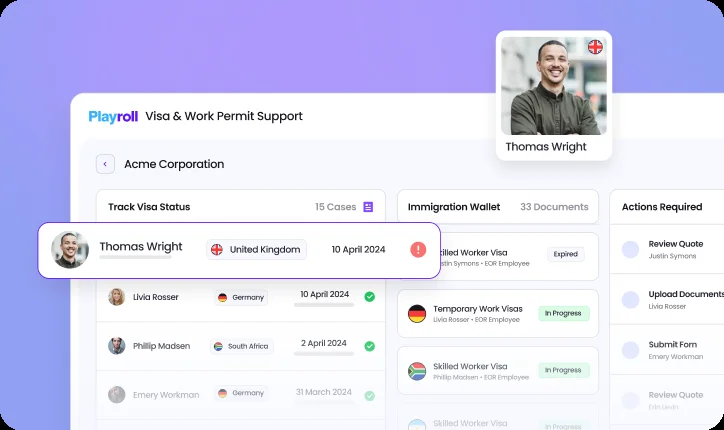
What Should You Consider When Choosing an Employer of Record in the United Kingdom?
If you’re evaluating EOR providers for the UK, here’s what I always recommend prioritising:
- Local Compliance & Regulatory Expertise: They should have an in-depth understanding of UK employment law and payroll rules, including PAYE reporting to HM Revenue & Customs (HMRC), Income Tax and National Insurance Contributions, Working Time Regulations, statutory holiday entitlement, sick pay, parental leave, and termination and redundancy requirements. Check that they also understand practical application of UK case law, not just statutory minimums.
- Entity Ownership vs. Subcontracting: EORs that own their UK entity, like Playroll, generally deliver cleaner PAYE payroll runs, faster onboarding, and clearer accountability. Providers that rely on local subcontractors must route payroll data, approvals, and issue resolution through third parties, which introduces extra handoffs, misaligned timelines, and limited control – often leading to delays, inconsistent processes, and slower issue resolution.
- In-Country Presence: Local specialists matter. With UK employment compliance being highly procedural and often driven by precedent, having local specialists on your team is critical for payroll adjustments, pension administration, employee relations, and handling terminations or redundancies correctly.
- Technology & Platform Capabilities: Look for automated PAYE payroll, employee self-service portals, holiday and absence management, benefits administration, integrations, and real-time HMRC reporting through Real Time Information (RTI) submissions.
- Pricing Transparency: Make sure you understand how your EOR fees will work. Also ask how they handle the details such as employer National Insurance Contributions, workplace pension costs, GBP ↔ USD currency conversion, benefits pricing, and any onboarding or offboarding charges.
- Payroll Reliability & Accuracy: UK payroll must follow strict HMRC timelines and RTI submission requirements. Errors in tax codes, National Insurance categories, or late filings can quickly trigger penalties or compliance reviews.
- Customer Support Responsiveness: UK employment is detail-heavy and process-driven. You’ll want fast, knowledgeable support for employee questions, payroll corrections, pension auto-enrolment issues, and UK-specific compliance guidance.
Estimated Cost for Hiring an Employee in the United Kingdom Through an EOR
UK Employer of Record pricing typically ranges from $399–$900 USD per employee per month, depending on role complexity, benefits, and payroll structure.
For example, hiring three employees through an EOR in the UK generally costs $1,197–$2,700 per month, which usually includes:
- UK-compliant employment contracts
- PAYE payroll processing
- Income tax and NIC withholding
- Workplace pension administration
- Statutory leave tracking
- Benefits administration
- Ongoing employee and employer support
Leading Employer of Record Providers in the United Kingdom
Below is a curated list of reputable EOR providers capable of supporting compliant hiring across the UK.
- Playroll: A global Employer of Record operating in 180+ countries with strong United Kingdom expertise. We offer fast onboarding, transparent pricing, AI-driven compliance checks, automated PAYE payroll workflows, and 24/5 customer support. You can expect expert guidance on HMRC payroll reporting, National Insurance Contributions, workplace pension auto-enrolment, statutory leave compliance, and termination and redundancy processes. Because we own our UK entity, we have boots on the ground and direct relationships with local providers, giving us first-hand insight into UK employment law and employment tribunal risk. Best for teams prioritising compliance accuracy, speed, and high-touch support when hiring in the UK.
- Deel: A well-known global EOR with its own UK entity. Deel delivers compliant UK employment contracts, PAYE payroll, pension auto-enrolment, and statutory benefits, supported by a highly automated, feature-rich platform. It’s a strong option for companies that value integrations and self-serve tooling, though it is generally more expensive than many alternatives.
- Remote: A global employment platform with solid coverage across the United Kingdom. Remote is known for intuitive onboarding flows, clear compliance documentation, and reliable handling of UK payroll and statutory benefits. However, some users report that the platform interface can feel confusing or difficult to navigate, particularly as teams scale or manage multiple countries.
- Multiplier: Provides global EOR service and suits smaller companies or first-time international/UK hires with its straightforward platform, relatively quick onboarding, and strong compliance (especially APAC). However, they lack dedicated support teams and invoicing is incredibly complicated.
- G-P (Globalization Partners): An enterprise-focused Employer of Record with mature processes around risk management, statutory benefits, and complex global hiring programmes. G-P is a strong fit for large or rapidly scaling organisations building a significant UK workforce. That said, pricing transparency is limited, and users frequently note additional fees for setup, FX, or administrative changes.
- Papaya Global: A payroll-centric global EOR with a strong analytics and business intelligence layer. Papaya Global helps organisations centralise payroll data across multiple countries, including the UK, making it appealing to finance-driven teams focused on reporting and automation. However, Papaya Global relies on third-party providers in the UK and does not own its own local entity, which can result in slower onboarding, payroll adjustments, and invoice processing.
- Native Teams: A flexible global employment platform offering EOR services, contractor management, and access to local benefits. Native Teams works well for distributed teams hiring in the UK as part of a broader multi-country workforce. Some users report slower onboarding times, limited depth in local compliance expertise, and an overreliance on email-based communication, which can create delays during setup and ongoing support.
Curious How Playroll Compares?
See how Playroll’s EOR offering stacks up against other globally recognized providers.
Compare Now
Insights from Real Users
Playroll
“What I like most about Playroll is how simple and reliable it makes everything. It takes away the stress of complex processes and lets me focus on what really matters. The platform feels intuitive, the support is responsive, and overall it gives me confidence that things are being handled the right way. It’s refreshing to use a solution that’s both efficient and genuinely user-friendly.”
- Verified G2 User
G-P
I really like G-P's platform because it's very intuitive and the employment generator contract is great and easy to use, which helps refine talent operations processing for hiring new FTE employees. Sometimes when we open a ticket, there can be a delay in response times or we're not updated as much as possible.
- Verified G2 User
Using an EOR vs. Setting Up an Entity in the United Kingdom
If you’re hiring your first employees in the United Kingdom, one of the biggest decisions you’ll face is whether to use an Employer of Record or incorporate a UK entity.
Use an EOR if:
- You need to hire quickly in the UK.
- You’re testing the UK market before making a long-term commitment.
- You want to avoid setting up PAYE payroll and ongoing reporting with HM Revenue & Customs (HMRC).
- You’re starting with a small team (typically fewer than 15 employees).
- You don’t want to manage workplace pension auto-enrolment, statutory benefits, and ongoing employment compliance internally.
Set up a UK entity if:
- You plan to scale beyond 20+ UK employees in the near term.
- You want a permanent UK business presence, offices, or VAT registration.
- You need licences, or long-term operational infrastructure.
Costs to consider:
- UK company incorporation: £12–£100
- Annual statutory filings, accounting, and bookkeeping: £3,000–£10,000+
- Payroll setup and compliance: £500–£3,000 initial (HMRC PAYE registration is free, but payroll software, setup, and advisory costs apply)
- Workplace pension setup and administration: £500–£2,000+ annually
- Ongoing HR and employment law support: £1,000–£5,000+ annually, depending on complexity
For most companies hiring their first UK employees, an Employer of Record is faster, safer, and more cost-effective than establishing a local entity. It allows teams to move quickly while avoiding the administrative burden and compliance risk that comes with PAYE payroll, pensions, and UK employment law.
That said, it’s important to confirm whether your chosen EOR owns its own UK entity rather than relying on third-party partners. A direct in-country presence typically means stronger local relationships, deeper understanding of UK employment law, faster issue resolution, and more reliable payroll execution.
Onboarding Process Through an EOR in the United Kingdom
Partnering with an EOR in the United Kingdom turns what can be a highly procedural, compliance-heavy process into a structured and predictable experience for both employers and employees. UK employment onboarding involves multiple regulators, strict timelines, and statutory obligations, and an EOR ensures each step is handled compliantly.
1. Collecting Required Information
The process begins with close coordination between you, the employee, and the EOR to gather the information required to legally employ someone in the UK.
Your responsibility as the employer:
- Confirm the role details, salary, working hours, and start date.
- Define the employee’s job responsibilities and reporting structure.
- Support the employee in providing accurate personal information. (An EOR will advise you on which documentation is required but it’s up to you and your team to gather it from your employees.)
What the EOR handles:
- Conducting right-to-work checks, ensuring the employee has legal authorisation to work in the UK and that documentation is verified and stored correctly.
- Collecting employee personal details, including address, date of birth, and National Insurance number (or managing interim processes if the NI number is pending).
- Gathering bank details for salary payments.
This step lays the foundation for compliant payroll, accurate tax withholding, and lawful employment from day one.
2. Issuing a Compliant Employment Contract
Once the core role details are confirmed, the EOR prepares a UK-compliant employment agreement. At this stage, you as the employer focus on approving the commercial terms of the role – such as compensation, working hours, job title, and any bonus or commission structure – while the EOR ensures those terms are reflected in a contract that complies fully with UK employment law.
The EOR drafts the agreement to include all legally required provisions, including notice periods, statutory holiday entitlement (a minimum of 5.6 weeks), working time requirements, sick pay eligibility, and statutory parental leave rights.
3. Setting Up Mandatory Payroll & Government Registrations
Once the employment contract is signed, the EOR completes all required UK registrations behind the scenes, typically within the first few days of employment to ensure full compliance from day one. These registrations ensure the employee is properly set up within the UK tax and social security system, with the EOR handling all reporting, deductions, remittances, and documentation through HM Revenue & Customs (HMRC).
This includes:
- Registering the employee under PAYE (Pay As You Earn) with HMRC: The EOR registers the employee for PAYE so Income Tax and National Insurance Contributions are automatically calculated and withheld from pay. Payroll data is reported to HMRC through Real Time Information (RTI) submissions, which must be filed on or before each pay run.
- Income Tax: Calculated based on HMRC-issued tax codes and withheld at source through PAYE.
- National Insurance Contributions (NICs): Employee NICs: Typically 8%–12% depending on earnings and thresholds. Employer NICs: 13.8% on earnings above the secondary threshold These contributions fund state pensions, healthcare, and other social benefits and must be calculated accurately each pay period.
- Configuring Payroll Cycles and Reporting: The EOR sets up payroll on the correct cycle (monthly in most UK roles) and ensures all RTI submissions, payslips, and year-end reporting obligations are met in line with HMRC requirements.
- Applying Statutory Employment Frameworks: Alongside payroll registration, the EOR configures statutory employment rules that apply nationally across the UK, including:
- Working Time Regulations: 48-hour average weekly working limit (with opt-out where applicable) and rest breaks and maximum working hours.
- Minimum Wage Compliance: Age-based National Minimum Wage and National Living Wage thresholds.
- Holiday Accrual Rules: Statutory minimum of 5.6 weeks paid annual leave.
- Statutory Leave Frameworks: Sick leave, maternity, paternity, adoption, and shared parental leave.
Because UK payroll operates on strict timelines and real-time reporting, errors at this stage – such as incorrect tax codes, late RTI filings, or misapplied NIC categories – can quickly trigger HMRC penalties. A UK-experienced EOR will make sure that each of these registrations are completed accurately and maintained on an ongoing basis.
4. Pension Auto-Enrolment & Statutory Benefits Setup
With payroll in place, the EOR sets up all mandatory UK benefits and statutory protections. You decide whether to offer benefits above the legal minimum and approve the associated costs as part of the employee’s total compensation.
The EOR is responsible for:
- Workplace pension auto-enrolment, including enrolling eligible employees into a compliant UK pension scheme.
- Managing employee communications, opt-outs, contribution deductions, and mandatory re-enrolment cycles.
- Applying statutory entitlements under UK law, including: paid annual leave (minimum 5.6 weeks), statutory sick pay (SSP), maternity, paternity, adoption, and shared parental leave.
- Administering any additional benefits offered, such as private medical insurance, life cover, or enhanced pension contributions.
5. Fast Activation and Ongoing Management
Once compliance is complete, the employee is ready to start! You manage the employee’s day-to-day work, performance, and integration into your team.
The EOR handles final payroll activation, the first salary payment, and ongoing PAYE reporting, tax remittances, and pension administration. They also monitor regulatory changes and support employee questions related to pay, benefits, and statutory rights. In most cases, UK employees can be fully onboarded within 24–72 hours, after which payroll runs automatically and compliance remains up to date.
Compliance Considerations for Hiring Employees in the United Kingdom
Hiring in the United Kingdom means operating within one of the most structured and employee-protective employment systems in the world. Rather than province-by-province rules, UK compliance is shaped by a combination of national legislation, detailed regulatory processes, and decades of employment tribunal and court precedent.
For employers, that means compliance isn’t a one-time setup task. It’s an ongoing exercise in applying UK employment rules consistently, accurately, and procedurally.
Here’s what employers should expect when hiring in the UK:
Need UK-Specific Guidance for Hiring Employees?
Our UK Hiring Guide breaks down employment law, PAYE payroll, pensions, statutory benefits, and key compliance risks.
Explore Guide Now
Key Takeaways
Hiring in the United Kingdom gives you access to an incredibly strong talent market and a mature, globally trusted business environment. But as many teams quickly discover, success in the UK hinges on getting the details right – from PAYE payroll and pensions to employment contracts and dismissal rules. The right Employer of Record makes all the difference, helping you hire faster, stay compliant, and give employees a great experience from day one.
If you’re looking for quick onboarding, reliable HMRC-compliant payroll, clear pricing, and hands-on local support, Playroll has you covered. Want to see what hiring in the UK looks like when it’s done properly?
Book a demo and we’ll show you how our on-the-ground team helps you hire confidently across the UK.

ABOUT THE AUTHOR
Jaime Watkins
Jaime is a content specialist at Playroll, specializing in global HR trends and compliance. With a strong background in languages and writing, she turns complex employment issues into clear insights to help employers stay ahead of the curve in an ever-changing global workforce.
7 EOR Services in the United Kingdom for 2026: Providers & Reviews FAQs
Can an EOR hire UK employees without a UK legal entity?

.png)
Yes, an EOR can employ staff in the UK on your behalf, but your company should still define management, performance, and compliance responsibilities in writing.
Who handles PAYE and National Insurance in a UK EOR model?
The employing entity runs PAYE payroll and National Insurance reporting, while clients should verify that filings, payments, and records are completed correctly.
Are right-to-work checks still required when using an EOR?
Yes, compliant right-to-work verification remains essential in UK hiring processes, and responsibilities should be clearly allocated between client and EOR.
How should companies compare UK EOR providers beyond headline price?
Compare contract clarity, payroll controls, response times, and support for onboarding and exits, not just per-employee pricing, to avoid hidden operational risk.
When should a company move from a UK EOR to its own entity?
Companies often reassess when headcount, margin impact, and long-term operational control needs make direct UK entity setup more cost-effective than ongoing EOR fees.

Back to Top
.svg)










.svg)