.svg)
.svg)

Thousands of global businesses can't be wrong.
Sign up for free and explore global hiring with Playroll.


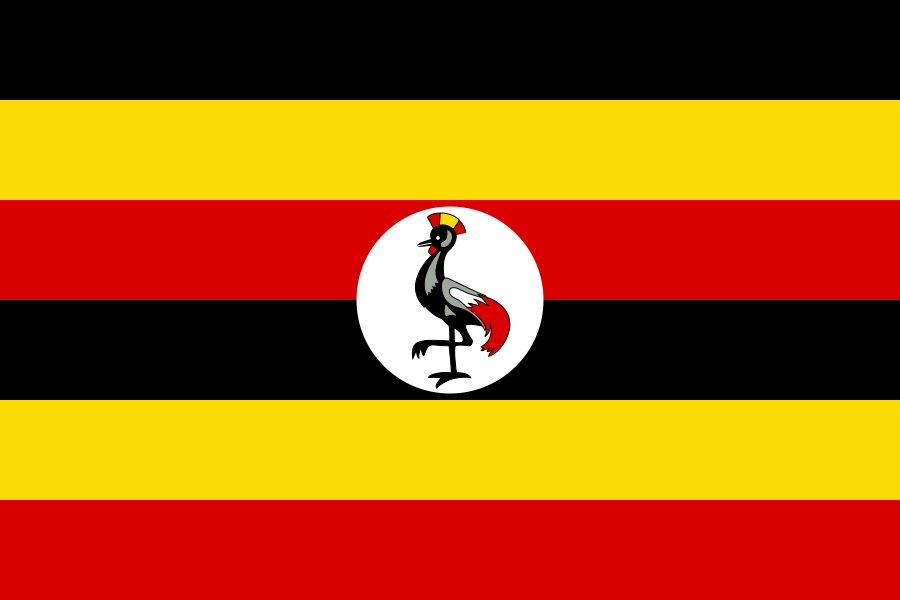

Uganda Public Holiday Regulations
In Uganda, public holidays are generally treated as paid days off for employees who would normally work on those days, with additional pay or time off in lieu if they are required to work. Most holidays are national rather than regional, and when a holiday falls on a Sunday it is typically observed on the following Monday, resulting in around 15–16 observed public holiday dates in 2026.

Thousands of global businesses can't be wrong.
Sign up for free and explore global hiring with Playroll.
List of Public Holidays in Uganda (2026)
Uganda recognises a mix of secular and religious public holidays that your company must factor into scheduling and payroll. The table below lists the key national public holidays for 2026, including likely observed days when a holiday falls on a Sunday.
Do Employers Have to Provide Paid Leave on Public Holidays?
Yes, under Ugandan labour practice, employees who normally work on the day a public holiday falls are generally entitled to a paid day off when that day is declared a public holiday. If your employees are required to work on a public holiday, they are typically entitled to premium pay and/or an alternative paid day off, as set out in their employment contracts, collective agreements or company policy, provided these meet or exceed statutory minimums.
Public holidays in Uganda are national rather than regional, so the same core list applies across the country, although the exact dates of Islamic holidays are confirmed each year by government notice. When a public holiday falls on a Sunday, it is commonly observed on the following Monday, and you should treat that Monday as the paid holiday for employees who would usually work that day.
For part‑time and shift workers, the usual approach is that a public holiday is paid only if it falls on a day they would ordinarily have worked. If your company operates a roster system, you should clearly document how public holiday pay is calculated, including any pro‑rating for irregular hours, and apply the rules consistently to avoid discrimination risks.
Legal Penalties for Not Providing Paid Holiday Leave
Uganda’s employment legislation is enforced primarily by the Ministry of Gender, Labour and Social Development and labour officers, who can investigate complaints about non‑payment of wages or public holiday entitlements. If your company fails to provide paid public holidays or agreed premium pay for work performed on those days, you may be ordered to pay arrears of wages, interest and, in some cases, additional compensation to affected employees.
Persistent or deliberate non‑compliance can expose your organisation to fines and, in serious cases, prosecution under employment and occupational safety laws. Disputes may also be escalated to labour tribunals or courts, which can issue binding orders and award damages. Beyond direct legal penalties, non‑payment of holiday entitlements can damage your employer brand, increase turnover and trigger union or collective action.
Common mistakes include treating public holidays as unpaid leave, failing to recognise observed days when a holiday falls on a Sunday, not applying premium rates for employees who work on holidays, and inconsistent treatment of part‑time or casual staff. Keeping clear written policies, accurate time records and payslips is essential if you need to demonstrate compliance during an inspection or dispute.
How Do Holidays Affect Overtime Thresholds?
In Uganda, public holidays interact with working time and overtime rules by changing what counts as “normal” working hours for that week. A public holiday that is taken as a paid day off should not be treated as hours worked when you calculate whether an employee has exceeded their standard weekly hours for overtime purposes.
When an employee works on a public holiday, many Ugandan employers apply a premium rate for those hours – often at least the same as, or higher than, the contractual overtime rate – or grant an equivalent paid day off in lieu. The exact multiplier is usually set out in the employment contract or collective agreement, provided it respects statutory minimums and any sector‑specific rules.
To stay compliant, you should clearly separate three elements in your payroll system: the paid holiday hours (counted as paid but not worked), the actual hours worked on the holiday (often paid at a premium rate), and any overtime hours above the normal daily or weekly threshold. This helps you avoid underpaying employees who both work on a holiday and exceed their standard hours in the same pay period.
Stay 100% Compliant with Leave Regulations Using Playroll
Managing Uganda's public holidays and leave rules doesn’t have to be complex. Playroll keeps you 100% compliant by automatically tracking local holidays, observed days, and pay requirements – so your team is paid correctly and on time, every time.
Whether you’re hiring your first employee or scaling a growing team, Playroll lets you employ talent without setting up a local entity. We handle compliant contracts, benefits, and payroll in one platform, so you can reduce compliance risk and focus on growing your business while we take care of the heavy-lifting in the background. Book a chat with our team to get started.

Never Miss a Leave Law Update — Stay 100% Compliant
01
Reach out to playroll
We’ll handle payroll, leave and benefits for your team, anywhere in the world.
02
Track Leave With Ease
Review, approve, and manage leave in line with local laws, all in one place.
03
Gain Hands-on Support
Each employer and employee gets support to promptly resolve queries.
04
Stay Up to Date With Regulations
We’ll keep you updated on changes in leave entitlements and regulations.


.svg)




.svg)