.svg)
.svg)

Thousands of global businesses can't be wrong.
Sign up for free and explore global hiring with Playroll.


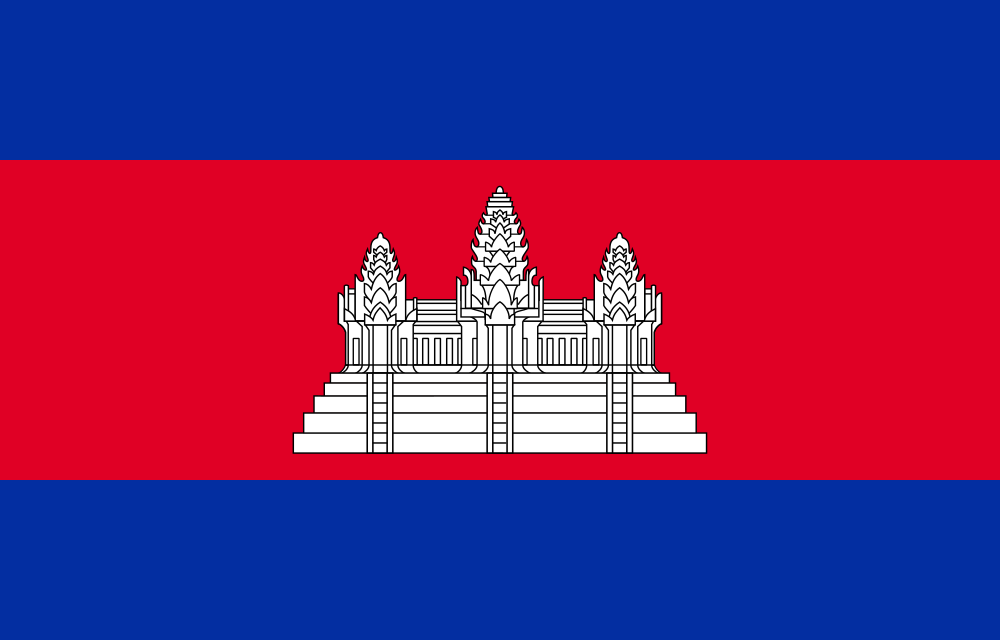

Cambodia Public Holiday Regulations
Most public holidays in Cambodia are treated as paid days off for employees when they fall on a normal working day, and they are observed nationwide rather than regionally. If a holiday falls on a Sunday, the following working day is typically observed. In 2026, Cambodia is expected to have around 20–22 public holidays, but the official list and exact count are confirmed each year by government sub‑decree.

Thousands of global businesses can't be wrong.
Sign up for free and explore global hiring with Playroll.
List of Public Holidays in Cambodia (2026)
Cambodia sets its official public holidays each year by government sub‑decree, and dates can change, especially for lunar and religious observances. The list below reflects commonly recognised holidays and likely 2026 dates, but you should always confirm against the official annual sub‑decree.
Do Employers Have to Provide Paid Leave on Public Holidays?
Yes, under Cambodian labour law, public holidays that are officially declared by the Royal Government are generally treated as paid days off for employees when they fall on a normal working day. Employees who are paid monthly, daily or by piece are typically entitled to their normal pay for these days without any reduction in salary, provided they are otherwise in active employment and not on unpaid leave.
Public holidays are national rather than regional, so the same list applies across Cambodia, although the government may adjust the list or dates each year by sub‑decree. If a public holiday falls on a Sunday, the following working day is usually observed as the paid day off. Where a holiday falls on an employee’s scheduled rest day other than Sunday, practice can vary, so you should check the current sub‑decree and, where relevant, your collective bargaining agreement or internal policy.
For part‑time employees, the safest approach is to provide paid holiday leave on a pro‑rated basis aligned with their normal work schedule. If a public holiday falls on a day when a part‑time employee would not ordinarily work, Cambodian law does not clearly require an additional paid day, but many employers adopt a consistent, pro‑rated policy to avoid disputes and to align with good practice.
If employees are required to work on a public holiday, they are still entitled to their normal holiday pay plus premium pay for the hours worked. In practice, this means you should treat the day as a paid holiday and then apply the relevant overtime or holiday work premium on top of the base salary.
Legal Penalties for Not Providing Paid Holiday Leave
Failure to respect public holiday entitlements in Cambodia can expose your company to administrative fines, back‑pay orders and, in more serious or repeated cases, additional sanctions. The Ministry of Labour and Vocational Training (MLVT) is the main enforcement authority and can conduct inspections, review payroll records and interview employees.
If inspectors find that employees were not paid correctly for public holidays or were denied their entitled days off, they can order you to pay arrears of wages, including any applicable premium rates, and impose monetary penalties under the Labour Law and related regulations. Non‑compliance can also affect your company’s reputation with regulators and may complicate future licensing or immigration processes for foreign staff.
Common employer mistakes include failing to update internal calendars when the government issues the annual sub‑decree, miscalculating premium pay for work performed on holidays, and applying inconsistent rules to part‑time or probationary staff. To reduce risk, you should keep written policies, maintain accurate time and attendance records, and ensure your local payroll provider or in‑house team tracks the official holiday list each year.
How Do Holidays Affect Overtime Thresholds?
In Cambodia, work performed on a public holiday is treated differently from standard overtime on a normal working day. Employees who work on an official public holiday are generally entitled to their normal daily wage for the holiday plus premium pay for the hours worked on that day, often at a higher rate than standard overtime. While exact percentages can vary depending on the nature of the work and the time of day, the principle is that holiday work should be compensated at a premium above the employee’s regular hourly rate.
Holiday work also counts toward daily and weekly working time limits. If an employee’s hours on a holiday push them beyond the standard maximum working hours, those additional hours should be treated as overtime and paid at the applicable overtime rate on top of the holiday premium. Night work or hazardous work on a public holiday may attract further uplifts, so you should review the Labour Law, implementing regulations and any sector‑specific rules that apply to your operations.
Because the rules are technical and can change, many global employers in Cambodia adopt a conservative approach: treat all hours worked on a public holiday as overtime at the highest applicable premium rate, and document the calculation clearly on payslips. This helps you demonstrate good‑faith compliance if the MLVT reviews your payroll.
Stay 100% Compliant with Leave Regulations Using Playroll
Managing Cambodia's public holidays and leave rules doesn’t have to be complex. Playroll keeps you 100% compliant by automatically tracking local holidays, observed days, and pay requirements – so your team is paid correctly and on time, every time.
Whether you’re hiring your first employee or scaling a growing team, Playroll lets you employ talent without setting up a local entity. We handle compliant contracts, benefits, and payroll in one platform, so you can reduce compliance risk and focus on growing your business while we take care of the heavy-lifting in the background. Book a chat with our team to get started.

Never Miss a Leave Law Update — Stay 100% Compliant
01
Reach out to playroll
We’ll handle payroll, leave and benefits for your team, anywhere in the world.
02
Track Leave With Ease
Review, approve, and manage leave in line with local laws, all in one place.
03
Gain Hands-on Support
Each employer and employee gets support to promptly resolve queries.
04
Stay Up to Date With Regulations
We’ll keep you updated on changes in leave entitlements and regulations.


.svg)




.svg)