.svg)
.svg)

Thousands of global businesses can't be wrong.
Sign up for free and explore global hiring with Playroll.


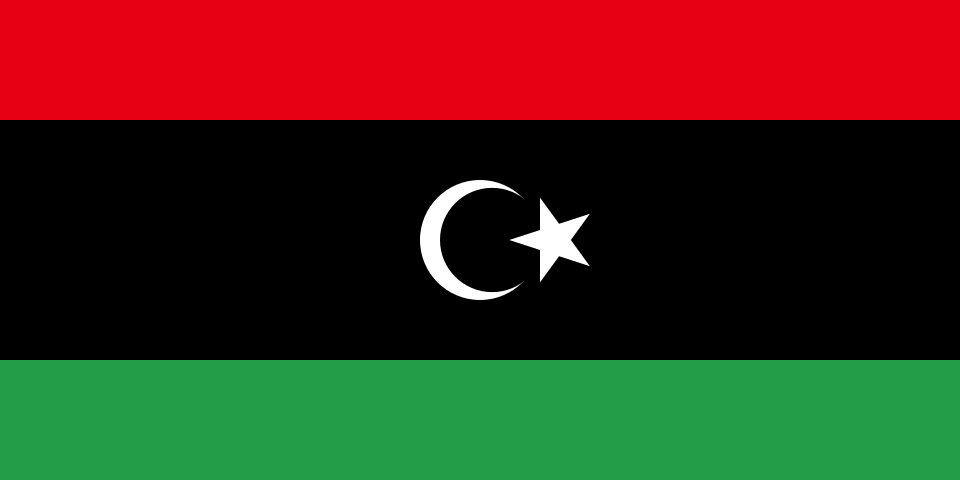

Is Severance Pay Mandatory in Libya?
Yes, severance pay is generally mandatory in Libya under the Labour Law No. 12 of 2010 and related regulations, particularly where employment ends without serious misconduct or on economic or organizational grounds. Severance is typically determined by the employee’s length of service and final wage, based on statutory end-of-service benefits and any more generous terms in the employment contract or collective agreement.

Thousands of global businesses can't be wrong.
Sign up for free and explore global hiring with Playroll.
Which Employees Qualify for Severance Pay?
- Employees working under indefinite-term contracts who are dismissed for reasons other than serious misconduct generally qualify for end-of-service severance.
- Employees terminated due to redundancy, restructuring, or economic reasons usually qualify if statutory procedures are followed.
- Fixed-term employees may qualify if their contract is ended early by the employer without a valid legal reason.
- Employees who resign for employer breach (such as non-payment of wages or unsafe conditions) can in some cases be treated as unfairly dismissed and qualify.
- Workers with continuous service meeting minimum tenure thresholds under Libyan law or contract terms are more likely to qualify.
- Employees covered by collective agreements or company policies that promise severance will qualify under those more favorable terms.
What Are the Legal Timelines for Paying Severance?
In Libya, the safest practice is to pay all severance and accrued entitlements on or very shortly after the employee’s final working day. While the Labour Law does not always specify a precise number of days, authorities expect prompt settlement and may treat long delays as a violation of wage payment rules. Your company should aim to calculate severance as soon as notice is given, obtain the employee’s sign-off on the calculation, and pay no later than the date of termination or within the next regular payroll cycle. For mass redundancies or restructurings, build in extra time to verify service records and approvals, but still keep payments within a clearly documented and reasonable timeframe. Always document payment dates and methods in case of inspection or dispute.
What Penalties Apply if Severance Is Not Paid Correctly?
If your company fails to pay severance correctly in Libya, you risk financial, administrative, and reputational consequences. Labour inspectors and courts can intervene where employees complain, and non-compliance can escalate into broader scrutiny of your employment practices. Under Libyan Labour Law, unpaid severance can be treated as unpaid wages, exposing you to back-pay orders, potential fines, and legal costs. Disputes may also delay business operations, especially if they involve group terminations or foreign staff.
- Courts can order payment of outstanding severance plus any other unpaid entitlements.
- Labour authorities may impose fines or administrative sanctions for repeated or serious breaches.
- Employees can claim compensation for unfair dismissal if severance and procedures were mishandled.
- Non-compliance can complicate work permit or licensing processes for foreign-owned companies.
- Reputational damage can affect hiring, retention, and relations with unions or works councils.
Does Outsourcing Employment via an EOR Change Severance Liability?
Using an Employer of Record (EOR) such as the service described at Employer of Record does not remove the need to comply with Libyan severance rules, but it can shift day-to-day liability and administration. In a typical EOR model, the EOR is the legal employer in Libya and is directly responsible for calculating and paying severance under local law. Your company, as the client, still bears commercial and contractual responsibility to fund those costs and to instruct the EOR on lawful termination grounds. If you push for a termination that breaches Libyan law, you may face indemnity claims from the EOR and reputational risk, even if the EOR is the formal employer. A well-drafted EOR agreement should clearly allocate severance funding, decision-making authority, and dispute-handling responsibilities.
Be 100 Percent Compliant in Offering Severance with Playroll
Managing severance in Libya can be challenging, especially when you are balancing local labour law, internal policies, and cross-border headcount planning. Playroll helps your team translate Libyan statutory rules into clear, predictable processes, from tracking length of service to modeling severance costs before you make termination decisions. With localized expertise, you can standardize approvals, avoid ad hoc deals, and ensure every departing employee is treated consistently and fairly.
When you engage Playroll as your global employment partner, we help you design compliant contracts, set realistic notice and severance terms, and coordinate payments through secure, auditable channels. Our team monitors legal changes in Libya, flags risks early, and supports you through sensitive exits, whether it is a single role or a broader restructuring. That way, your company can stay focused on strategy while knowing that severance and end-of-service obligations are handled correctly every time.

Handle Terminations Smoothly and Compliantly
01
Reach out to playroll
We’ll manage compliant onboarding and offboarding for your global team.
02
Accurate Severance Pay
Our payroll experts manage severance payouts in compliance with local laws.
03
Get Hands-On Support
Employers and employees receive personalized support for any queries.
04
Stay Current With Regulations
We’ll alert you to any updates in severance pay or employment compliance.


.svg)




.svg)