.svg)
.svg)

.svg)
.svg)

Copied to Clipboard

Ready to get Started?


In short, the main pros of hiring international employees include access to global talent pools, reduced office costs, increased team diversity, and local market insights; while the cons include compliance complexity, time zone challenges, and cultural differences that require careful management.
Pros and Cons at a Glance:
- Pros: Access to global talent, reduced office space costs, increased diversity and innovation, local market insights for expansion
- Cons: Legal and compliance complexity, time zone and communication challenges, cultural differences, entity setup costs
But global hiring isn’t without complexity. From compliance and payroll to alignment in cultural backgrounds and operational overhead, the challenges of hiring international employees are real. In this guide, we’ll break down the pros and cons and share practical strategies to help you navigate them effectively.
What Are the 4 Biggest Advantages of Hiring International Employees?
If you're exploring global hiring, you likely already see the upside of hiring international employees. But it's still worth stepping back and looking at the advantages clearly because understanding what you gain makes it much easier to manage the trade-offs that come with it.
Pro #1: Hiring International Employees Reduces Office Space Costs
Office space used to be one of the highest fixed costs on your balance sheet. That's changed. With remote work now firmly established (and supported by updated labor frameworks in many countries that formally recognize remote and hybrid arrangements), you're no longer tied to a physical footprint in the same way.
Many companies have reduced or even eliminated offices altogether, while others are rethinking how they use space. Either way, global hiring gives you the flexibility to scale your team without scaling your real estate costs.
It's not just a win for your business. Your team benefits too, less commuting, more flexibility, and often better work–life balance. That's increasingly important as employee expectations continue to shift globally.
Pro #2: Hiring Internationally Improves Cost Efficiency Without Sacrificing Quality
Hiring globally doesn't only result in lower costs, but it can actually result in better value for your money.
Talent markets vary significantly by region. Compensation expectations, availability of skills, and local economic conditions all play a role. When you expand your hiring footprint, you're no longer limited to one market's salary benchmarks or talent shortages.
At the same time, the quality of talent available globally has never been higher. Countries invest heavily in different areas of expertise, and global skills data continues to show strong regional specializations across tech, operations, and professional services.
The result is simple: you can often hire highly qualified employees at a more sustainable cost, without compromising on capability.
Pro #3: International Hiring Diversifies Your Team and Reduces Business Risk
Start thinking about hiring foreign nationals as a resilience strategy rather than just a cost savings and talent acquisition strategy.
When your workforce is spread across regions, you're less exposed to local disruptions, whether that's economic shifts, regulatory changes, or talent shortages in a single market. At the same time, you're building a more diverse organization.
And that diversity delivers measurable impact. Research from BCG shows that companies with above-average diversity on their leadership teams report 19% more innovation revenue than companies with below-average leadership diversity. Different perspectives lead to better problem-solving. This is especially true in complex, fast-moving environments.
For global employers, this also aligns with evolving expectations around fair hiring practices, pay transparency, and inclusive workplaces, which are increasingly reflected in regulations across the U.S., EU, and beyond.

Pro #4: International Employees Provide Talent That Strengthens Your Market Reach
When you hire employees internationally, you are essentially adding local insight: employees based in different regions bring an understanding of language, culture, and market dynamics that's difficult to replicate from the outside. That can shape everything from product decisions and company culture to customer experience and go-to-market strategy.
In many cases, this allows you to enter or expand into new markets more confidently and without relying as heavily on external consultants or third parties.
In short, global hiring doesn't just help you build a stronger team. It helps you build a smarter, more adaptable business.
Hire Globally Without Setting Up Entities
Hire international employees as full-time, compliant team members with Playroll – without the cost and complexity of setting up local entities.
Learn More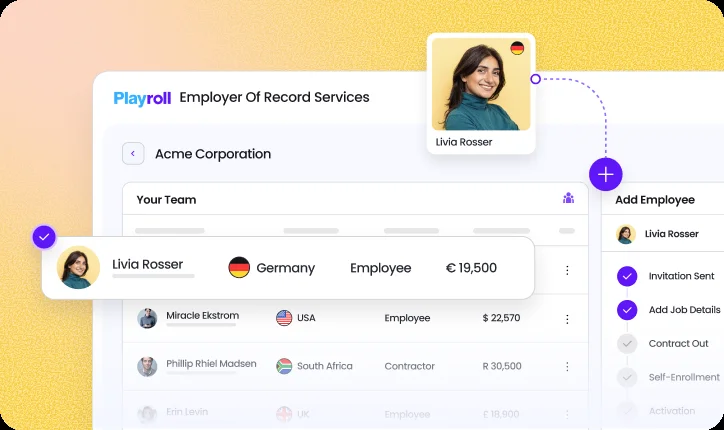
What Are the 4 Biggest Challenges of Hiring International Employees?
While global hiring can open up great opportunities, it can also introduce real complexity. If you understand where things can go wrong, you can put the right structures in place early and avoid costly mistakes later.
Con #1: Legal and Compliance Complexity Creates Real Liability Exposure
Every country has its own employment rules, and they're not optional. You need to comply with local laws on classification, termination, statutory benefits, tax withholding, notice periods, and working time. For example, in Germany, employers must provide statutory health insurance, while in Brazil, the 13th-month salary is mandatory.
Regulators are paying closer attention, especially to misclassification. Authorities in the U.S., UK, and EU have stepped up enforcement, with penalties that can include back pay, fines, and forced reclassification.
Data protection adds another layer. Laws like GDPR set strict standards for handling employee data across borders. Without local expertise, compliance risk builds quickly.
Con #2: Operational and Payroll Complexity Increases at Scale
Running payroll across multiple countries isn't just more work – it's fundamentally different work. You're managing multiple currencies, payroll cycles, and filing deadlines. Some countries require monthly reporting, others quarterly and errors can lead to penalties.
Benefits vary widely too. This includes mandatory pensions, healthcare, or 13th-month salaries depending on the country.
Add time zones into the mix, and coordination becomes a daily challenge. Without the right systems, the admin load grows fast.
Con #3: Cultural and Communication Barriers Create Management Challenges
Hiring foreign employees brings different languages, norms, and ways of working. Without structure, that can lead to misalignment.
Strong onboarding is your first line of defense. Clear processes, documented workflows, and defined communication channels make a big difference early on. You'll also need simple, consistent communication norms – how your team collaborates, shares feedback, and handles issues across time zones.
Invest in connection too. Small efforts in team building and inclusive management go a long way in turning diversity into a strength.
Con #4: Entity Setup Costs and Local Barriers to Entry
In most countries, hiring international workers directly means setting up a local entity. That takes time, money, and ongoing administrative effort.
Even after setup, you're responsible for local payroll, tax filings, and compliance with employment laws.
If you're hiring in just one or two markets, that overhead rarely makes sense.
That's why many companies consider partnering with an Employer of Record (EOR). An Employer of Record is a third-party organization that legally employs workers on behalf of another company, handling payroll, contracts, taxes, and compliance in the employee's country. It lets you hire full-time employees legally in new markets without opening entities, while staying compliant with local regulations and reducing operational burden.
When Does It Make Sense to Hire Internationally?
Global hiring isn't the right move for every company at every stage. However, it can act as a powerful growth lever (rather than just a hiring tactic) in the right context.
Here's a simple way to evaluate whether it makes sense for your business:
- You're struggling to hire locally: Talent shortages in your home market are slowing growth, driving up salaries, or extending time-to-hire. Expanding your search globally can unlock faster, more cost-effective hiring.
- You need specialized or hard-to-find skills: Certain roles are more concentrated in specific regions. Hiring internationally gives you access to deeper talent pools with the expertise your team needs.
- You're expanding into new markets: Local employment can help you understand customer behavior, navigate regulations, and build credibility in new regions.
- You have the operational maturity to support it: Global hiring adds complexity. You'll need clear processes, strong onboarding, and the ability to manage compliance, payroll, and communication across borders.
If you're checking most of these boxes, international hires are likely worth exploring. This is especially true if you have the right infrastructure or partners in place to support it.
How to Hire International Employees Legally and Safely
Once you've decided to hire globally, the next question is how to hire foreign employees the right way. Compliance isn't optional ,and getting it wrong can mean fines, back taxes, and employee disputes.
There are three main ways to hire internationally, each with different levels of control, cost, and complexity:
1. Open a local entity
Setting up a legal entity in the country where you want to hire gives you full control. You employ workers directly, run local payroll, and manage compliance yourself.
This approach makes sense if you’re building a long-term presence in a specific market.
But it comes with overhead. Entity setup can take months, and you’ll need to register for payroll taxes, comply with local labor laws, and manage ongoing filings. In many countries, you’re also required to provide statutory benefits, follow strict termination rules, and meet local reporting requirements.
This may be the most comprehensive option but it’s also the most resource-intensive.
2. Use an Employer of Record (EOR)
An Employer of Record allows you to hire full-time employees in another country without setting up a local entity.
The EOR becomes the legal employer on paper and handles employment contracts, payroll, tax withholding, and statutory benefits in line with local laws. You still manage the employee’s day-to-day work, just like any other team member.
This model has become increasingly popular as regulations tighten around worker classification and cross-border employment. It offers a faster, lower-risk way to hire internationally while staying compliant with local labor and tax requirements.
For many companies, it’s the most practical way to test new markets or scale distributed teams without taking on entity-level complexity.
3. Work compliantly with contractors
Hiring independent contractors can be a flexible option, especially for short-term or project-based work.
But it’s important to get classification right. Many countries have strict rules that distinguish contractors from employees based on factors like control, exclusivity, and integration into your business.
Regulators in regions like the U.S., UK, and EU are increasingly enforcing these rules. Misclassification can result in penalties, backdated taxes, and mandatory employee benefits.
If the role looks and operates like employment, it usually needs to be structured as employment.
Simplifying International Hiring with Playroll
Global hiring offers a gateway to better talent, and helps you build stronger resilience and smarter cost structures. But it comes with real complexity. The key is choosing a setup that balances speed, compliance, and simplicity as you scale.
With Playroll, you can hire full-time employees globally without setting up local entities. We handle contracts, payroll, taxes, and compliance so you can focus on building your team instead of managing red tape. Book a demo to start scaling without the complexity.
- Global hiring unlocks access to talent, cost savings, and market expansion, but requires careful planning around compliance and operations.
- The biggest risks are legal compliance and worker misclassification; with regulators in the U.S., UK, and EU increasing enforcement and penalties.
- An Employer of Record (EOR) offers the fastest, lowest-risk path to hiring internationally without setting up local entities.
- Diverse, distributed teams drive measurable business outcomes; including 19% higher innovation revenue according to BCG research.
- Success depends on operational maturity; including strong onboarding, clear communication norms, and the right compliance infrastructure.

ABOUT THE AUTHOR
Milani Notshe
Milani is a seasoned research and content specialist at Playroll, a leading Employer Of Record (EOR) provider. Backed by a strong background in Politics, Philosophy and Economics, she specializes in identifying emerging compliance and global HR trends to keep employers up to date on the global employment landscape.
Hiring International Employees FAQs
What are the pros and cons of hiring international employees?

.png)
The main pros include access to global talent pools, reduced office costs, increased team diversity, and local market insights for expansion. The main cons include legal and compliance complexity, time zone challenges, cultural differences, and entity setup costs.
Is it legal to hire employees in another country?
Yes, it is legal to hire employees in another country, but you must comply with that country's employment laws, tax requirements, and labor regulations—either by establishing a local entity or partnering with an Employer of Record (EOR).
What are the benefits of hiring international employees?
The key benefits include access to a wider talent pool, cost efficiency through regional salary differences, increased team diversity that drives innovation, and local market knowledge that supports international expansion.
What are the biggest risks when hiring internationally?
The biggest risks come down to compliance and misclassification. Each country has its own labor laws, tax rules, and termination requirements, and getting these wrong can lead to fines, back payments, or legal disputes. Misclassifying employees as contractors is a common issue, with regulators in the U.S., UK, and EU increasing enforcement. There's also risk around data protection – especially under laws like GDPR – and failing to meet local employment standards.
How should companies manage time-zone gaps in international teams?
Companies should set protected overlap windows, document handoff protocols, and default to asynchronous updates for non-urgent work so global teams maintain output quality without creating unsustainable meeting loads.

Back to Top
.svg)









.svg)