.svg)
.svg)

.svg)
.svg)

Copied to Clipboard

Ready to get Started?

Key Takeaways
The most effective tools reduce admin, surface risks, and highlight patterns so HR teams can make better human judgments.
With AI now embedded in core HR operations, leaders are under pressure to prove measurable outcomes while staying compliant with evolving global regulations and data-privacy laws.
Tools grounded in verified employment, payroll, and legal expertise help teams navigate real-world complexity – something broad, internet-trained models simply can’t do reliably.
In today’s hiring landscape, the question isn’t really whether to use AI HR software or not – it’s how to balance speed with humanity. It’s a global catch-22 scenario playing out where HR teams are expected to move faster than ever, keep up with constant market shifts, and run increasingly complex operations, all while preserving empathy and trust in moments that directly shape people’s working lives. Staying competitive now requires hyper-efficiency and fluency in new tools, but not at the expense of the human touch that defines good HR.
That tension is only intensifying. According to SHRM’s 2026 State of the Workplace report, 92% of CHROs expect AI to be more deeply embedded in workforce operations, and 43% of organisations already use AI in HR – up from 26% just two years ago. Forbes notes that while 2025 was about experimentation, 2026 marks a shift toward accountability: 74% of CEOs say their success now depends on delivering measurable AI outcomes.
Below, we'll explore the AI tools human resources teams are using in 2026 through that lens – where they reduce friction, surface risks, support fairness, and help teams make more informed, human decisions rather than fewer.
What Are the Best HR GPT for Global Teams in 2026?
AI tools in HR aren’t all trying to solve the same problem. Some exist to reduce administrative load, others to surface patterns or risks that are easy to miss at scale. In fast-growing and globally distributed organizations, the most useful tools are those that improve your judgment, rather than attempting to replace it.
The tools below are widely used in 2026 – but their value depends heavily on how intentionally they’re applied.
Best AI Tools for HR: Compliance & Employment Law
Everyone wants the do-it-all AI – the tool that can tell you who to hire, where to hire them, how to stay compliant, and which local rule you’re about to forget. That promise is especially attractive in global HR, where decisions move quickly and the cost of getting something wrong isn’t always obvious at the point you make it.
Used well, select compliance AI for HR teams can help you pressure-test key business decisions and catch risk early.
So what does this look like in practice? Let’s take a look at a few tools that can help you and your team do just that.
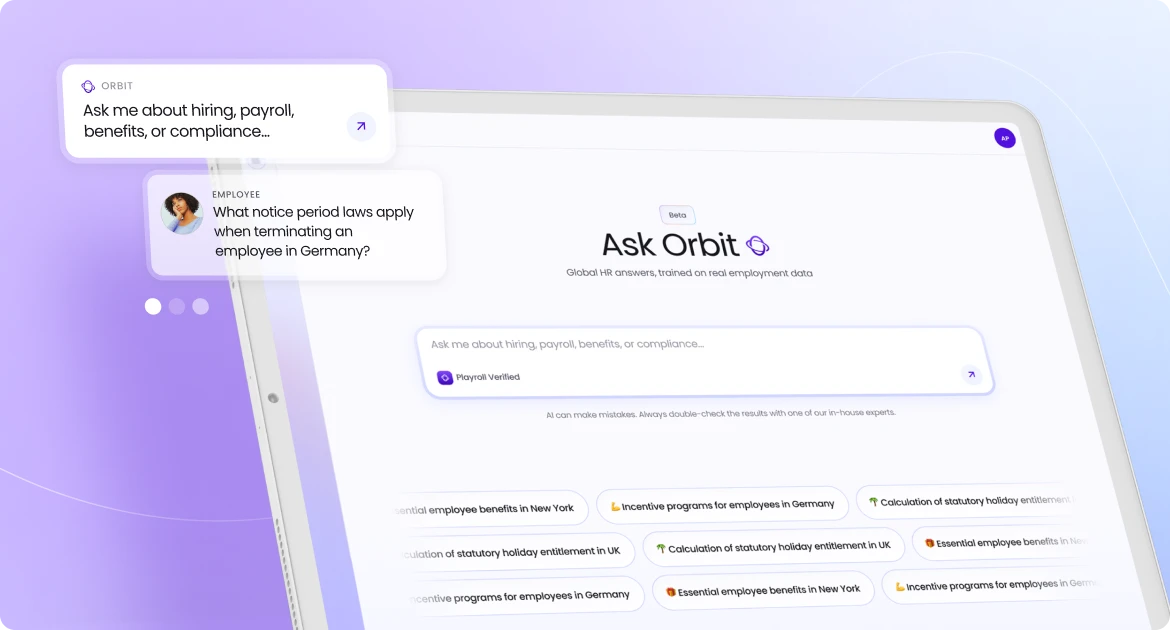
- Playroll Orbit (HR-GPT): Best for Global HR Compliance. If you’re going to lean into generative AI tooling to mitigate international payroll risk, you want something built on real HR know-how – not generic internet scraping that gives you surface-level answers. We couldn’t find a tool that we fully trusted to do that, so we built one. Rather than pulling answers from broad text on the web, Orbit is powered by verified, up-to-date employment, payroll, and compliance knowledge from Playroll’s own HR, legal, and payroll professionals.
- Deel AI: Commonly used by teams hiring or paying workers through Deel’s platform to quickly understand local employment and payroll requirements across multiple countries. It helps HR teams sense-check compliance details during onboarding or contract setup, with guidance closely tied to Deel’s execution workflows.
- Papaya Global: Used primarily for monitoring and validating global payroll across complex, multi-country setups. HR and finance teams rely on it to spot anomalies, support compliance checks, and maintain consistency across regions, particularly in larger or more mature payroll operations.
- Remote AI: Typically used by teams hiring internationally through Remote to support compliance workflows tied to employment and contractor management. It helps HR teams navigate local requirements and worker classification considerations when scaling distributed teams into new jurisdictions.
Built For The Questions Hr Teams Actually Ask
Orbit supports global hiring and payroll decisions using data verified by real HR, legal, and payroll experts across 180+ countries, meaning insights are grounded in practice, not theory.
Explore Orbit
Best AI Tools for HR: Recruiting & Talent Acquisition
Recruiting is often where HR teams first encounter AI tools, largely because it’s one of the most admin-heavy parts of the job – and one that repeats itself constantly. Screening applications, coordinating interviews, and keeping multiple stakeholders aligned all happen at pace, and the workload scales quickly as hiring ramps up.
In that context, inefficiencies don’t stay hidden for long. They show up as delays, dropped candidates, inconsistent assessments, or burned-out teams. AI shines when it takes care of this type of repetitive work that slows everything else down.
HR teams typically use these AI-driven tools:
- HireVue: Commonly used to sort and assess large volumes of candidates through structured video interviews and standardised assessment frameworks. This helps teams apply consistent criteria early on, particularly in high-volume or enterprise hiring, without relying solely on manual screening.
- Pymetrics: Used to add behavioural data into early screening, helping teams understand candidate traits and potential fit beyond CVs alone. Often positioned as a way to introduce more consistency – and reduce reliance on gut feel – at the top of the funnel.
- Paradox (Olivia): Primarily used to handle candidate engagement and interview scheduling. By automating screening questions and coordinating calendars, it removes one of the biggest administrative bottlenecks in recruiting – especially at scale.
- Eightfold AI: Used for skills-based matching across large candidate pools, helping teams connect roles to relevant experience more efficiently. It’s often applied where organisations want to move away from keyword-heavy CV screening and toward a broader view of skills and potential.
Tools like these are used when hiring volume increases. Their primary value is to reduce noise and administrative load early on, creating space for more thoughtful, human decision-making later in the process.
Best AI Tools for HR: Employee Experience & HR Support
As organisations grow, HR teams often find themselves answering the same questions again and again – about leave, benefits, policies, or how a process works in practice. None of these questions are unimportant, but when they stack up, they can pull time and attention away from the situations that really need a human response.
Why not use reliable AI solutions to answer the more generic questions for you? They take care of the routine and repeatable, so HR teams can be more present when context, discretion, or empathy matter the most.
HR teams typically use these tools:
- Leena AI: Commonly used as an HR self-service layer to answer routine employee questions about policies, benefits, and processes. It helps reduce repeat queries and ticket volume, giving HR teams more space to focus on issues that require context, discretion, or empathy.
- Moveworks: Used in larger organisations to support employee requests across HR and IT through a single conversational interface. Its strength lies in routing and resolving common issues quickly, particularly in distributed environments where response time and consistency matter.
- Resolve: Often used to manage and streamline HR case workflows, helping teams track requests, route issues to the right stakeholders, and maintain visibility across regions. It’s particularly useful where employee support needs to scale without losing structure or accountability.
- Playroll Orbit (HR-GPT): Used by global HR teams to sense-check hiring, payroll, and compliance questions across countries. Unlike generic AI tools, Orbit is built on verified employment and payroll knowledge from HR, legal, and payroll experts – making it especially valuable when accuracy, local nuance, and risk reduction matter.
The nuance is important. AI can surface risks and prompt better questions, but it can’t reconcile local interpretation, organisational context, and human impact on its own. That responsibility stays with HR – particularly across regions with differing regulatory priorities, from the ethics-heavy EU AI Act to stricter data-sovereignty regimes like GDPR or POPIA.
Best AI Tools for HR: Performance Management & Workforce Analytics
In larger organisations, the challenge when it comes to performance management is rarely a lack of data. Most HR teams are already sitting on plenty of it. The harder part is knowing what to pay attention to, and when.
AI tools in this space use predictive analytics to surface patterns that are easy to miss when you’re deep in the weeds of the day-to-day operations. They can highlight shifts in engagement, changes in performance over time, or early signals around retention – giving HR teams something concrete to react to, rather than relying on instinct alone.
HR teams typically use these tools:
- Lattice AI: Used to bring structure to performance and engagement analysis by tracking goals, feedback, and review cycles in one place. It helps teams identify trends over time and support continuous development conversations rather than ad-hoc assessments.
- Visier: A people analytics platform that unifies HR and business data to surface insights about workforce trends, retention risks, skill gaps, and organisational health. It’s often used by enterprise HR teams to inform strategic planning and workforce forecasting through pre-built dashboards and metrics.
- ChartHop: Used for organisational visualisation and people data analysis, helping HR teams see how roles, skills, and hierarchies evolve over time. Its strength lies in interactive org charts and trend reports that support planning and decision-making around structure and growth.
- Qualtrics Employee Experience: Focuses on gathering and analysing employee feedback, engagement, and sentiment at scale. HR teams use it to spot shifts in morale or culture, correlate engagement with performance data, and design interventions informed by employee voices.
- Paylocity (Analytics Module): Used by HR teams to gain real-time insights into workforce performance, costs, engagement, and turnover metrics. Its strength is combining HR data with payroll and operational inputs to help teams forecast trends and act on retention or productivity signals.
- PerformYard: Helps organisations focus on performance management analytics by tracking review cycles, goals achievement, and feedback loops. It’s commonly used to generate data-backed performance insights that inform coaching and talent decisions.
Best AI Tools for HR: Learning, Development & Skills Intelligence
As roles continue to change and skill gaps shift across industries, many HR teams are rethinking how learning and internal mobility work in practice. Linear career paths make less sense than they once did, particularly in global organisations where teams are spread across markets with very different access to formal education and training.
AI has opened up a different approach to skills development. With the right structure, people can now build capabilities in months that once required years of formal study.
HR teams typically use these tools:
- Degreed: Used as a learning experience platform that aggregates content from multiple sources and recommends personalised learning pathways. HR teams rely on it to map skills, guide development, and support continuous learning across global workforces.
- Cornerstone: Commonly used to connect learning, performance, and skills data in one system. It helps organisations understand current capabilities, plan for future skills needs, and deliver learning at scale across regions and roles.
- Gloat: Used as an internal talent marketplace to match employees with projects, roles, or gigs based on their skills and interests. It helps surface opportunities that support mobility and development without requiring external hiring.
These tools don’t replace formal education or experience. What they do is make learning more accessible, allow people to learn at a quick pace, and give employees clearer ownership over their own development.
How HR Teams Can Use AI Tools Compliantly and Effectively
AI is most effective in HR when its role is clearly defined and well-governed, primarily because HR sits on some of the most sensitive data in an organisation. They’re the custodians of information about employees’ livelihoods, candidates’ careers, and the inner workings of the business itself.
In practice, responsible use of AI tools for HR usually means putting a few clear guardrails in place:
- Protecting Employee and Candidate Data: Being explicit about what information can and can’t be shared with AI tools, and ensuring sensitive personal data is handled in line with local privacy and data protection laws.
- Clear Policies On AI Usage And Company IP: Defining how AI tools can be used at work, what data is off-limits, and how proprietary or confidential information should be protected.
- Human Oversight For High-Stakes Decisions: Making sure AI supports decisions rather than makes them – particularly in areas like hiring, termination, compensation, and performance management.
- Transparency and Explainability: Being open with employees and candidates about where AI is used in HR processes, and ensuring outputs can be understood and challenged where necessary.
- Regular Review For Accuracy and Bias: Treating AI outputs as something to be checked and tested over time, not trusted blindly.
- Awareness Of Global Privacy and Data Regulations: Ensuring AI tools and workflows align with requirements across geographies – whether that’s GDPR, local labour laws, or region-specific data handling rules.
The safest approach is to treat AI as a support mechanism – one that surfaces information, highlights patterns, and flags potential risks – while accountability remains firmly with people. When a decision affects someone’s job, pay, legal status, or access to opportunity, there should always be a human name attached to it.
Improve Your Decision-Making with Orbit
We’re all operating in a period of real uncertainty. AI is moving quickly, opinions are polarised, and no one can say with confidence how dramatically work will change over the next decade. What is clear is that HR leaders can’t afford to wait on perfect clarity – decisions still need to be made today, often with incomplete information and real risk attached.
That’s why, if I had to choose one tool from this list to guide decision-making, it would be Orbit. Unlike generic AI tools, Orbit is built specifically for global HR. It's grounded in verified employment, payroll, and compliance expertise, and designed to support human judgment rather than replace it.
It helps teams sense-check decisions, understand how local rules apply in practice, and surface risks early – giving HR leaders clearer insight when it matters most.
You can get started by trying it for free here.

ABOUT THE AUTHOR
Jaime Watkins
Jaime is a content specialist at Playroll, specializing in global HR trends and compliance. With a strong background in languages and writing, she turns complex employment issues into clear insights to help employers stay ahead of the curve in an ever-changing global workforce.
Using AI for HR FAQs
What are AI tools for HR?

.png)
AI tools support HR functions such as compliance, payroll, hiring, employee experience, and workforce planning by analysing data and surfacing relevant insights.
How can HR teams use AI tools compliantly?
HR teams can use AI tools compliantly by maintaining human oversight, prioritising transparency and privacy, and regularly auditing outputs for bias and accuracy.
Are AI tools for HR legal to use?
In most jurisdictions, yes, there are AI tools for HR that are legal to use. But they must be aligned with employment law, data protection regulations, and rules around automated decision-making.
What HR decisions should not be fully automated?
HR decisions that should not be completely automated include: hiring, termination, compensation, promotion, and worker classification decisions. These areas should always involve human judgment.
What’s the difference between generic AI tools and HR-specific AI tools?
The main diference between generic AI tools and HR-specific AI tools is that HR-specific tools are designed around employment rules, payroll systems, and people processes, with safeguards suited to real-world HR use. Generic tools on the other hand, are designed to answer basic queries and won't hold the depth of labor and compliance knowledge that HR-specific tools have been trained on.

Back to Top
.svg)








.svg)