.svg)
.svg)

.svg)


.svg)

.svg)
.svg)
.svg)
.svg)
.svg)
.svg)
.svg)
.svg)
Minimum Wage: The statutory minimum wage in Venezuela is VES 130 per month and applies across all sectors.
Working Hours: Venezuela has a standard 40-hour work week (or 35 hours for night shifts), with strict limits on overtime to prevent exploitation.
Payroll Taxes: In Venezuela, employers contribute about 4% in payroll taxes, which typically cover social security, health care, and other statutory benefits.
Average Salary: The average gross monthly salary in Venezuela is approximately VES 5,000–6,000 (about USD 135–165) as of early 2026.
Hiring independent contractors has boomed in popularity because of the cost savings and flexibility they offer. It can be a great option if you require niche skills or short-term project support. Contractors allow businesses to access specialized skills quickly, without the time and cost of setting up a local entity.
However, it’s important to know the limits of this model: contractors are not a substitute for full-time employees. Relying on them for ongoing, long-term roles can create serious compliance risks, including employee misclassification, which can lead to fines, back taxes, and reputational damage.
Playroll’s contractor management solutions make it simple to compliantly engage, onboard, and pay contractors around the world. We provide clear visibility into agreements, streamline payments, and reduce compliance risks – so you can focus on getting the work done. And when you’re ready to take the next step, we can help seamlessly convert contractors into full-time employees through our global Employer of Record service.
From compliant contracts to competitive benefits, Playroll’s EOR services keep you aligned with local labor laws and regulations, safeguarding your business, so you can focus on growth.
Book a Demo
Businesses can only operate smoothly in Venezuela if they comply with local labor laws including drafting compliant employment contract agreements and meeting taxation and payroll obligations. Learn more about the employment laws and regulations in Venezuela below, to avoid any compliance issues.
Onboarding Process
We can help you get a new employee started in Venezuela quickly, with a minimum onboarding time of just 1-2 working days. The timeline starts once the employee submits all required information onto the Playroll platform and completes any necessary local authority registrations.
For non-nationals, the Right to Work assessment (if applicable) may add up to three extra days. Additional time may be needed for follow-ups on this assessment.
In early 2026, the average gross monthly salary in Venezuela is around VES 5,000–6,000 (approximately USD 135–165), which serves as a practical benchmark as you budget for your team. Actual pay varies significantly by experience, industry, and location, with sectors such as oil and gas, mining, financial services, and information technology typically offering higher wages. You can expect to pay more in major urban and economic centers, particularly Caracas, Valencia, and Maracaibo, where competition for skilled employees is stronger and living costs are higher.
Macroeconomic conditions remain a critical factor for your wage planning, with annual inflation having slowed but still elevated at roughly 40–60% in late 2025 and early 2026. Real GDP growth is projected to be modest, in the range of 2–3% for 2025–2026, reflecting a fragile recovery in the oil sector and broader economy. Unemployment is estimated in the high single to low double digits, around 8–12%, giving your company access to a relatively large pool of job seekers while still requiring competitive offers to attract and retain qualified talent.

Venezuela has a standard 40-hour workweek (or 35 hours for night shifts), with strict limits on overtime to prevent exploitation. Employers must be particularly attentive to overtime compensation requirements, which mandate at least 50% premium pay for extra hours, double pay for weekly rest days, and triple pay for public holidays. Compliance with these regulations not only avoids significant financial penalties but also contributes to workforce stability and productivity by ensuring employees receive adequate rest and fair compensation for their time.

Hiring in Venezuela means navigating local labor laws, mandatory employee benefits, payroll taxes, and strict employment regulations. These requirements aren’t always intuitive, especially if your team lacks in-country legal or HR expertise. An Employer of Record steps in as the legal employer for your hires, managing all compliance-related responsibilities. This includes issuing locally compliant contracts, registering employees with relevant authorities, processing payroll, and handling social security contributions and taxes in line with national laws.
By handing over these complexities to an EOR, your business avoids costly compliance errors and the time required to master local employment standards. You can focus on growing your team and operations while trusting that the legal and administrative foundation is solid. Whether you're making one strategic hire or building out an entire team, the EOR keeps you compliant, removes guesswork, and reduces the risk of legal or financial penalties, without requiring you to open a legal entity or maintain a local HR team.

In Venezuela, employers must manage several key payroll taxes to remain compliant, including social security contributions, housing policy contributions, income tax withholding, and INCES contributions. Social security requires employee contributions of 4% of their salary, with employer contributions ranging from 9% to 11%. Housing policy contributions are 1% from employees and 2% from employers. Income tax withholding follows progressive rates starting at 6% for lower income brackets and going up to 34%, while INCES contributions are 2% from employers and 0.5% from employee profit-sharing.
These taxes must be filed and paid on specific deadlines, with the social security and housing contributions due by the 16th and first five business days of each month, respectively. Employing payroll management software, like Playroll, can streamline the payroll process, helping businesses consolidate data, automate calculations, and stay compliant with the evolving regulations in Venezuela.
Running payroll in Venezuela is complex, especially when you're hiring without a local entity. Local laws determine everything from tax withholdings and reporting deadlines to benefit contributions and currency requirements. Missteps can lead to fines, payment delays, or unhappy employees. An Employer of Record takes this burden off your plate by handling the full payroll process. Acting as the legal employer, the EOR ensures you remain compliant with all payroll-related obligations, while still allowing you to manage your team’s day-to-day work and performance.
Key Ways an EOR Supports Payroll in Venezuela:
- Compliance Assurance: Ensures payroll aligns with local tax laws, labor regulations, and statutory deadlines.
- Payroll Processing & Tax Management: Calculates salaries, applies correct tax withholdings, and submits required reports.
- Benefits & Social Security Contributions: Manages employer obligations for pensions, health insurance, and other legal entitlements.
- Contract Generation & HR Administration: Drafts compliant employment contracts and supports onboarding, terminations, and HR tasks.
- Currency Payments: Issues timely salary payments in local currency, ensuring employees are paid accurately and on time.
Make better business decisions by consolidating global payroll data, while seamlessly syncing your existing payroll operations.
Book a Demo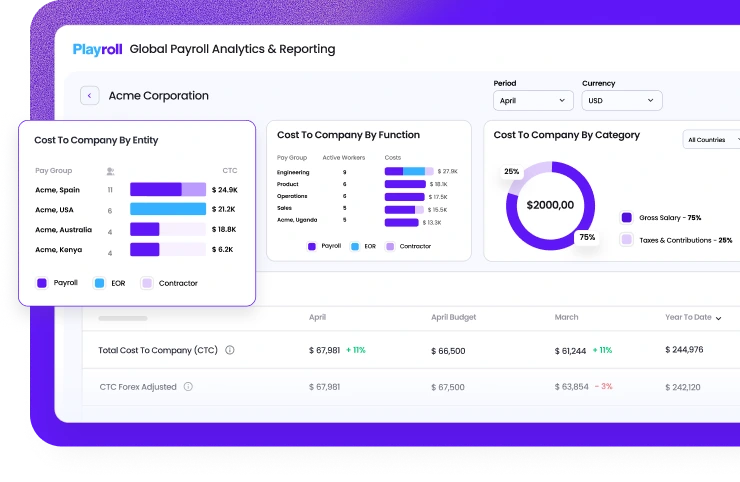
In Venezuela, foreign nationals who wish to live and work legally typically do so under a Visa de Transeúnte Laboral (TR-L) or other transeúnte categories, such as the Transeúnte Empresario for investors or business owners. These visas function as both a residence and work authorization when sponsored by a locally registered employer that is in good standing with Venezuelan labor, tax, and immigration authorities.
Employers generally initiate the process in Venezuela by preparing corporate documentation and a job offer, while the employee applies for the corresponding visa at a Venezuelan consulate abroad once the sponsorship is approved. Compliance with local labor standards, minimum salary rules, and registration with social security and tax authorities is essential to maintain the validity of the work authorization and avoid penalties or disruption to the employee’s status.
Mandatory Leave Entitlement in Venezuela
The annual leave entitlement in Venezuela is 15 days for a full time worker. These can include public holidays on top of that or within those days, which would otherwise be unpaid.
An Employer of Record (EOR) helps businesses manage annual leave, paid time off (PTO), and local holidays across the globe, including in Venezuela. By partnering with an EOR, companies ensure full compliance with local labor laws in Venezuela when it comes to annual leave and time-off management. EOR providers like Playroll offer platforms that simplify tracking and managing employee time off in Venezuela. By outsourcing this responsibility to Playroll, you can streamline leave management, ensure compliance, and free up time to focus on other business priorities.
Venezuela’s employee benefits framework is highly protective of workers and heavily regulated, which means your company needs to plan carefully before hiring. Mandatory benefits such as paid annual leave, profit sharing, and extensive social security coverage significantly increase total employment cost compared with many other markets, but they also provide a clear compliance roadmap.
At the same time, you can strengthen your employer brand in Venezuela by layering voluntary perks on top of the legal minimums. Enhancing health coverage, offering additional paid time off, and supporting employees with inflation‑sensitive benefits can make your roles more attractive and help you retain key talent in a challenging economic environment.
- Top mandatory benefits: registration and contributions to the Venezuelan Social Security System (IVSS) and associated funds (employment regime, housing, and recreation funds), paid annual vacation with vacation bonus, statutory public holidays, profit sharing (participación en los beneficios), and paid maternity and paternity leave plus other protected leaves
- Additional important mandatory elements: seniority-related benefits and vacation premium under the Organic Labor Law for Workers (LOTTT), and protections around working time and rest
- Top supplemental benefits: private medical insurance (including family coverage), meal or food benefits above the statutory ticket allowance, transportation support, and performance‑based bonuses in foreign currency
- Key legal and tax considerations: strict adherence to LOTTT and social security regulations, proper payroll records and payslips, timely payment and reporting of contributions and profit sharing, and careful treatment of non‑cash and foreign‑currency perks to avoid unexpected taxable income assessments
Administering employee benefits in Venezuela requires more than just offering a standard package. Local labor laws often mandate specific entitlements, from health insurance to paid leave, and the rules can change without warning. Venezuela also has unique standards for what an attractive, competitive benefits package looks like. For businesses without in-country expertise, meeting these obligations and expectations can quickly become risky and expensive. An Employer of Record acts as your compliance partner, ensuring all benefits are provided according to the latest legal requirements and without administrative strain on your internal team.
Beyond compliance, an EOR brings clarity and consistency to a process that’s often complex and fragmented. They handle enrollments, ensure accurate employer contributions, manage communications with local providers, and keep everything properly documented. This means employees get what they’re entitled to, and you avoid the headache of navigating benefits systems in a foreign market. Whether you're hiring one person or building a larger team, an EOR provides a clear, dependable structure that lets you offer competitive benefits without taking on unnecessary risk or workload.
Disclaimer
THIS CONTENT IS FOR INFORMATIONAL PURPOSES ONLY AND DOES NOT CONSTITUTE LEGAL OR TAX ADVICE. You should always consult with and rely on your own legal and/or tax advisor(s). Playroll does not provide legal or tax advice. The information is general and not tailored to a specific company or workforce and does not reflect Playroll’s product delivery in any given jurisdiction. Playroll makes no representations or warranties concerning the accuracy, completeness, or timeliness of this information and shall have no liability arising out of or in connection with it, including any loss caused by use of, or reliance on, the information.

ABOUT THE AUTHOR
Jesse Weisz
Jesse is an experienced R&D Analyst at Playroll, a leading Employer of Record (EOR) provider. With a strong background in data analysis and market research, Jesse specializes in identifying emerging trends and driving innovation in global HR solutions. She is an all-rounder, critical thinker and success-seeker (often inextricably linked to being a late-night tea drinker).

.svg)


.png)

















.webp)


.svg)