.svg)
.svg)

.svg)


.svg)

.svg)
.svg)
.svg)
.svg)
.svg)
.svg)
.svg)
.svg)
Minimum Wage: The statutory minimum wage in Republic of Congo is XAF 150,000 per month and applies across all sectors.
Working Hours: In the Republic of the Congo, the legal work week is 40 hours, typically spread over five or six days depending on the nature of the work.
Payroll Taxes: In the Republic of Congo, employers contribute approximately 20.28% of employee salaries to the National Social Security Fund (CNSS).
Average Salary: The average gross monthly salary in Republic of Congo is approximately XAF 260,000–290,000 (about USD 420–470) as of early 2026.
Hiring independent contractors has boomed in popularity because of the cost savings and flexibility they offer. It can be a great option if you require niche skills or short-term project support. Contractors allow businesses to access specialized skills quickly, without the time and cost of setting up a local entity.
However, it’s important to know the limits of this model: contractors are not a substitute for full-time employees. Relying on them for ongoing, long-term roles can create serious compliance risks, including employee misclassification, which can lead to fines, back taxes, and reputational damage.
Playroll’s contractor management solutions make it simple to compliantly engage, onboard, and pay contractors around the world. We provide clear visibility into agreements, streamline payments, and reduce compliance risks – so you can focus on getting the work done. And when you’re ready to take the next step, we can help seamlessly convert contractors into full-time employees through our global Employer of Record service.
From compliant contracts to competitive benefits, Playroll’s EOR services keep you aligned with local labor laws and regulations, safeguarding your business, so you can focus on growth.
Book a Demo
Businesses can only operate smoothly in Republic of Congo if they comply with local labor laws including drafting compliant employment contract agreements and meeting taxation and payroll obligations. Learn more about the employment laws and regulations in Republic of Congo below, to avoid any compliance issues.
Onboarding Process
We can help you get a new employee started in Republic of Congo quickly, with a minimum onboarding time of just 1-2 working days. The timeline starts once the employee submits all required information onto the Playroll platform and completes any necessary local authority registrations. For non-nationals, the Right to Work assessment (if applicable) may add up to three extra days. Additional time may be needed for follow-ups on this assessment.
In Republic of Congo, the average gross monthly salary in early 2026 is estimated at around XAF 260,000–290,000 (roughly USD 420–470), which serves as a practical benchmark as you budget for your team. Actual pay varies significantly by experience, sector, and location, with higher wages typically found in oil and gas, mining, telecommunications, and financial services. You can expect to offer higher salaries in major urban centers such as Brazzaville and Pointe-Noire, where competition for skilled employees is stronger and living costs are higher.
Macroeconomic conditions are also shaping wage expectations, with annual inflation running at roughly 3–5 percent in late 2025 and into early 2026, which you should factor into planned salary reviews for your workforce. Real GDP growth is projected to be in the range of 3–4.5 percent over 2025–2026, supported largely by the hydrocarbons sector and related services, which can gradually lift pay levels in connected industries. Unemployment is estimated in the high single to low double digits, giving your company access to a relatively broad pool of job seekers while still requiring competitive offers to attract and retain qualified talent in specialized roles.

In the Republic of Congo, you should keep overtime exceptional and ensure hours, rest days, and premiums are all supported by auditable attendance records. In 2026, regulators increasingly expect employers to show consistent application of statutory overtime bands and weekly rest protection.
- Standard Working Hours: 40 hours per week.
- Overtime Thresholds: Overtime applies beyond 40 hours per week.
- Overtime Pay Rates: +30% for the first 6 overtime hours; +60% for additional overtime hours; +100% for overtime worked on the weekly rest day.
- Daily And Weekly Rest Requirements: Weekly rest is at least 24 consecutive hours.
- Night Work Restrictions: Night work is regulated and should be tracked distinctly for correct premium treatment.
- Penalties For Non–Compliance: Exposure includes fines, corrective orders, and mandatory back pay for underpaid overtime.

The current minimum wage in the Republic of Congo is set by the Ministry of Labour and Social Security, with compliance being a key obligation for employers.
- The current rate is XAF 70,400 per month, approximately USD 117.33.
- Pay frequency is monthly.
- The effective date of the current rate is 1 January 2025.
- The Ministry of Labour and Social Security sets the minimum wage.
- The review cycle considers inflation and cost-of-living indices.
- Key exemptions include apprentices and small businesses, with specific conditions.
- Penalties for non-compliance range from XAF 100,000 to XAF 500,000 per violation.
- Employer contribution rates are Social Security 20%, Health Insurance 4%, and Pension 8%.
Global expansion shouldn't mean losing time to paperwork or dealing with complicated, country-specific HR systems. An Employer of Record helps you keep your focus on talent by handling the operational side of employment in Republic of Congo. That includes onboarding, contract management, payroll processing, and statutory compliance, all aligned with local laws and best practices. The EOR guarantees that employees are legally employed and properly supported from day one.
This streamlined setup allows you to prioritize recruiting the best people and integrating them into your company culture. Your team stays lean, and you avoid getting caught up in the details of local processes or shifting regulations. For founders, global hiring managers, or HR teams working across borders, an EOR multiplies your impact, reducing admin time, preventing errors, and helping ensure that new hires have a smooth experience from the get-go.

To run payroll in Republic of Congo in 2026, you need to manage progressive income tax withholding, employee social charges of around 4%, and employer contributions that typically add about 20%–25% on top of gross salaries, all while meeting monthly filing and payment deadlines with DGICP and CNSS. A robust setup that includes correct registrations, reliable payroll calculations, and clear payslips will help you avoid penalties, support employee trust, and give your finance team accurate visibility into total employment costs.
- Core Employer Cost: Budget for employer payroll contributions of roughly 20%–25% of gross salary in addition to the employee’s cash compensation.
- Withholding Obligations: Calculate and withhold income tax and employee social security each pay cycle using the current Congolese tax brackets and CNSS rates.
- Monthly Compliance: File and pay income tax and social security contributions monthly, typically by the 15th of the following month.
- Entity Vs EOR: Decide between running payroll through your own Congolese entity or partnering with an Employer of Record for faster, lower-risk market entry.
- Documentation And Records: Maintain detailed payroll records, declarations, and payment proofs to support audits and annual reporting obligations.
Hiring in Republic of Congo means taking on local payroll obligations, which often include unique tax rates, contribution rules, and strict documentation. If you're not familiar with the system, or don't have a local entity, it’s easy to make mistakes. That’s where an Employer of Record ccomes in. The EOR manages payroll for your team on your behalf, ensuring every process is accurate, timely, and legally compliant.
Key Ways an EOR Supports Payroll in Republic of Congo:
- Full Legal Compliance: Ensures all payments, deductions, and filings meet country-specific requirements.
- Payroll Setup & Processing: Handles salary calculations, tax withholdings, and local reporting obligations.
- Statutory Benefit Contributions: Pays into required social programs and manages country-mandated benefits.
- Employee Documentation: Generates compliant contracts and manages hiring and termination paperwork.
- Local Currency Payouts: Delivers salaries in local currency, avoiding delays or exchange rate issues for employees.
Make better business decisions by consolidating global payroll data, while seamlessly syncing your existing payroll operations.
Book a Demo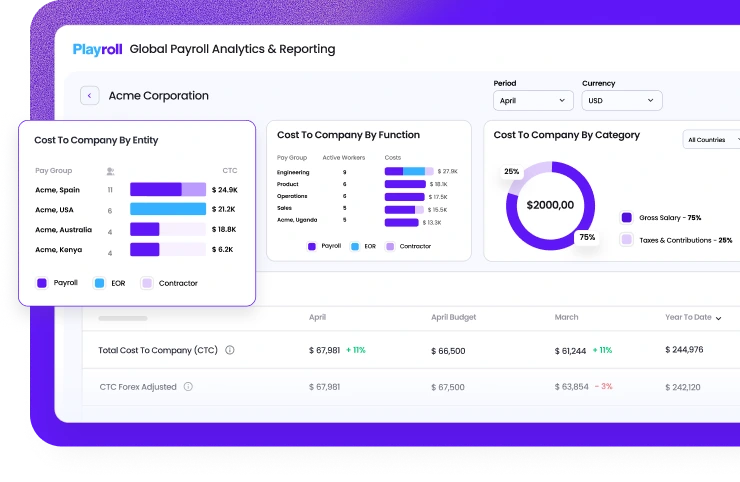
In Republic of Congo, foreign nationals typically need both the appropriate entry visa (such as a long-stay visa or visa de long séjour) and an authorization to work, often referred to as a work permit or autorisation de travail, to be lawfully employed. In many cases, the process starts with securing a job offer from a Congolese employer, who then sponsors the work authorization with the Ministry of Labor and relevant immigration authorities.
Depending on the assignment, workers may enter on a short-stay business visa for meetings or assessments, or on a long-stay visa that is converted into a residence permit (carte de séjour) with work authorization after arrival. Requirements and processing practices can vary by sector and region, so employers should always confirm current rules with local authorities or a qualified immigration advisor before hiring or relocating international talent.
Mandatory Leave Entitlement in Republic of Congo
The annual leave entitlement in Republic of Congo is 26 working days for a full time worker. These can include public holidays on top of that or within those days, which would otherwise be unpaid.
An Employer of Record (EOR) helps businesses manage annual leave, paid time off (PTO), and local holidays across the globe, including in Republic of Congo. By partnering with an EOR, companies ensure full compliance with local labor laws in Republic of Congo when it comes to annual leave and time-off management. EOR providers like Playroll offer platforms that simplify tracking and managing employee time off in Republic of Congo. By outsourcing this responsibility to Playroll, you can streamline leave management, ensure compliance, and free up time to focus on other business priorities.
Public Holidays in Republic of Congo
The Republic of the Congo observes 10 national public holidays, with some dates, such as Easter Monday and Ascension Day, varying each year based on the Christian calendar.
Employee benefits in the Republic of Congo sit at the intersection of statutory social protection and market‑driven perks. To hire successfully, your company needs to understand the core legal obligations around social security, leave, and basic protections, then layer on additional benefits that align with local expectations and your global standards.
Most full‑time employees expect you to respect the Labour Code, register them with the national social security system, and provide clear policies on leave, health and safety, and family‑related absences. From there, supplemental benefits such as private medical cover or transport support can significantly improve your employer brand and retention, especially in competitive professional roles.
- Key mandatory benefits: registration with the Caisse Nationale de Sécurité Sociale (CNSS) and payment of social security contributions, maternity leave with pay funded partly through social security, statutory paid annual leave, paid public holidays, and work injury and occupational disease protection.
- Additional important mandatory protections: paid sick leave according to the Labour Code and collective agreements, working time limits with weekly rest, and basic health and safety obligations in the workplace.
- Top supplemental benefits to stand out: private health insurance (often extending to dependants), meal or transport allowances, and performance‑based bonuses or allowances beyond statutory requirements.
- Key legal considerations: strict compliance with the Labour Code and social security legislation, timely CNSS registration and contribution payments, accurate payroll and leave records, and written contracts that clearly define benefits without undercutting statutory minimums.
- Key tax considerations: mandatory employer social security contributions are a significant additional payroll cost, some benefits in kind may be treated as taxable income for employees, and you should work with a local advisor to structure allowances and perks in a tax‑compliant way under Republic of Congo rules.
When hiring across multiple countries, maintaining consistency in how you deliver employee benefits quickly gets tricky. Each country, including Republic of Congo, has its own legal rules, cultural norms, and contribution systems. An Employer of Record helps you strike the right balance between global structure and local compliance. They take over the complexity of delivering benefits that are aligned with Republic of Congo’s legal requirements and competitive with local market expectations.
From ensuring statutory benefits are in place to managing local onboarding timelines and enrollment systems, the EOR provides a seamless experience for both employer and employee. This makes it easier to grow your team across borders without reinventing your benefits process in each new location. You stay in control of your overall benefits strategy, while the EOR takes care of executing it in a way that works legally and culturally in Republic of Congo. It’s a smarter way to scale benefits globally without losing local relevance.
Disclaimer
THIS CONTENT IS FOR INFORMATIONAL PURPOSES ONLY AND DOES NOT CONSTITUTE LEGAL OR TAX ADVICE. You should always consult with and rely on your own legal and/or tax advisor(s). Playroll does not provide legal or tax advice. The information is general and not tailored to a specific company or workforce and does not reflect Playroll’s product delivery in any given jurisdiction. Playroll makes no representations or warranties concerning the accuracy, completeness, or timeliness of this information and shall have no liability arising out of or in connection with it, including any loss caused by use of, or reliance on, the information.

ABOUT THE AUTHOR
Jesse Weisz
Jesse is an experienced R&D Analyst at Playroll, a leading Employer of Record (EOR) provider. With a strong background in data analysis and market research, Jesse specializes in identifying emerging trends and driving innovation in global HR solutions. She is an all-rounder, critical thinker and success-seeker (often inextricably linked to being a late-night tea drinker).

.svg)


.png)

















.webp)


.svg)