.svg)
.svg)

Thousands of global businesses can't be wrong.
Sign up for free and explore global hiring with Playroll.


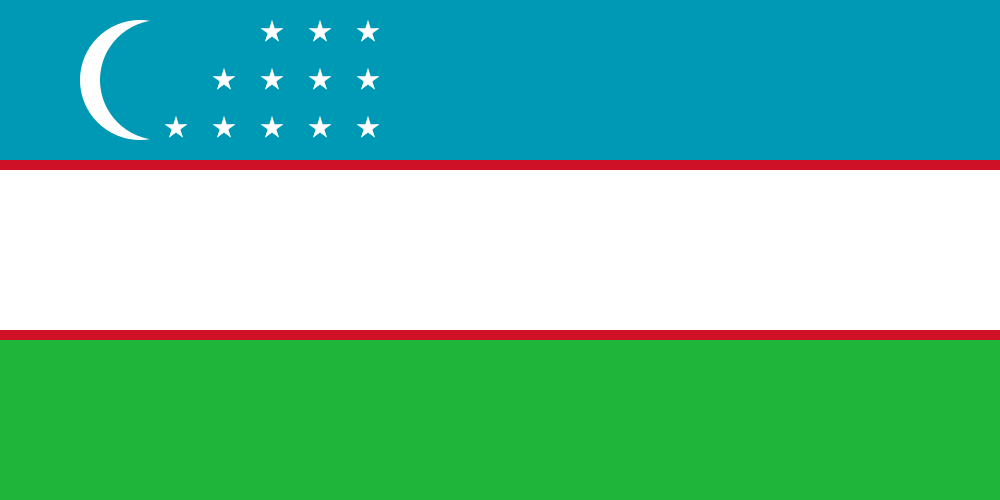

Uzbekistan Public Holiday Regulations
In Uzbekistan, public holidays are generally treated as paid non-working days at the national level, with limited regional variation and substitute days when a holiday falls on a weekend. In 2026 there are around 10–12 nationally observed public holidays, and employers must follow official government decrees on observed days and pay rules.

Thousands of global businesses can't be wrong.
Sign up for free and explore global hiring with Playroll.
List of Public Holidays in Uzbekistan (2026)
Uzbekistan’s official public holidays are set at national level by the government, and each year a presidential decree may adjust the exact observed days, especially when holidays fall on weekends. The table below reflects the core national holidays typically observed in Uzbekistan; you should always confirm final dates against the official 2026 government calendar.
Do Employers Have to Provide Paid Leave on Public Holidays?
Yes, under Uzbekistan’s labour legislation, public holidays are generally treated as paid non‑working days for employees, and work on these days is allowed only in limited cases with enhanced pay. The Labour Code provides that public holidays are non‑working days at the national level, and employees who are not required to work are entitled to retain their average earnings for the day.
When a public holiday falls on a weekend, the government often issues a specific decree shifting the non‑working day to an adjacent weekday or creating bridge days and compensatory working Saturdays. Your company must follow the official decree for 2026, as it determines which calendar days are legally non‑working and therefore paid.
Part‑time employees and employees with irregular schedules are generally entitled to paid public holidays on the same basis as full‑time staff, proportionate to their work schedule. If a public holiday falls on a day they would normally work, they should receive their usual pay or average earnings for that day, unless they actually work and receive premium pay instead.
If an employee is required to work on a public holiday, Uzbekistan’s labour rules typically require at least double pay for hours worked on that day, or normal pay plus an additional day off, depending on the agreement with the employee. In practice, many employers pay double the regular hourly rate for work performed on public holidays to clearly demonstrate compliance.
There are no broad regional public holidays that override national rules, although local authorities may organise observances or events. For compliance purposes, you should treat the nationally declared holidays and any officially announced substitute days as binding for all employees in Uzbekistan, regardless of region.
Legal Penalties for Not Providing Paid Holiday Leave
Failure to respect public holiday rules in Uzbekistan can expose your company to administrative liability, back‑pay claims, and reputational risk. Labour inspectors and other competent state authorities can review whether your company correctly treated public holidays as non‑working days, paid employees appropriately, and obtained proper consent and documentation for any work performed on those days.
Where violations are identified, authorities may order you to pay outstanding wages, premium pay for work on holidays, and compensation for any underpayments. Administrative fines can be imposed on the company and, in some cases, on responsible managers, under Uzbekistan’s administrative offence framework. Repeated or serious violations may lead to increased scrutiny, more frequent inspections, and potential suspension of certain activities until compliance is restored.
Common employer mistakes include treating public holidays as normal working days without premium pay, failing to follow the annual presidential decree on shifted non‑working days, miscalculating average earnings for paid holidays, and excluding part‑time or fixed‑term employees from holiday pay. To reduce risk, you should keep clear records of work schedules, attendance, pay calculations, and any written agreements for work on public holidays.
How Do Holidays Affect Overtime Thresholds?
In Uzbekistan, public holidays interact with overtime rules by triggering premium pay for work performed on those days, separate from standard overtime thresholds. Hours worked on an official public holiday are generally compensated at a higher rate than ordinary hours, often at least double the regular rate, regardless of whether the employee has exceeded their normal weekly or daily working time limit.
If an employee works beyond their normal daily or weekly hours and those excess hours fall on a public holiday, your company may need to apply both the holiday premium and any applicable overtime premium, depending on the interpretation of the Labour Code and the terms of the employment contract or collective agreement. Many employers adopt the safest approach by paying the higher of the applicable premiums or clearly specifying in internal policies how combined premiums are calculated, provided the result is not less favourable than the law.
Public holidays that are shifted by government decree can also affect how you count working days and overtime for that particular week. For example, if a weekday is declared a non‑working holiday and a Saturday is declared a working day in exchange, you should treat the declared non‑working day as a holiday for pay purposes and the Saturday as a regular working day when assessing overtime. Because practice can vary and decrees may contain specific instructions, you should review the official 2026 decree and adjust your scheduling and payroll rules accordingly.
Stay 100% Compliant with Leave Regulations Using Playroll
Managing Uzbekistan's public holidays and leave rules doesn’t have to be complex. Playroll keeps you 100% compliant by automatically tracking local holidays, observed days, and pay requirements – so your team is paid correctly and on time, every time.
Whether you’re hiring your first employee or scaling a growing team, Playroll lets you employ talent without setting up a local entity. We handle compliant contracts, benefits, and payroll in one platform, so you can reduce compliance risk and focus on growing your business while we take care of the heavy-lifting in the background. Book a chat with our team to get started.

Never Miss a Leave Law Update — Stay 100% Compliant
01
Reach out to playroll
We’ll handle payroll, leave and benefits for your team, anywhere in the world.
02
Track Leave With Ease
Review, approve, and manage leave in line with local laws, all in one place.
03
Gain Hands-on Support
Each employer and employee gets support to promptly resolve queries.
04
Stay Up to Date With Regulations
We’ll keep you updated on changes in leave entitlements and regulations.


.svg)







.svg)