.svg)
.svg)

Thousands of global businesses can't be wrong.
Sign up for free and explore global hiring with Playroll.


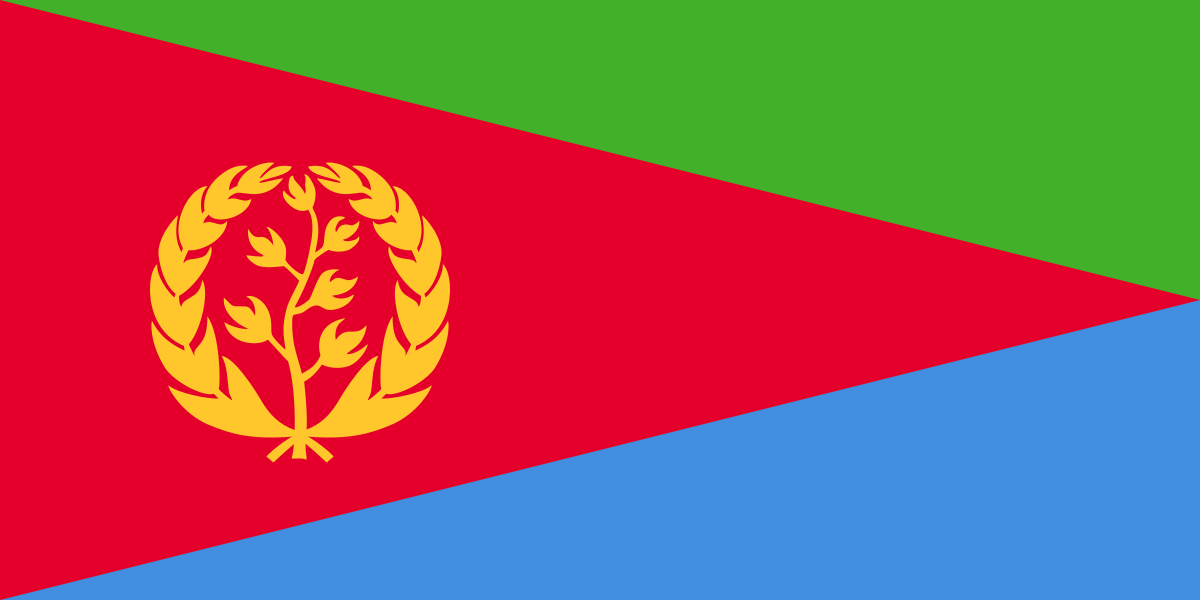

Eritrea Public Holiday Regulations
In Eritrea, public holidays are generally treated as paid days off for employees, with most holidays observed nationally rather than regionally. When a holiday falls on a Sunday, it is typically observed on the same day rather than moved. In 2026, there are around 12 main national public holidays, but you should confirm exact dates and entitlements in local contracts and with Eritrean legal counsel.

Thousands of global businesses can't be wrong.
Sign up for free and explore global hiring with Playroll.
List of Public Holidays in Eritrea (2026)
Eritrea’s public holidays combine national independence milestones, remembrance days, and major religious festivals. Always confirm exact dates locally, especially for Islamic holidays, which follow the lunar calendar and may shift by a day depending on moon sighting.
*Eid al‑Adha is based on the Islamic lunar calendar. The 2026 date shown is an estimate; local religious authorities may announce a different date by one day.
Do Employers Have to Provide Paid Leave on Public Holidays?
Yes, under Eritrean labour practice, public holidays are generally treated as paid rest days for employees, meaning your company should pay employees their normal daily wage if they are not required to work on a public holiday. This expectation applies across the country and does not usually differ by region, although specific entitlements can be refined in collective agreements or individual contracts.
Where employees must work on a public holiday due to operational needs, it is common for employers to provide either premium pay for the hours worked or a paid day off in lieu. Because Eritrean labour legislation and enforcement practice are not always easily accessible in English, you should confirm the exact premium rate and compensatory rest rules with a local legal adviser or your in‑country payroll partner, and then document the approach clearly in employment contracts and internal policies.
Part‑time and temporary employees are typically entitled to public holiday pay on a pro‑rated basis, aligned with their normal working schedule. For example, if a part‑time employee is normally scheduled to work on a day that becomes a public holiday, they should usually receive pay for the hours they would have worked. If the holiday falls on a non‑working day for that employee, there is usually no additional entitlement unless your company policy or a collective agreement provides a more generous benefit.
Most Eritrean public holidays are national rather than regional, so you can generally apply a single holiday calendar for your Eritrea‑based team. However, religious holidays may be observed more widely among employees of the relevant faith, and some employers choose to offer additional flexibility or floating days to accommodate diverse religious observances.
Legal Penalties for Not Providing Paid Holiday Leave
Eritrea’s labour framework expects employers to respect official public holidays and related pay entitlements. Failure to do so can expose your company to labour inspections, administrative penalties, and back‑pay claims. While detailed penalty schedules are not always published or easily verifiable in English, non‑compliance can lead to orders to reimburse unpaid holiday wages, potential fines, and, in serious or repeated cases, broader scrutiny of your employment practices.
Labour authorities and courts in Eritrea can require employers to correct underpayments, adjust payroll records, and compensate employees for lost earnings. Disputes may also damage your company’s reputation locally and make it harder to attract and retain talent.
Common mistakes by foreign employers include treating public holidays as unpaid leave, failing to provide any premium or time off in lieu when employees work on a holiday, and applying a home‑country holiday calendar instead of Eritrea’s national calendar. To reduce risk, you should maintain clear written policies on holiday pay, keep accurate time and attendance records, and ensure your local HR or payroll provider is aligned with Eritrean requirements.
How Do Holidays Affect Overtime Thresholds?
In Eritrea, public holidays are generally treated as rest days, and hours worked on these days are typically considered more onerous than regular working time. While precise statutory overtime multipliers are not consistently available in public English‑language sources, the safest approach is to treat work on a public holiday as overtime and to compensate it at a premium rate above the employee’s normal hourly wage, or to grant an equivalent paid day off in lieu in addition to normal pay.
Overtime thresholds are usually calculated based on standard weekly working hours. If an employee’s total hours, including any work performed on a public holiday, exceed the normal weekly limit, the excess should be treated as overtime. For shift‑based or part‑time staff, you should compare actual hours worked against their contracted hours and apply overtime or premium pay accordingly.
Because local practice can vary and written guidance is limited, you should align your Eritrea policy with three principles: do not pay less than the normal daily wage for a public holiday, apply a clear premium or compensatory rest when employees work on a holiday, and document your approach transparently in contracts and employee handbooks. When in doubt, seek local legal advice and adopt the more employee‑favourable interpretation to minimise disputes.
Stay 100% Compliant with Leave Regulations Using Playroll
Managing Eritrea's public holidays and leave rules doesn’t have to be complex. Playroll keeps you 100% compliant by automatically tracking local holidays, observed days, and pay requirements – so your team is paid correctly and on time, every time.
Whether you’re hiring your first employee or scaling a growing team, Playroll lets you employ talent without setting up a local entity. We handle compliant contracts, benefits, and payroll in one platform, so you can reduce compliance risk and focus on growing your business while we take care of the heavy-lifting in the background. Book a chat with our team to get started.

Never Miss a Leave Law Update — Stay 100% Compliant
01
Reach out to playroll
We’ll handle payroll, leave and benefits for your team, anywhere in the world.
02
Track Leave With Ease
Review, approve, and manage leave in line with local laws, all in one place.
03
Gain Hands-on Support
Each employer and employee gets support to promptly resolve queries.
04
Stay Up to Date With Regulations
We’ll keep you updated on changes in leave entitlements and regulations.


.svg)







.svg)