.svg)
.svg)

.svg)


.svg)

.svg)
.svg)
.svg)
.svg)
.svg)
.svg)
.svg)
.svg)
If you’re planning to hire in the United Kingdom, it’s not a difficult market to enter, but it is one where structure matters from the outset. UK employment law isn’t built around heavy pre-approval or government filings, yet it creates immediate statutory rights for employees and clear procedural expectations for employers. From your first hire, you’re operating under the Employment Rights Act 1996, which requires a written statement of employment particulars on or before day one, alongside minimum pay rules under the National Minimum Wage framework.
Payroll must run through PAYE with His Majesty’s Revenue and Customs (HMRC), with correct Income Tax and National Insurance Contributions withheld, and the Pensions Act 2008 requires you to assess and auto-enrol eligible employees into a compliant workplace pension scheme. The Equality Act 2010 applies from day one, meaning discrimination risks attach immediately, even though standard unfair dismissal protection typically requires two years of service.
If you don’t have a UK entity, those obligations don’t disappear. In this guide, we’ll walk you through how to structure contracts correctly, set up payroll in a compliant way, and avoid the common pitfalls that lead to penalties or Employment Tribunal claims.
Minimum Wage: The statutory minimum wage in The United Kingdom is typically 12.71 GBP per hour for workers aged 21 and over.
Working Hours: In the UK, standard working hours are typically 37.5 to 40 hours per week, spread across Monday to Friday.
Payroll Taxes: In The United Kingdom, employers contribute about 20% in payroll taxes, which typically cover social security, health care, and other statutory benefits.
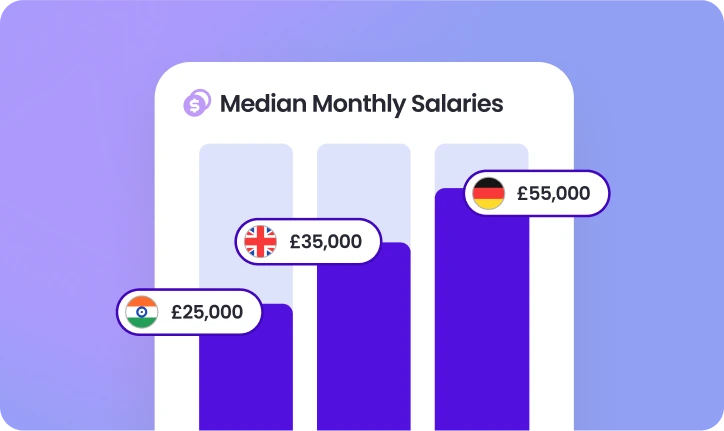
Average Salary: The average gross monthly salary in The United Kingdom is approximately GBP 3,300–3,600 (about USD 4,200–4,600) as of early 2026.
Hiring in The United Kingdom for the first time can be overwhelming, especially when navigating unfamiliar employment laws. So, how do you get started? There are three main ways to hire in The United Kingdom: set up your own legal entity, hire independent contractors, or use an EOR service to handle payroll and global HR for you. Below, we’ll walk you through each option in detail.
1. Set Up A Local Entity In The United Kingdom
Setting up a local entity in The United Kingdom is the traditional route for businesses that want to build a long-term presence in a new market. It allows for direct hiring, fine control over operations, and compliance with local labor laws.
That said, the process is rarely simple. It involves navigating complex legal structures, extensive registration procedures, ongoing payroll administration, and local tax obligations. Beyond the administrative burden, the costs of incorporation, maintaining local offices, and hiring compliance experts can quickly add up.
For companies operating with slim margins or testing new markets, these financial and operational commitments often make setting up a local entity an unfeasible option compared to more flexible and cost-effective solutions.
2. Use an Employer of Record in the United Kingdom
If you want to hire in the United Kingdom without setting up your own entity, using an Employer of Record can be a practical shortcut. The EOR becomes the legal employer on paper, running payroll, withholding taxes, managing pension auto-enrolment, and making sure statutory benefits and employment documentation are handled in line with UK law. You stay focused on the day-to-day management of the employee, while they take care of the compliance infrastructure behind the scenes.
That said, UK law looks at what’s really happening in the working relationship, not just what the contract says. If, in practice, the individual is working as part of your organisation under your control, a court or Employment Tribunal may examine the substance over the structure.
The Agency Workers Regulations 2010 also mean that workers supplied through intermediaries can gain rights to equal treatment after 12 weeks. So the way the arrangement is set up and managed matters. A properly structured Employer of Record model, with clear lines around supervision, benefits, and termination processes, is what keeps the arrangement commercially useful and legally sound.
Cost of Employer of Record vs Setting Up an Entity
If you’re deciding between setting up a UK entity or using an Employer of Record, it comes down to scale and how much responsibility you want to manage internally. Incorporating a private limited company is inexpensive in itself, and registration with Companies House can cost less than £100. The real cost sits in setup and ongoing compliance.
Most overseas companies spend between £2,000 and £6,000 getting fully operational, including:
- Registration with HMRC for Pay As You Earn
- Employer National Insurance registration
- Workplace pension scheme setup under auto-enrolment rules
- VAT registration if required
- Drafting compliant employment contracts and policies
- Putting accounting and payroll infrastructure in place
Then come the ongoing costs:
- Accounting and payroll support, typically £300 to £1,000 per month
- Employer National Insurance Contributions at 13.8 percent on qualifying earnings
- Minimum 3 percent employer pension contributions
- Apprenticeship Levy at 0.5 percent of payroll if your annual UK pay bill exceeds £3 million
- Administration of statutory payments such as Statutory Sick Pay and Statutory Maternity Pay
- Internal HR time and exposure to Employment Tribunal claims, including unfair dismissal, redundancy, and uncapped discrimination awards
If you use an EOR instead, you avoid incorporation and much of the infrastructure build. In the UK, Employer of Record fees typically range from £300 to £900 per employee per month depending on the level of service. There’s no entity to maintain, no Companies House filings, and no need to manage HMRC reporting or pension compliance directly. For smaller teams or market testing, that simplicity can significantly reduce both administrative burden and legal exposure.
3. Hire Independent Contractors In The United Kingdom
Hiring independent contractors has boomed in popularity because of the cost savings and flexibility they offer. It can be a great option if you require niche skills or short-term project support. Contractors allow businesses to access specialized skills quickly, without the time and cost of setting up a local entity.
However, it’s important to know the limits of this model: contractors are not a substitute for full-time employees. Relying on them for ongoing, long-term roles can create serious compliance risks, including employee misclassification, which can lead to fines, back taxes, and reputational damage.
Playroll’s contractor management solutions make it simple to compliantly engage, onboard, and pay contractors around the world. We provide clear visibility into agreements, streamline payments, and reduce compliance risks – so you can focus on getting the work done. And when you’re ready to take the next step, we can help seamlessly convert contractors into full-time employees through our global Employer of Record service.
From compliant contracts to competitive benefits, Playroll’s EOR services keep you aligned with local labor laws and regulations, safeguarding your business, so you can focus on growth.
Book a Demo
Businesses can only operate smoothly in The United Kingdom if they comply with local labor laws including drafting compliant employment contract agreements and meeting taxation and payroll obligations. Learn more about the employment laws and regulations in The United Kingdom below, to avoid any compliance issues.
Employment Contract Requirements
When employing an individual in the UK, the following formalities must be adhered to:
- An employer must give employees a document known as a written statement of employment particulars, stating the main conditions of employment.
- The employment of particulars includes a principal statement and a wider written statement.
- The principal statement must include several inputs including: pay, how long the job will last, work hours, probation period length, benefits, location of work, amongst others.
- On the first day of employment, employers must provide employees info on sick pay, paid leave and notice periods.
- Within the first two months of employment, employers must provide employees with details on pensions, collections agreemment, non-compulsory training, and grievance procedures.
Onboarding Process
We can help you get a new employee started in The United Kingdom quickly, with a minimum onboarding time of just 1-2 working days. The timeline starts once the employee submits all required information onto the Playroll platform and completes any necessary local authority registrations.
For non-nationals, the Right to Work assessment (if applicable) may add up to three extra days. Additional time may be needed for follow-ups on this assessment. Please note, payroll cut-off dates can impact the actual start date. Playroll's payroll cut-off date is the 10th of each month unless otherwise specified.
Probation Period in The United Kingdom
Probationary periods in the UK help mitigate risk in hiring. Employees can be subject to a probationary period that enables the employer to assess employees skills. Unless an employees collective bargaining agreement outlines increased protections, the contract can be terminated during the probationary period without cause and at no additional cost to the employer outside of providing the mandatory notice.
This probationary period is not automatic and must be provided in the employment contract. Standard probationary periods can be 3-6 months on average.
In early 2026, the average gross monthly salary in The United Kingdom is in the region of GBP 3,300–3,600 (around USD 4,200–4,600), which provides a useful benchmark as you budget for your team. Actual pay varies significantly by experience level, industry, and location, with sectors such as information technology, finance and banking, and professional services typically paying above the national average, so your company may need to offer higher salaries to attract talent in these areas. Wages in major cities like London, Manchester, Birmingham, and Edinburgh are generally higher than in smaller towns and rural regions, which will influence what you need to pay your employees in those labour markets.
Macroeconomic conditions in The United Kingdom are also shaping wage expectations, with annual inflation running at roughly 2–3% in late 2025 and early 2026, meaning you can expect moderate cost-of-living pressures when planning salary reviews. Real GDP growth is projected at about 1–2% for 2025–2026, indicating a steady but not rapid expansion that supports gradual pay increases rather than aggressive wage inflation. Unemployment is hovering around 4–5%, giving you access to a relatively broad pool of talent while still requiring competitive offers to secure skilled employees for your workforce.

In the UK, standard working hours are typically 37.5 to 40 hours per week, spread across Monday to Friday. Employees under 18 are limited to a maximum of 40 hours per week and 8 hours per day, with no option to opt out of these limits. For adult workers, the legal maximum is 48 hours per week on average, calculated over a 17-week period.
A minimum meal interval of 20 minutes must be observed by employees who work more than 6 hours in a day. In typical working hours, Monday through Friday, the hours are 9 am to 5 pm.
Overtime in The United Kingdom
Overtime pay rates are not mandated by law in the UK. However, it's common practice for employers to offer higher pay rates for overtime, such as time-and-a-half or double time, to compensate employees for the additional hours worked. If employees work more than 40 hours in a week, their average pay for that amount of time must not fall below the National Minimum Wage.
A detailed description of any overtime pay rates and how they are calculated is normally included in an employment contract.

As of 2026 (Effective as of April 1 2026), the minimum wage rates in the United Kingdom are:
- National Living Wage (NLW) for workers aged 21 and over: £12.71 per hour
- Ages 18 to 20: £10.85 per hour
- Ages 16 to 17: £8.00 per hour
- Apprentices: £8.00 per hour
These adjustments are based on recommendations from the Low Pay Commission and aim to align the National Living Wage with two-thirds of median earnings, enhancing the purchasing power of lower-income workers.
The UK offers access to world-class talent in sectors like tech, finance, and creative industries, but the regulatory environment demands precise administration from day one. Details from PAYE income tax withholding, National Insurance Contributions, workplace pension auto-enrolment, to statutory sick pay and leave entitlements must all be managed accurately to avoid HMRC penalties or Employment Tribunal claims.
A compliant EOR in the UK typically manages:
- Drafting employment contracts and written statements of particulars aligned with UK law (required on or before day one, including details on pay, hours, holiday, notice, and any probation)
- Payroll processing via PAYE, monthly income tax withholding, and Real Time Information (RTI) submissions to HMRC
- Employer National Insurance Contributions (15% on earnings above £5,000 per year / £96 per week in 2026/27) and employee deductions
- Workplace pension auto-enrolment compliance (minimum 3% employer contribution to a qualifying scheme)
- Statutory leave administration and benefit tracking (including holiday entitlement of 5.6 weeks, Statutory Sick Pay from day one with no lower earnings limit or waiting days from April 2026, maternity/paternity/adoption/shared parental leave, and day-one rights to paternity and unpaid parental leave)
- Right-to-work checks, employment documentation, record maintenance (e.g., keeping holiday pay records for 6 years), and ongoing compliance with the Employment Rights Act 2025 updates
You still manage the employee’s day-to-day work, performance, tasks, and overall direction. The EOR simply handles the compliance side of things behind the scenes, including payroll runs, statutory filings, HMRC reporting, and local employment requirements.
Employer Tax Contributions
Employer payroll contributions are generally estimated at an additional 17.3% on top of the employee salary in The United Kingdom.
Employee Payroll Tax Contributions
In The United Kingdom , the typical estimation for employee payroll contributions cost is around 17%.
Individual Income Tax Contributions
The individual income tax ranges from 0% to 45%. Income tax is calculated according to progressive rates. Multiple additional factors may impact overall rates such as the household status and the number of children.
Pension in The United Kingdom
Employers must offer a workplace pension scheme to every employee, but it is up to the employee to take it or not. If the employee chooses to enter the pension scheme, their minimum contribution is 5% of their salary. The employers minimum contribution is 3%, and government tax relief is 1%, for a total minimum contribution of 8%.

Employers in the United Kingdom must navigate a range of payroll and employment taxes to ensure compliance, including PAYE income tax, National Insurance Contributions (NICs), the Apprenticeship Levy, and benefits-in-kind levies. Employees pay income tax according to progressive rates (20% for earnings between £12,571 and £50,270, 40% up to £125,140, and 45% above that), while employers must contribute 15% NICs on earnings over £5,000 and 0.5% for the Apprenticeship Levy if their annual pay bill exceeds £3 million.
Employers are also required to submit various reports such as Full Payment Submissions (FPS) and Employer Payment Summaries (EPS), with strict deadlines for tax payments, including NICs by the 22nd of each month. Using payroll management software, such as Playroll, can significantly simplify payroll processing by automating tax calculations, compliance tasks, and reporting, helping employers stay organized and avoid costly penalties.
When you’re scaling quickly, setting up local payroll systems in each new country slows you down. In The United Kingdom, the administrative load can include government registration, benefits management, and accurate, on-time payment delivery. An EOR gives you a plug-and-play solution that handles all of this while your internal team stays focused on growth, not red tape.
Key Ways an EOR Supports Payroll in The United Kingdom:
- Rapid Payroll Setup: Onboards employees quickly with ready-to-go infrastructure.
- End Administration: Handles salary, tax, and benefits with no extra internal resources.
- Vendor Simplicity: Consolidates payroll across countries for centralized oversight.
- No Entity Required: Operates legally, saving your business the time and resources needed for local incorporation.
Make better business decisions by consolidating global payroll data, while seamlessly syncing your existing payroll operations.
Book a Demo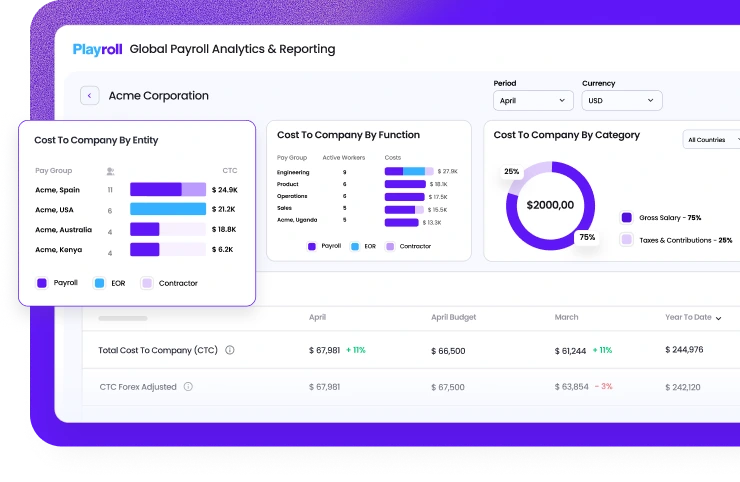
The United Kingdom operates a points-based immigration system, with most work routes falling under the Skilled Worker visa, Global Business Mobility routes (such as Senior or Specialist Worker), and temporary schemes like the Graduate visa or Seasonal Worker visa. In most cases, a UK-based employer must hold a Home Office sponsor licence and issue a Certificate of Sponsorship (CoS) before a worker can apply for a visa.
Eligibility typically depends on the role being at an appropriate skill level, meeting minimum salary thresholds, and, where applicable, English language and financial requirements. Different routes, such as the Skilled Worker visa, Health and Care Worker visa, Global Talent visa, and High Potential Individual visa, have distinct criteria and documentation, so employers and employees should always check the latest Home Office guidance before proceeding.
Leave entitlements in the United Kingdom are largely set by statute, and they interact directly with how you draft employment contracts and structure policies. The Working Time Regulations 1998 establish minimum paid holiday, while separate legislation governs maternity, paternity, sick pay, and shared parental leave.
As an employer, you can offer more generous benefits, but you can’t contract out of the statutory minimums. Understanding what’s mandatory versus discretionary is key when budgeting employment costs and aligning UK policies with your global framework.
Mandatory Leave Entitlement in The United Kingdom
The annual leave entitlement in The United Kingdom is 8 days for a full time worker. These can include public holidays on top of that or within those days, which would otherwise be unpaid.
Public Holidays In The United Kingdom
Public holidays, also known as bank holidays, vary by region in the United Kingdom. There are 8 bank holidays in England and Wales, 9 in Scotland, and 10 in Northern Ireland.
Paid Time Off in The United Kingdom
Full-time employees are entitled to 20 day of paid time off (PTO) a year plus an additional eight public holidays. PTO (Including public holidays) accrues at 5.6 weeks (28 days) proportioned to the number of days a week the employee works.
Maternity Leave In The United Kingdom
Eligible employees can take up to 52 weeks of maternity leave: 26 weeks of Ordinary Maternity Leave and 26 weeks of Additional Maternity Leave. Statutory Maternity Pay (SMP) for eligible employees can be paid for up to 39 weeks, usually as follows:
- First 6 weeks: 90% of their average weekly earnings (AWE) before tax.
- Following 33 weeks: 187.18 GBP or 90% of their AWE (whichever is lower).
- Final 13 weeks of maternity leave are unpaid.
Paternity Leave In The United Kingdom
Eligible employees are entitled to two weeks of paid paternity leave. The leave must be taken in one period. The employee will receive 184.03 GBP, or 90% of their average weekly earnings (whichever is lower) during this period.
Sick Leave In The United Kingdom
Employees are entitled to an unlimited number of sick days. The first 3 days of leave are paid at 100% salary by the company. After 3 days of sick leave, employees are entitled to employer-paid Statutory Pay Leave of up to 28 weeks for eligible employees. Statutory Sick Pay is 118.75 GBP per week.
Parental Leave In The United Kingdom
The United Kingdom has a shared parental leave (SPL) policy that allows parents to share leave following the birth or adoption of a child. Parents can share up to 50 weeks of leave and up to 37 weeks of statutory shared parental pay. Shared parental leave is available to employees who have worked with their employer for at least 26 weeks by the 15th week before the child is due (or adoption placement). Parents may be eligible for Statutory Shared Parental Pay (ShPP) if they meet certain criteria, including average earnings and employment status. This pay is set at 187.18 GBP per week or 90% of the parent's average weekly earnings, whichever is lower.
Employee benefits in The United Kingdom combine strong legal protections with a high expectation for additional, employer-funded perks. When you hire in the UK, you need to understand both the statutory minimums and what local talent typically views as a competitive package.
Your company will need to budget for social security contributions, paid time off, and pensions as a baseline, then decide how far you want to go beyond that baseline with health, wellbeing, and flexible benefits that help you stand out in the market.
- Top mandatory benefits: automatic enrolment in a workplace pension, paid annual leave, public holidays (through contract), statutory sick pay, and statutory family leave and pay
- Top supplemental benefits: private health insurance, enhanced pension contributions, and bonuses or performance incentives
- Key legal and tax considerations: compliance with UK employment law and HMRC rules, correct reporting of taxable benefits in kind, and timely payment of employer National Insurance contributions
For startups and small teams, managing global employee benefits isn’t just complex, it’s a full-time job. In The United Kingdom, understanding what benefits are required, how to deliver them, and how to stay compliant can be overwhelming, especially without local HR expertise. An Employer of Record removes that pressure by taking complete ownership of benefits administration, so you don't have to become an expert in local employment law.
Whether it’s healthcare contributions, pension enrollment, or statutory leave, the EOR ensures everything is delivered accurately and on time. They navigate any country-specific nuances, keep up with legal changes, and ensure each benefit is properly tracked and documented. For founders, that means fewer distractions and more time to focus on growth. Your employees get the security and support they expect from a local employer, and you get to scale your team in The United Kingdom without building complex infrastructure or worrying about compliance missteps.
Ending employment in the United Kingdom is less about at-will flexibility and more about process and justification. The Employment Rights Act 1996 gives employees with two years of continuous service the right not to be unfairly dismissed, which means you must have a legally valid reason and follow a fair procedure.
Termination Process in The United Kingdom
Employees who have been continuously employed by an employer for 2 years or more have a right not to be unfairly dismissed. According to the UK employment law, there are 5 statutory reasons for dismissal, which are listed below. Upon dismissal, the employer will have to prove that one applies and that they acted reasonably and legally in treating the reason as sufficient to justify dismissal of the employee.
- Conduct
- Capability
- Redundancy
- Breach of a statutory restriction
- Some other substantial reason
Notice Period in The United Kingdom
Notice periods in the UK depend on the length of the employment relationship, as well as whether the notice is being given by the employee or the employer. For employees who have worked for more than one month, the minimum notice period is 1 week. For employers, the minimum notice periods are as follows:
- 1 month - 2 years of service: 1 week
- 2 - 12 years of service: 1 week per year of employment
- Over 12 years of service: 12 weeks
Severance in The United Kingdom
In the UK, all employees who are terminated due to redundancy are entitled to severance pay. Severance pay is calculated as follows.
- 0.5 weeks pay for each year of service where the employee was below the age of 22
- 1 weeks pay for each year of service where the employee was between 22 to 40 of age
- 1.5 weeks pay for each year of employment where the employee was 41 and over
Disclaimer
THIS CONTENT IS FOR INFORMATIONAL PURPOSES ONLY AND DOES NOT CONSTITUTE LEGAL OR TAX ADVICE. You should always consult with and rely on your own legal and/or tax advisor(s). Playroll does not provide legal or tax advice. The information is general and not tailored to a specific company or workforce and does not reflect Playroll’s product delivery in any given jurisdiction. Playroll makes no representations or warranties concerning the accuracy, completeness, or timeliness of this information and shall have no liability arising out of or in connection with it, including any loss caused by use of, or reliance on, the information.

ABOUT THE AUTHOR
Jesse Weisz
Jesse is an experienced R&D Analyst at Playroll, a leading Employer of Record (EOR) provider. With a strong background in data analysis and market research, Jesse specializes in identifying emerging trends and driving innovation in global HR solutions. She is an all-rounder, critical thinker and success-seeker (often inextricably linked to being a late-night tea drinker).

.svg)


.png)

















.webp)


.svg)