.svg)
.svg)

.svg)


.svg)

.svg)
.svg)
.svg)
.svg)
.svg)
.svg)
.svg)
.svg)
Minimum Wage: The statutory minimum wage in St Kitts and Nevis is $12.50 per hour as of July 1, 2025, which is equivalent to EC$500 per week.
Working Hours: Standard working week is 40 hours; overtime is compensated at 1.5 times the regular rate on weekdays and 2 times on Sundays and public holidays.
Payroll Taxes: In St Kitts and Nevis, employers contribute about 5% in payroll taxes, which typically cover social security, health care, and other statutory benefits.
Average Salary: The average gross monthly salary in St Kitts and Nevis is approximately XCD 3,200–3,500 (about USD 1,185–1,295) as of early 2026.
Hiring independent contractors has boomed in popularity because of the cost savings and flexibility they offer. It can be a great option if you require niche skills or short-term project support. Contractors allow businesses to access specialized skills quickly, without the time and cost of setting up a local entity.
However, it’s important to know the limits of this model: contractors are not a substitute for full-time employees. Relying on them for ongoing, long-term roles can create serious compliance risks, including employee misclassification, which can lead to fines, back taxes, and reputational damage.
Playroll’s contractor management solutions make it simple to compliantly engage, onboard, and pay contractors around the world. We provide clear visibility into agreements, streamline payments, and reduce compliance risks – so you can focus on getting the work done. And when you’re ready to take the next step, we can help seamlessly convert contractors into full-time employees through our global Employer of Record service.
From compliant contracts to competitive benefits, Playroll’s EOR services keep you aligned with local labor laws and regulations, safeguarding your business, so you can focus on growth.
Book a Demo
Businesses can only operate smoothly in St Kitts and Nevis if they comply with local labor laws including drafting compliant employment contract agreements and meeting taxation and payroll obligations. Learn more about the employment laws and regulations in St Kitts and Nevis below, to avoid any compliance issues.
Onboarding Process
We can help you get a new employee started in St Kitts and Nevis quickly, with a minimum onboarding time of just 1-2 working days. The timeline starts once the employee submits all required information onto the Playroll platform and completes any necessary local authority registrations.
For non-nationals, the Right to Work assessment (if applicable) may add up to three extra days. Additional time may be needed for follow-ups on this assessment.
In early 2026, the average gross monthly salary in St Kitts and Nevis is around XCD 3,200–3,500 (about USD 1,185–1,295), which you can use as a benchmark as you budget for your team. Actual pay varies significantly by experience, role, and sector, with higher salaries typically found in tourism and hospitality management, financial services, and government or public administration. Wages in major urban and tourism hubs such as Basseterre and the main resort areas on St Kitts and Nevis tend to be above the national average, so your company may need to offer higher pay in these locations to attract and retain talent.
As you plan compensation for your workforce, you should factor in a moderate inflation environment of roughly 2–3% in late 2025 and early 2026, which supports relatively stable but gradual wage increases. Real GDP growth is projected to remain solid at about 3–4% per year over 2025–2026, driven largely by tourism and related services, which can increase competition for skilled employees in those industries. Unemployment is estimated in the mid‑single to low‑double digits, giving you access to a reasonable pool of candidates while still requiring competitive offers for experienced professionals in high‑demand roles.

In St Kitts and Nevis, you should document working hours and overtime rules in contracts and ensure overtime is approved and consistently calculated. In 2026, enforcement and disputes typically focus on payroll accuracy and whether rest days and holiday work were handled correctly.
- Standard Working Hours: 40 hours per week.
- Overtime Thresholds: Overtime applies beyond the standard weekly schedule.
- Overtime Pay Rates: Overtime is commonly paid at 1.5 times the regular hourly rate, with higher rates often applied for public holidays.
- Daily And Weekly Rest Requirements: Weekly rest should be scheduled and protected.
- Night Work Restrictions: Night work should be governed by policy and correctly classified for pay purposes.
- Penalties For Non–Compliance: Exposure includes wage recovery and labour enforcement action.

In 2026, the minimum wage in St Kitts and Nevis is set at EC$12.50 per hour by the Government of St. Kitts and Nevis. Employers must ensure compliance with this rate to avoid penalties.
- The current minimum wage is EC$12.50 per hour, approximately USD 4.63.
- Pay frequency is hourly, effective from July 1, 2025.
- The Government of St. Kitts and Nevis sets the minimum wage.
- The review cycle considers inflation and cost-of-living indices.
- Key exemptions include apprenticeships and small businesses with formal approval.
- Penalties for non-compliance range from EC$500 to EC$5,000 per violation.
- Employer contributions include social security, adding to total employment costs.
Hiring in St Kitts and Nevis means navigating local labor laws, mandatory employee benefits, payroll taxes, and strict employment regulations. These requirements aren’t always intuitive, especially if your team lacks in-country legal or HR expertise. An Employer of Record steps in as the legal employer for your hires, managing all compliance-related responsibilities. This includes issuing locally compliant contracts, registering employees with relevant authorities, processing payroll, and handling social security contributions and taxes in line with national laws.
By handing over these complexities to an EOR, your business avoids costly compliance errors and the time required to master local employment standards. You can focus on growing your team and operations while trusting that the legal and administrative foundation is solid. Whether you're making one strategic hire or building out an entire team, the EOR keeps you compliant, removes guesswork, and reduces the risk of legal or financial penalties, without requiring you to open a legal entity or maintain a local HR team.

Managing payroll and employment taxes in St Kitts and Nevis requires a clear understanding of multiple statutory obligations—from social security and levies to the newly reintroduced PAYE system. Employers must accurately deduct employee contributions (5% SS, 3–12% HSDL) and make employer contributions (SS 6%, HSDL 3% - 12%, severance 1%), while ensuring timely filing by the 15th of each month.
The progressive PAYE framework adds a layered complexity. Using payroll management software or services can consolidate calculations, filing, and compliance, reducing risk and administrative burden for firms operating in this jurisdiction.
Running payroll in St Kitts and Nevis is complex, especially when you're hiring without a local entity. Local laws determine everything from tax withholdings and reporting deadlines to benefit contributions and currency requirements. Missteps can lead to fines, payment delays, or unhappy employees. An Employer of Record takes this burden off your plate by handling the full payroll process. Acting as the legal employer, the EOR ensures you remain compliant with all payroll-related obligations, while still allowing you to manage your team’s day-to-day work and performance.
Key Ways an EOR Supports Payroll in St Kitts and Nevis:
- Compliance Assurance: Ensures payroll aligns with local tax laws, labor regulations, and statutory deadlines.
- Payroll Processing & Tax Management: Calculates salaries, applies correct tax withholdings, and submits required reports.
- Benefits & Social Security Contributions: Manages employer obligations for pensions, health insurance, and other legal entitlements.
- Contract Generation & HR Administration: Drafts compliant employment contracts and supports onboarding, terminations, and HR tasks.
- Currency Payments: Issues timely salary payments in local currency, ensuring employees are paid accurately and on time.
Make better business decisions by consolidating global payroll data, while seamlessly syncing your existing payroll operations.
Book a Demo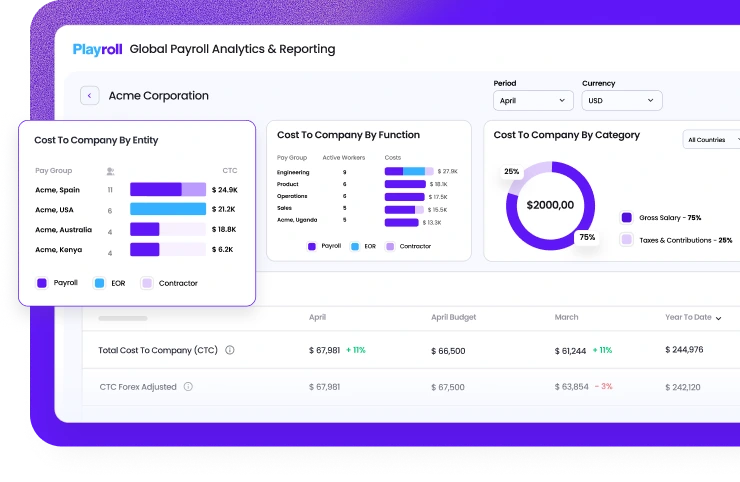
In St Kitts and Nevis, foreign nationals who wish to live and work in the country generally need both immigration permission (such as a Visitor Visa, Temporary Residence, or Long-Term Residence) and a separate Work Permit issued by the Ministry of National Security and Immigration, often in coordination with the Department of Labour. The work authorization is usually tied to a specific employer, role, and location, and must be obtained before the employee starts work.
Common routes include a Temporary Work Permit for employees hired by local entities, a Temporary Residence Permit for those staying longer than a standard visitor period, and, in some cases, a Business or Investor-related status for senior executives or shareholders. Employers are expected to demonstrate that no suitably qualified Kittitian or Nevisian national is available for the role and to maintain compliance with local labor, tax, and social security rules throughout the employee’s assignment.
Mandatory Leave Entitlement in St Kitts and Nevis
The annual leave entitlement in St Kitts and Nevis is 14 days for a full time worker, exclusive of Sundays and public holidays. These 14 days are paid holiday days that employees are entitled to after completing one year of service.
An Employer of Record (EOR) helps businesses manage annual leave, paid time off (PTO), and local holidays across the globe, including in St Kitts and Nevis. By partnering with an EOR, companies ensure full compliance with local labor laws in St Kitts and Nevis when it comes to annual leave and time-off management. EOR providers like Playroll offer platforms that simplify tracking and managing employee time off in St Kitts and Nevis. By outsourcing this responsibility to Playroll, you can streamline leave management, ensure compliance, and free up time to focus on other business priorities.
Employee benefits in St Kitts and Nevis are built around the Social Security system, statutory leave entitlements, and employer practices that reflect a relatively small and relationship‑driven labour market. As an international employer, you will usually be expected to at least mirror local norms on leave and statutory contributions, and then layer on supplemental perks to stay competitive.
Your company should think of benefits as part of your overall employment value proposition in St Kitts and Nevis. Meeting legal minimums protects you from compliance risk, while going beyond them with healthcare support, retirement savings, and flexible work options can significantly strengthen retention and engagement, especially for skilled or remote roles.
- Top mandatory benefits: Social Security contributions, maternity leave, paid public holidays, paid annual vacation leave, and sick leave (statutory or contractual).
- Top supplemental benefits: Private health insurance or medical stipends, enhanced retirement or savings plans, and performance‑linked bonuses or allowances.
- Key legal and tax points: mandatory registration and contributions to the St Christopher and Nevis Social Security Board, proper record‑keeping for leave and wages, and understanding that most cash benefits are treated as taxable employment income while employer Social Security contributions are generally deductible business expenses.
Administering employee benefits in St Kitts and Nevis requires more than just offering a standard package. Local labor laws often mandate specific entitlements, from health insurance to paid leave, and the rules can change without warning. St Kitts and Nevis also has unique standards for what an attractive, competitive benefits package looks like. For businesses without in-country expertise, meeting these obligations and expectations can quickly become risky and expensive. An Employer of Record acts as your compliance partner, ensuring all benefits are provided according to the latest legal requirements and without administrative strain on your internal team.
Beyond compliance, an EOR brings clarity and consistency to a process that’s often complex and fragmented. They handle enrollments, ensure accurate employer contributions, manage communications with local providers, and keep everything properly documented. This means employees get what they’re entitled to, and you avoid the headache of navigating benefits systems in a foreign market. Whether you're hiring one person or building a larger team, an EOR provides a clear, dependable structure that lets you offer competitive benefits without taking on unnecessary risk or workload.
Disclaimer
THIS CONTENT IS FOR INFORMATIONAL PURPOSES ONLY AND DOES NOT CONSTITUTE LEGAL OR TAX ADVICE. You should always consult with and rely on your own legal and/or tax advisor(s). Playroll does not provide legal or tax advice. The information is general and not tailored to a specific company or workforce and does not reflect Playroll’s product delivery in any given jurisdiction. Playroll makes no representations or warranties concerning the accuracy, completeness, or timeliness of this information and shall have no liability arising out of or in connection with it, including any loss caused by use of, or reliance on, the information.

ABOUT THE AUTHOR
Jesse Weisz
Jesse is an experienced R&D Analyst at Playroll, a leading Employer of Record (EOR) provider. With a strong background in data analysis and market research, Jesse specializes in identifying emerging trends and driving innovation in global HR solutions. She is an all-rounder, critical thinker and success-seeker (often inextricably linked to being a late-night tea drinker).

.svg)


.png)

















.webp)


.svg)