.svg)
.svg)

.svg)


.svg)

.svg)
.svg)
.svg)
.svg)
.svg)
.svg)
.svg)
.svg)
Minimum Wage: The statutory minimum wage in Paraguay is PYG 2,899,408 per month.
Working Hours: In Paraguay, the standard work week consists of 48 hours, with 8 hours per day.
Payroll Taxes: In Paraguay, employers contribute about 16.5% in payroll taxes, which typically cover social security, health care, and other statutory benefits.
Average Salary: The average gross monthly salary in Paraguay is approximately PYG 4,000,000–4,300,000 (about USD 520–560) as of early 2026.
Hiring independent contractors has boomed in popularity because of the cost savings and flexibility they offer. It can be a great option if you require niche skills or short-term project support. Contractors allow businesses to access specialized skills quickly, without the time and cost of setting up a local entity.
However, it’s important to know the limits of this model: contractors are not a substitute for full-time employees. Relying on them for ongoing, long-term roles can create serious compliance risks, including employee misclassification, which can lead to fines, back taxes, and reputational damage.
Playroll’s contractor management solutions make it simple to compliantly engage, onboard, and pay contractors around the world. We provide clear visibility into agreements, streamline payments, and reduce compliance risks – so you can focus on getting the work done. And when you’re ready to take the next step, we can help seamlessly convert contractors into full-time employees through our global Employer of Record service.
From compliant contracts to competitive benefits, Playroll’s EOR services keep you aligned with local labor laws and regulations, safeguarding your business, so you can focus on growth.
Book a Demo
Businesses can only operate smoothly in Paraguay if they comply with local labor laws including drafting compliant employment contract agreements and meeting taxation and payroll obligations. Learn more about the employment laws and regulations in Paraguay below, to avoid any compliance issues.
Employment Contract Requirements
In Paraguay, written employment contracts are required for most types of employment. These contracts, in Spanish and signed by both parties, must specify:
- Termination terms
- Notice period
- Working hours
- Bonuses
- Holiday leave
- Sick leave
- Duties
- Confidentiality provisions
- Agreed salary should be in Paraguayan guaranÃ
Onboarding Process
We can help you get a new employee started in Paraguay quickly, with a minimum onboarding time of just 1-2 working days. The timeline starts once the employee submits all required information onto the Playroll platform and completes any necessary local authority registrations.
For non-nationals, the Right to Work assessment (if applicable) may add up to three extra days. Additional time may be needed for follow-ups on this assessment. Please note, payroll cut-off dates can impact the actual start date. Playroll's payroll cut-off date is the 10th of each month unless otherwise specified.
Working Hours in Paraguay
In Paraguay, the standard workweek consists of 48 hours, with 8 hours per day. However, if employees work between 8:00 pm and 6:00 am, their weekly hours must not exceed 42.
Overtime in Paraguay
In Paraguay, overtime is voluntary and must be agreed upon by both employer and employee. The maximum overtime allowed is 10 hours per week or 3 hours per day. Overtime compensation is 150% for daytime work and 200% for work on Sundays, nights, or holidays, applicable when employees exceed 48 hours per week.
Probation Period in Paraguay
In Paraguay, probation periods are mandatory for employment contracts. They last:
- 30 days for unqualified employees or domestic workers.
- 60 days for qualified workers or apprentices.
- 90 days for highly skilled workers.
In Paraguay, the average gross monthly salary in early 2026 is estimated at around PYG 4,000,000–4,300,000 (about USD 520–560), which serves as a practical benchmark as you budget for your team. Actual pay varies significantly by experience, industry, and location, with higher salaries common in information technology, finance and banking, and energy or utilities. Wages in major cities like Asunción and key urban centers such as Ciudad del Este and Encarnación tend to be above the national average, so your company may need to offer higher pay in these areas to attract and retain talent.
Macroeconomic conditions are also shaping wage expectations, with annual inflation in Paraguay running at roughly 3–4% in late 2025 and early 2026, which you should factor in as you plan annual salary reviews. Real GDP growth is projected at about 3.5–4.5% for 2025–2026, supporting gradual improvements in productivity and pay levels for your workforce. An unemployment rate in the range of 6–8% provides your company with a reasonably broad pool of candidates, while still requiring competitive offers for skilled roles.

In Paraguay, you should plan rosters around day, night, and mixed schedules and use overtime only with written approval and strong timekeeping. In 2026, inspections commonly focus on whether you stay within statutory overtime caps and whether your payroll calculations match recorded hours.
- Standard Working Hours: Day work – 8 hours per day and 48 hours per week; night work – 7 hours per day and 42 hours per week; mixed work – 7.5 hours per day and 45 hours per week.
- Overtime Thresholds: Overtime starts beyond the applicable schedule limits and is capped at 3 overtime hours per day and 57 total hours per week including overtime.
- Overtime Pay Rates: Standard overtime – +50% (150% total); weekly rest days or public holidays – +100% (200% total).
- Daily And Weekly Rest Requirements: Weekly rest is typically 24 consecutive hours.
- Night Work Restrictions: Night work is generally defined as 20:00–06:00 and uses the reduced 42-hour weekly cap.
- Penalties For Non–Compliance: Exposure includes administrative fines and mandatory back pay for unpaid overtime premiums.

In Paraguay, the current minimum wage is set by the Consejo Nacional de Salarios Mínimos, with compliance being a key obligation for employers.
- The current minimum wage is PYG 2,899,408 per month, approximately USD 400.00.
- Pay frequency is monthly, effective from 1 July 2025.
- The wage is set by the Consejo Nacional de Salarios Mínimos (CONASAM).
- Review cycles consider inflation and cost-of-living indices.
- Key exemptions include apprentices and small businesses, subject to approval.
- Penalties for non-compliance range from 30 minimum daily wages per violation.
- Employer contribution rates include Social Security at 16.5%, Health Insurance at 9%, and Pension at 7.5%.
Employment laws in Paraguay can be intricate, and even unintentional mistakes in contracts, benefits, or termination processes can carry legal and reputational consequences. With an Employer of Record, you gain a local partner that ensures every hire is compliant. The EOR takes care of drafting compliant contracts, processing accurate payroll, managing contributions to statutory benefits, and handling lawful terminations if needed, all according to local employment standards.
This level of protection is especially valuable when expanding into new or unfamiliar regions. Instead of using time and resources to build in-house legal knowledge, you gain immediate access to local expertise. The EOR keeps you ahead of regulatory updates and shields your company from potential compliance gaps, so you can confidently hire and manage employees while minimizing risk. For hiring managers and founders, it's the difference between hiring with uncertainty and building your team on a legally sound foundation.
Employer Tax Contributions
Employer payroll contributions are generally estimated at an additional 16.5% on top of the employee salary in Paraguay.
Employee Payroll Tax Contributions
In Paraguay, the typical estimation for employee payroll contributions cost is around 9%.
Individual Income Tax Contributions
The individual income tax in Paraguay ranges from 8% to 10%. The tax calculation is based on progressive rates. The income tax is calculated annually, based on the income earned during the calendar year.
Pension in Paraguay
In Paraguay, both employers and employees must make mandatory pension contributions. An individual aged 60 with at least 25 years of service receives 100% of the average salary of the last 36 months. Alternatively, those with a minimum of 30 years of service and aged 55 can receive 80% of the average salary of the last 36 months.

To run payroll in Paraguay in 2026, you need to register with SET and IPS, calculate IPS contributions of roughly 16.5% for employers and 9% for employees, apply IRP income tax withholding where thresholds are met, and pay everything in PYG via approved channels by the monthly deadlines. Your total employer cost typically reaches about 17.5%–19% above gross salary once you include labor accident insurance, so building accurate cost models, using reliable payroll tools, and reconciling filings with payslips each month is essential for staying compliant and avoiding penalties.
- Core Contributions: Budget for employer IPS at around 16.5% plus 1%–2% labor risk insurance on top of gross salaries.
- Employee Deductions: Withhold approximately 9% for IPS and apply IRP income tax when employees exceed annual thresholds.
- Mandatory Registrations: Secure a RUC with SET and register with IPS before hiring or running your first payroll.
- Operational Cadence: Run payroll monthly, pay in PYG, and align payment dates with IPS and SET due-date calendars.
- Scalable Approach: Use an Employer of Record or local payroll provider if you lack a Paraguayan entity but still need compliant hiring.
When you’re scaling quickly, setting up local payroll systems in each new country slows you down. In Paraguay, the administrative load can include government registration, benefits management, and accurate, on-time payment delivery. An EOR gives you a plug-and-play solution that handles all of this while your internal team stays focused on growth, not red tape.
Key Ways an EOR Supports Payroll in Paraguay:
- Rapid Payroll Setup: Onboards employees quickly with ready-to-go infrastructure.
- End Administration: Handles salary, tax, and benefits with no extra internal resources.
- Vendor Simplicity: Consolidates payroll across countries for centralized oversight.
- No Entity Required: Operates legally, saving your business the time and resources needed for local incorporation.
Make better business decisions by consolidating global payroll data, while seamlessly syncing your existing payroll operations.
Book a Demo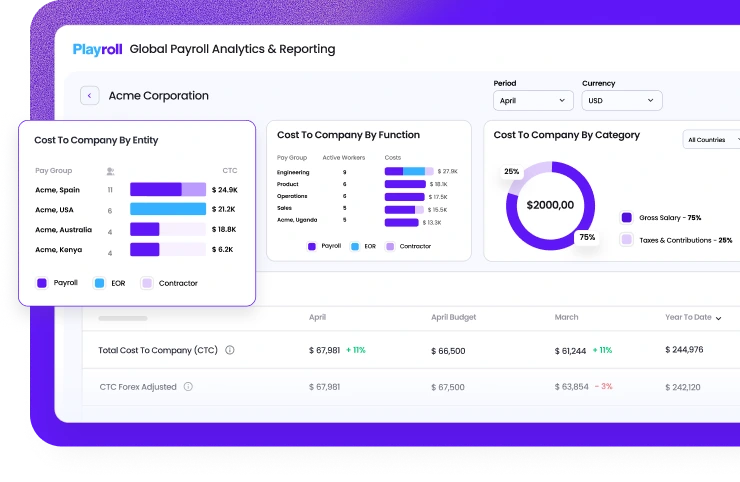
Paraguay’s immigration framework distinguishes between short-term entry (often under a business or tourist visa), temporary residence with work authorization, and permanent residence for longer-term stays. Foreign nationals who wish to work in Paraguay typically need to obtain Residencia Temporaria (Temporary Residence) combined with a work authorization, or move toward Residencia Permanente (Permanent Residence) if they plan to stay and work in the country on a long-term basis.
Employers that hire foreign talent must ensure that the right combination of visa, residence, and work authorization is in place before the employee starts work. This usually involves securing an entry visa if required (depending on nationality), applying for temporary residence and a Paraguayan ID card (Cédula de Identidad), and registering the employee with local labor and social security authorities. Processing times can vary, so planning ahead is essential for compliant onboarding.
Mandatory Leave Entitlement in Paraguay
The annual leave entitlement in Paraguay is 12 days for a full time worker. These can include public holidays on top of that or within those days, which would otherwise be unpaid.
Public Holidays In Paraguay
Paraguay has 11 mandatory national public holidays in a year.
Paid Time Off in Paraguay
In Paraguay, annual leave entitlements are based on tenure with the employer and accrue as follows:
- 1 to 5 years of service: 12 days
- 5 to 10 years of service: 18 days
- Over 10 years of service: 30 days
Maternity Leave In Paraguay
In Paraguay, employees are entitled to 18 weeks of fully paid maternity leave, managed by Social Security (IPS) with a medical certificate. Additional conditions include:
- Six extra weeks for illness during pregnancy or delivery.
- An additional 30 days per child for multiple births.
- Adoptive mothers receive 18 weeks of leave for children under six months and 12 weeks for older children. Extensions may be granted under special circumstances.
Paternity Leave In Paraguay
After the birth of a child in Paraguay, employees are entitled to 2 weeks (14 calendar days) of paid paternity leave. During this period, the employee will receive their regular salary, which will be paid by the employer.
Sick Leave In Paraguay
In Paraguay, employees qualify for paid sick leave after contributing to Social Security for at least four weeks. Sick leave can last up to 26 weeks, with Social Security (IPS) covering 50% of the employee's salary, based on the average income from the previous four months. Payments are managed through the employer.
Parental Leave In Paraguay
Paraguay does not have a separate shared parental leave policy.
Employee benefits in Paraguay combine strong statutory protections with growing expectations for more flexible, employee-centric perks. Your company will need to comply with a clear set of mandatory benefits, then decide how far to go beyond the legal minimum to stay competitive in the local market.
When you plan your total rewards strategy, think holistically: required contributions to social security, paid leave, and the statutory bonus all affect your total cost of employment, while voluntary benefits like private health cover, meal vouchers, and transport support can significantly influence how attractive your offer feels to Paraguayan candidates.
- Top mandatory benefits include: enrollment in the Instituto de Previsión Social (IPS) social security system, paid annual vacation leave with vacation bonus, paid public holidays and weekly rest, maternity and paternity leave, and the “aguinaldo” 13th-month bonus.
- Key supplemental benefits include: private health insurance or medical top-ups, meal vouchers or cafeteria subsidies, and performance or retention bonuses beyond the mandatory aguinaldo.
- Key legal and tax considerations include: mandatory IPS registration and contributions, income tax treatment of cash compensation and bonuses, proper tracking and documentation of leave and benefits, and ensuring your supplemental benefits do not discriminate between employees in comparable roles.
For startups and small teams, managing global employee benefits isn’t just complex, it’s a full-time job. In Paraguay, understanding what benefits are required, how to deliver them, and how to stay compliant can be overwhelming, especially without local HR expertise. An Employer of Record removes that pressure by taking complete ownership of benefits administration, so you don't have to become an expert in local employment law.
Whether it’s healthcare contributions, pension enrollment, or statutory leave, the EOR ensures everything is delivered accurately and on time. They navigate any country-specific nuances, keep up with legal changes, and ensure each benefit is properly tracked and documented. For founders, that means fewer distractions and more time to focus on growth. Your employees get the security and support they expect from a local employer, and you get to scale your team in Paraguay without building complex infrastructure or worrying about compliance missteps.
Termination Process in Paraguay
In Paraguay, termination procedures vary based on employment agreements, contracts, and reasons for termination. Employers must provide written notice of termination. Employers are limited in unjustly terminating employees with over ten years of employment unless a valid cause exists. Fair termination reasons include:
- The dismissal of the worker for just cause or without just cause (with severance payment)
- Resignation of the worker or withdrawal for justified reasons
- Mutual agreement
- By expiration of the contract
Notice Period in Paraguay
In Paraguay, the minimum mandatory notice period is one day, which increases based on tenure:
- 30 days for employees with up to 1 year of service
- 45 days for employees with 1 year to 5 years of service
- 60 days for employees with 5 years to 10 years of service
- 90 days for employees with more than 10 years of service
Severance in Paraguay
In Paraguay, employees terminated due to redundancy or unsuitability are entitled to severance pay. If terminated without valid reason, the employer must compensate them with 15 days' wages for each year of service, or a proportional amount for six months of service.
Disclaimer
THIS CONTENT IS FOR INFORMATIONAL PURPOSES ONLY AND DOES NOT CONSTITUTE LEGAL OR TAX ADVICE. You should always consult with and rely on your own legal and/or tax advisor(s). Playroll does not provide legal or tax advice. The information is general and not tailored to a specific company or workforce and does not reflect Playroll’s product delivery in any given jurisdiction. Playroll makes no representations or warranties concerning the accuracy, completeness, or timeliness of this information and shall have no liability arising out of or in connection with it, including any loss caused by use of, or reliance on, the information.

ABOUT THE AUTHOR
Jesse Weisz
Jesse is an experienced R&D Analyst at Playroll, a leading Employer of Record (EOR) provider. With a strong background in data analysis and market research, Jesse specializes in identifying emerging trends and driving innovation in global HR solutions. She is an all-rounder, critical thinker and success-seeker (often inextricably linked to being a late-night tea drinker).

.svg)


.png)

















.webp)


.svg)