.svg)
.svg)

.svg)


.svg)

.svg)
.svg)
.svg)
.svg)
.svg)
.svg)
.svg)
.svg)
Minimum Wage: The current minimum monthly wage in Chile is CLP 529,000, which is equivalent to approximately $535.
Working Hours: The standard maximum working hours per week are 44, reduced from 45 hours.
Payroll Taxes: In Chile, employers contribute about 1% in payroll taxes, which typically cover social security, health care, and other statutory benefits.
Average Salary: The average gross monthly salary in Chile is approximately CLP 1,050,000–1,120,000 (about USD 1,100–1,170) as of early 2026.
Hiring independent contractors has boomed in popularity because of the cost savings and flexibility they offer. It can be a great option if you require niche skills or short-term project support. Contractors allow businesses to access specialized skills quickly, without the time and cost of setting up a local entity.
However, it’s important to know the limits of this model: contractors are not a substitute for full-time employees. Relying on them for ongoing, long-term roles can create serious compliance risks, including employee misclassification, which can lead to fines, back taxes, and reputational damage.
Playroll’s contractor management solutions make it simple to compliantly engage, onboard, and pay contractors around the world. We provide clear visibility into agreements, streamline payments, and reduce compliance risks – so you can focus on getting the work done. And when you’re ready to take the next step, we can help seamlessly convert contractors into full-time employees through our global Employer of Record service.
From compliant contracts to competitive benefits, Playroll’s EOR services keep you aligned with local labor laws and regulations, safeguarding your business, so you can focus on growth.
Book a Demo
Businesses can only operate smoothly in Chile if they comply with local labor laws including drafting compliant employment contract agreements and meeting taxation and payroll obligations. Learn more about the employment laws and regulations in Chile below, to avoid any compliance issues.
Employment Contract Requirements
When it comes to employment in Chile, there are three main types of agreements: individual contracts, collective contracts, and special contracts (like apprenticeships). Collective contracts set general employment terms, but the actual job relationship begins with an individual contract, which can be either permanent or temporary. As per Chilean Labor Code Article 10, the agreement needs to cover basics like:
- Identification of both parties
- Contract date and place
- Job details
- Pay terms
Onboarding Process
We can help you get a new employee started in Chile quickly, with a minimum onboarding time of just 1-2 working days. The timeline starts once the employee submits all required information onto the Playroll platform and completes any necessary local authority registrations. For non-nationals, the Right to Work assessment (if applicable) may add up to three extra days. Additional time may be needed for follow-ups on this assessment. Please note, payroll cut-off dates can impact the actual start date. Playroll's payroll cut-off date is the 10th of each month unless otherwise specified.
Working Hours in Chile
The standard maximum working hours per week are 44, reduced from 45 hours. The allocation of the reduction must be agreed upon by the parties.
Overtime in Chile
Employees can work up to two extra hours a day or ten extra hours a week. For this overtime, they get paid 50% more than their regular salary for that day. Parties may agree on up to 5 additional days off, instead of receiving a premium for overtime hours worked.
Probation Period in Chile
The labor laws don't set rules for how long an employee's probation period should be. An employee with a fixed contract may be considered as being on probation for the duration of the contract, to a maximum of 12 months.
In Chile, the average gross monthly salary in early 2026 is around CLP 1,050,000–1,120,000 (about USD 1,100–1,170), which serves as a practical benchmark as you budget for your team. Actual pay varies significantly by experience level, industry, and location, with sectors such as information technology, finance and banking, mining, and energy typically offering higher wages, so your company may need to offer above-average salaries to attract talent there. Wages in major cities like Santiago, Valparaíso, and Concepción tend to be higher than in smaller regions, which will influence what you need to pay your employees in these urban centers.
As you plan compensation for your workforce, you should factor in Chile’s current macroeconomic context, where annual inflation has eased to roughly 3–4% in late 2025 and early 2026, supporting more predictable wage adjustments. Real GDP growth is projected at about 2–3% for 2025–2026, indicating a gradually improving environment in which you can expect steady but not rapid salary pressure. Unemployment is hovering around 8–9%, giving you access to a relatively broad pool of candidates while still requiring competitive offers to secure skilled professionals for your company.

In Chile, you should update scheduling rules and employment documentation to align with the phased reduction of ordinary weekly hours and keep overtime tightly controlled and recorded. In 2026, compliance checks are likely to focus on whether you have implemented the reduced weekly cap correctly and whether overtime is being used within legal limits and paid accurately.
- Standard Working Hours: 44 hours per week is in effect under the phased reduction, decreasing to 42 hours per week in 2026.
- Overtime Thresholds: Overtime is limited to 2 hours per day.
- Overtime Pay Rates: Overtime must be paid with at least a +50% surcharge, equal to 1.5 times the regular hourly rate.
- Daily And Weekly Rest Requirements: Ensure schedules provide a full weekly rest day and maintain records showing rest is taken.
- Night Work Restrictions: Night shift premiums are often addressed by contract or policy, while overtime rules still apply when limits are exceeded.
- Penalties For Non Compliance: Exposure typically includes fines and back pay for unpaid overtime and record keeping failures.

As of 2026, Chile's minimum wage rates are as follows:
- Adults aged 18 to 65: CLP 539,000 per month (approximately USD 560- USD 575)
- Minors under 18 and seniors over 65: CLP 402,082 per month (approximately USD 415)
- Non-remunerative minimum income: CLP 340,988 per month (approximately USD 355)
These adjustments follow agreements between the Chilean government and the Central Unitaria de Trabajadores (CUT) and form part of broader efforts to strengthen workers’ purchasing power, reduce poverty, and improve labour conditions. Together with the ongoing reduction of statutory working hours, the 2026 minimum wage framework reflects Chile’s continued focus on wage equity and social protection across sectors.
Global expansion shouldn't mean losing time to paperwork or dealing with complicated, country-specific HR systems. An Employer of Record helps you keep your focus on talent by handling the operational side of employment in Chile. That includes onboarding, contract management, payroll processing, and statutory compliance, all aligned with local laws and best practices. The EOR guarantees that employees are legally employed and properly supported from day one.
This streamlined setup allows you to prioritize recruiting the best people and integrating them into your company culture. Your team stays lean, and you avoid getting caught up in the details of local processes or shifting regulations. For founders, global hiring managers, or HR teams working across borders, an EOR multiplies your impact, reducing admin time, preventing errors, and helping ensure that new hires have a smooth experience from the get-go.
Employer Tax Contributions
Employer payroll contributions are generally estimated at an additional 4.24% on top of the employee salary in Chile.
Employee Payroll Tax Contributions
In Chile , the typical estimation for employee payroll contributions cost is around 17.6%.
Individual Income Tax Contributions
Individual income tax in Chile is calculated based on progressive rates ranging from 0% to 40%. The tax is applied to monthly income, and 1 Monthly Tax Unit is equivalent to approximately 68,306 CLP as of August 2025, but changes monthly.
Pension in Chile
Employees are required to contribute approximately 10% to their pension. Getting the old-age pension is a choice. To qualify, employees need to be 65 (for men) or 60 (for women) and be part of AFP (Administradoras de Fondos de Pensiones).

Managing payroll taxes in Chile requires careful attention to the country's comprehensive social security system and progressive income tax structure. Starting August 1, 2025, Chile introduced a new mixed pension and social security system requiring employers to make mandatory contributions starting with an additional 1% of employees’ taxable income. This contribution is divided between the individual capitalization account and the Autonomous Pension Protection Fund.
The employer contribution is planned to gradually increase over nine years to a total of 8.5%, which will support individual accounts, mandatory loans to the State, and a new social insurance system aimed at strengthening social protection, improving pensions, and addressing gender disparities. This reform represents a significant increase in employer pension-related costs and is subject to social security contribution caps. The full implementation is expected around 2033, and employers must adjust payroll practices accordingly.
Monthly submissions to government authorities are required between the 10th and 12th of each month, with strict penalties for non-compliance. The Chilean system includes specific requirements for employee registration, documentation, and record-keeping that businesses must follow.
Using specialized payroll management software like Playroll can significantly simplify these processes, helping employers consolidate payroll data, ensure accurate calculations, meet submission deadlines, and maintain compliance with Chile's evolving tax and labor regulations.
Hiring in Chile means taking on local payroll obligations, which often include unique tax rates, contribution rules, and strict documentation. If you're not familiar with the system, or don't have a local entity, it’s easy to make mistakes. That’s where an Employer of Record ccomes in. The EOR manages payroll for your team on your behalf, ensuring every process is accurate, timely, and legally compliant.
Key Ways an EOR Supports Payroll in Chile:
- Full Legal Compliance: Ensures all payments, deductions, and filings meet country-specific requirements.
- Payroll Setup & Processing: Handles salary calculations, tax withholdings, and local reporting obligations.
- Statutory Benefit Contributions: Pays into required social programs and manages country-mandated benefits.
- Employee Documentation: Generates compliant contracts and manages hiring and termination paperwork.
- Local Currency Payouts: Delivers salaries in local currency, avoiding delays or exchange rate issues for employees.
Make better business decisions by consolidating global payroll data, while seamlessly syncing your existing payroll operations.
Book a Demo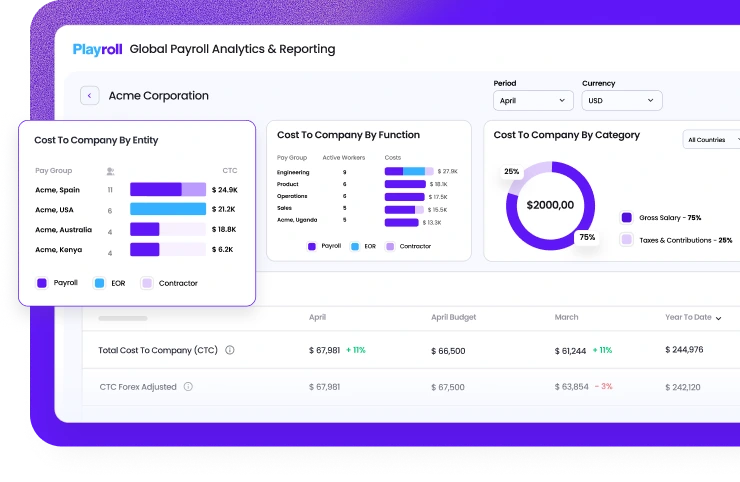
Chile’s immigration framework offers several routes for foreign nationals to live and work legally, including the Visa de Residencia Temporal para Trabajadores (Temporary Residence Visa for Workers), the Visa de Residencia Temporal para Reunificación Familiar (family-based), and the Visa de Residencia Temporal para Inversionistas y Emprendedores (for investors and entrepreneurs). Most foreign employees will work under a temporary residence category that authorizes remunerated activities with a specific employer and role, and may later transition to permanent residence if they meet stay and income conditions.
Employers that hire foreign talent must comply with Chilean labor, social security, and tax rules, and in many cases must issue a compliant employment contract and support the online application before the Servicio Nacional de Migraciones (National Migration Service). Processing is largely digital, but requirements and timelines can vary by consulate, visa type, and the applicant’s personal situation, so careful planning and up-to-date advice are essential.
Mandatory Leave Entitlement in Chile
The annual leave entitlement in Chile is 15 days for a full time worker. These can include public holidays on top of that or within those days, which would otherwise be unpaid.
Public Holidays In Chile
Public holidays that fall on the weekend are usually forfeited.
Paid Time Off in Chile
Employees with at least 1 year of service get 15 days of paid leave. After 10 years of employment for one or more employers, an employee will earn an additional day off for every 3 years of service with the current employer.
Maternity Leave In Chile
Female employees are entitled to a total of 18 weeks of maternity leave - Six weeks before the child is born, and 12 weeks after the birth. Women are entitled to an additional 12 weeks of leave after the compulsory maternity leave is completed. The social security system covers the wages of the employee, up to a prescribed legal cap.
Paternity Leave In Chile
Fathers are eligible for 5 days of paid paternity leave.
Sick Leave In Chile
If employees get sick, Social Security pays for sick leave starting from the 4th day off. If the illness lasts more than 10 days, they get benefits from the first day. A doctor's note must be provided within 2 days of starting sick leave.
Parental Leave In Chile
Women employees can take 10 days of leave for a child under 18. Although they are entitled to payment during this period, they need to compensate for the time off at a later date.
Bereavement Leave
Employee is entitled to 10 days of Bereavement leave for the death of a child and 7 days for the death of a spouse/civil partner.
Marriage Leave
Employee is entitled to 5 days of paid leave in the case of marriage.
Chile’s employee benefits framework combines mandatory social security contributions with strong protections in the Labor Code. Core statutory benefits include pension contributions to the AFP system, health insurance through FONASA or Isapre, paid annual leave, family-related leave such as maternity and paternity leave, and severance pay in cases of unjustified dismissal. Together, these benefits support employee welfare across health, income security, and family life.
To stay competitive, many employers in Chile offer supplemental benefits such as private health insurance upgrades, meal and transportation vouchers, flexible work arrangements, and performance-based bonuses. Mandatory contributions are typically deductible, while cash allowances and bonuses are taxable and must be reported accurately. Ongoing compliance requires correct registrations, timely social security contributions, and regular reviews of benefit policies to reflect changes in labor and tax regulations.
Key takeaways:
- Mandatory benefits: AFP pension contributions, health insurance (FONASA or Isapre), paid annual leave, family-related leave, and severance pay.
- Supplemental benefits: Private health upgrades, meal and transport vouchers, flexible work options, and performance bonuses.
- Legal and tax considerations: Governed by the Chilean Labor Code; mandatory contributions are deductible; accurate payroll reporting is essential.
When hiring across multiple countries, maintaining consistency in how you deliver employee benefits quickly gets tricky. Each country, including Chile, has its own legal rules, cultural norms, and contribution systems. An Employer of Record helps you strike the right balance between global structure and local compliance. They take over the complexity of delivering benefits that are aligned with Chile’s legal requirements and competitive with local market expectations.
From ensuring statutory benefits are in place to managing local onboarding timelines and enrollment systems, the EOR provides a seamless experience for both employer and employee. This makes it easier to grow your team across borders without reinventing your benefits process in each new location. You stay in control of your overall benefits strategy, while the EOR takes care of executing it in a way that works legally and culturally in Chile. It’s a smarter way to scale benefits globally without losing local relevance.
Termination Process in Chile
To terminate an employee in Chile, a valid reason must be determined. According to the law, acceptable reasons for termination include:
- Mutual agreement
- Resignation
- Breach of contract
- Company needs or reorganization
Notice Period in Chile
According to the law, the notice period for termination is one month. However, it's common for the notice period to be skipped, and instead, payment is made in place of the notice.
Severance in Chile
If an employee has worked for at least one year, they are entitled to severance pay. For each year up to 11 years, they get one month's salary. After the first year, they earn an extra month of severance pay if they have worked for at least half of the following year. The monthly salary used for severance calculation is capped at 90 UF.
Disclaimer
THIS CONTENT IS FOR INFORMATIONAL PURPOSES ONLY AND DOES NOT CONSTITUTE LEGAL OR TAX ADVICE. You should always consult with and rely on your own legal and/or tax advisor(s). Playroll does not provide legal or tax advice. The information is general and not tailored to a specific company or workforce and does not reflect Playroll’s product delivery in any given jurisdiction. Playroll makes no representations or warranties concerning the accuracy, completeness, or timeliness of this information and shall have no liability arising out of or in connection with it, including any loss caused by use of, or reliance on, the information.

ABOUT THE AUTHOR
Jesse Weisz
Jesse is an experienced R&D Analyst at Playroll, a leading Employer of Record (EOR) provider. With a strong background in data analysis and market research, Jesse specializes in identifying emerging trends and driving innovation in global HR solutions. She is an all-rounder, critical thinker and success-seeker (often inextricably linked to being a late-night tea drinker).

.svg)


.png)

















.webp)


.svg)