.svg)
.svg)

.svg)


.svg)

.svg)
.svg)
.svg)
.svg)
.svg)
.svg)
.svg)
.svg)
Minimum Wage: The current minimum hourly wage in the Cayman Islands (from 1 Jan 2026) is CI$8.75/hour, which is approximately $10.60 USD/hour, or about $1,837/month (assuming 40 h/week × 4.33 weeks).
Working Hours: In the Cayman Islands, the work week is usually 40–45 hours, typically Monday to Friday.
Payroll Taxes: In Cayman Island, employers are required to make payroll contributions that fund social security, health care, and other statutory employee benefits.
Average Salary: The average gross monthly salary in Cayman Islands is approximately KYD 3,800–4,200 (about USD 4,560–5,040) as of early 2026.
Hiring independent contractors has boomed in popularity because of the cost savings and flexibility they offer. It can be a great option if you require niche skills or short-term project support. Contractors allow businesses to access specialized skills quickly, without the time and cost of setting up a local entity.
However, it’s important to know the limits of this model: contractors are not a substitute for full-time employees. Relying on them for ongoing, long-term roles can create serious compliance risks, including employee misclassification, which can lead to fines, back taxes, and reputational damage.
Playroll’s contractor management solutions make it simple to compliantly engage, onboard, and pay contractors around the world. We provide clear visibility into agreements, streamline payments, and reduce compliance risks – so you can focus on getting the work done. And when you’re ready to take the next step, we can help seamlessly convert contractors into full-time employees through our global Employer of Record service.
From compliant contracts to competitive benefits, Playroll’s EOR services keep you aligned with local labor laws and regulations, safeguarding your business, so you can focus on growth.
Book a Demo
Businesses can only operate smoothly in Cayman Island if they comply with local labor laws including drafting compliant employment contract agreements and meeting taxation and payroll obligations. Learn more about the employment laws and regulations in Cayman Island below, to avoid any compliance issues.
Onboarding Process
We can help you get a new employee started in Cayman Island quickly, with a minimum onboarding time of just 1-2 working days. The timeline starts once the employee submits all required information onto the Playroll platform and completes any necessary local authority registrations. For non-nationals, the Right to Work assessment (if applicable) may add up to three extra days. Additional time may be needed for follow-ups on this assessment.
In Cayman Islands, the average gross monthly salary in early 2026 is in the region of KYD 3,800–4,200 (around USD 4,560–5,040), which serves as a practical benchmark as you budget for your team. Actual pay varies significantly by experience, role, and location, with higher salaries common in financial services, legal and professional services, and information technology. Wages in major economic centres such as George Town and the wider Grand Cayman area tend to be above the national average, so your company may need to offer higher pay there to attract and retain qualified employees.
As you plan compensation for your workforce, you can expect wage decisions to be shaped by a macroeconomic backdrop of relatively low but positive inflation of roughly 3–4% in late 2025 and early 2026. Real GDP growth is projected to remain solid at about 2.5–3.5% annually over 2025–2026, supported by tourism, financial services, and ongoing construction activity. Unemployment is low, generally around 3–4%, which means a tight labour market and strong competition for skilled talent, so you may need to factor in regular salary reviews and competitive benefits to secure and keep the employees your company needs.

In the Cayman Islands, you should define normal hours in the employment contract, enforce pre approval for overtime, and keep accurate daily time logs to support payroll calculations. In 2026, scrutiny is likely to focus on whether you are paying overtime correctly, preserving weekly time off, and maintaining compliant records.
- Standard Working Hours: 45 hours per week, typically 9 hours per day over 5 days or 7.5 hours per day over 6 days.
- Overtime Thresholds: Overtime is payable after 9 hours per day or 45 hours per week.
- Overtime Pay Rates: Overtime is paid at 1.5 times the regular hourly rate, and public holiday work is paid at 2 times the regular hourly rate.
- Daily And Weekly Rest Requirements: Employees must receive 1 full 24 hour day off each week.
- Night Work Restrictions: No general statutory night premium is typically mandated, but overtime rules still apply when limits are exceeded.
- Penalties For Non Compliance: Exposure typically includes orders to correct underpayment and back pay for unpaid overtime.

The current minimum wage in the Cayman Islands is CI$8.75 per hour, set by the Ministry of Caymanian Employment and Immigration. Employers must ensure compliance with this rate to avoid penalties.
- The current rate is CI$8.75 per hour, approximately USD 10.50.
- Pay frequency is hourly.
- The effective date is 1 January 2026.
- The rate is set by the Ministry of Caymanian Employment and Immigration.
- The review cycle considers inflation and cost-of-living indices.
- Key exemptions include service employees with gratuities and live-in household employees.
- Penalties for non-compliance range from CI$500 to CI$5,000 per violation.
- Employer contribution rates include mandatory pension and health insurance.
Setting up a local legal entity in Cayman Island can be time-consuming and expensive. It often involves complex paperwork, local representation, banking, registrations, and ongoing tax filings, which isn't cost-effective if you're simply looking to hire a few employees or test the market. An Employer of Record removes these barriers entirely. Instead of spending months establishing a presence, an EOR lets you hire and onboard employees within days while staying fully compliant.
This enables faster market entry and greater agility. Whether you’re launching a pilot program, supporting a regional client, or adding specialized talent, you don't need to commit to long-term infrastructure to explore new business opportunities. The EOR handles local employment logistics while you retain day-to-day oversight of your hires. This model lets you scale up or down based on business needs, giving you more flexibility with less overhead and risk.

To run payroll in Cayman Island in 2026, you need to focus less on income tax and more on statutory benefits such as pensions, health insurance, and immigration-related costs, which typically add around 7% – 15% in employer contributions on top of base salaries. Accurate calculations, timely remittances to pension and insurance providers, and tight coordination with immigration requirements will keep your operation compliant and protect both your employees and your organisation.
- Employer Cost Load: Budget an additional 7% – 15% of salary for employer pension, health insurance, and related statutory costs.
- No Income Tax: Remember that employees do not pay income tax on salaries, so net pay is mainly reduced by pension and insurance deductions.
- Pension Compliance: Apply the standard 10% pension contribution split 5% employer and 5% employee for eligible staff unless a higher plan rate applies.
- Health Coverage: Ensure every eligible employee is covered by at least the standard health insurance plan and that premiums are paid on time.
- Entity Strategy: Decide between setting up a local entity or using an Employer of Record to manage contracts, payroll, and statutory obligations.
One of the biggest risks in global hiring is payroll mismanagement. In Cayman Island, even small errors in tax reporting or social contribution payments can trigger audits, fines, or reputational damage. For companies without in-country expertise, the risk isn’t worth taking. An Employer of Record removes this burden by owning the legal responsibility of payroll, executing every step with built-in compliance.
Key Ways an EOR Supports Payroll in Cayman Island:
- Mitigates Compliance Risk: Oversees all legal obligations for payroll, tax filings, and recordkeeping.
- Local Regulatory Expertise: Interprets and applies Cayman Island’s latest labor and tax changes in real time.
- Free Processing: Reduces mistakes in wage calculations and reporting through built
- Payroll Record Management: Maintains compliant payroll audit trails and documentation for each employee.
Make better business decisions by consolidating global payroll data, while seamlessly syncing your existing payroll operations.
Book a Demo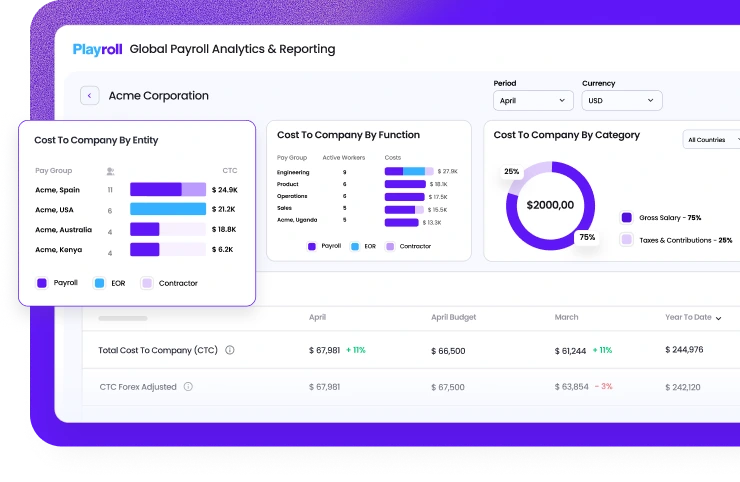
In the Cayman Islands, most foreign nationals who wish to live and work must obtain a work permit issued by the Cayman Islands Department of Workforce Opportunities & Residency Cayman (WORC). Common categories include Temporary Work Permits, Work Permits (1–3 years), and Short-Term Work Permits for assignments of up to six months. Separate pathways such as Residency and Employment Rights Certificates (RERC) and Permanent Residence with the Right to Work may apply for longer-term or senior hires.
Employers are the primary sponsors and must first demonstrate that no suitably qualified Caymanian, Permanent Resident, or existing resident worker is available before hiring a foreign national. The process typically involves advertising the role locally, submitting a detailed work permit application, paying government fees, and ensuring ongoing compliance with immigration and labor regulations. Employees must provide accurate personal documentation, medicals, and police clearances as required.
Mandatory Leave Entitlement in Cayman Island
The annual leave entitlement in Cayman Island is 2 weeks (10 working days) for a full time worker with less than 4 years of service. Annual leave entitlement increases with years of service, up to 3 weeks (15 working days) for workers with 4 years-10 years. For workers with more than 10 years of service, up to 4 weeks 20 working days). In addition, Cayman Island recognizes 13 official public holidays that are observed nationwide.
An Employer of Record (EOR) helps businesses manage annual leave, paid time off (PTO), and local holidays across the globe, including in Cayman Island. By partnering with an EOR, companies ensure full compliance with local labor laws in Cayman Island when it comes to annual leave and time-off management. EOR providers like Playroll offer platforms that simplify tracking and managing employee time off in Cayman Island. By outsourcing this responsibility to Playroll, you can streamline leave management, ensure compliance, and free up time to focus on other business priorities.
Employee benefits in the Cayman Islands center on statutory pension contributions, health insurance, and a suite of leave entitlements, all shaped by a legal framework designed to protect employees in a relatively small but sophisticated financial services market. As a global employer, you will find that while the overall regime is less prescriptive than in many European jurisdictions, there are clear, enforceable obligations that you must build into your employment contracts and payroll processes.
Your company should think of Cayman Islands benefits in two layers: the mandatory core that every compliant employer must provide, and the supplemental benefits that help you stand out in a competitive hiring environment. Combining both layers in a clear and transparent way will help you manage compliance risk while also supporting attraction and retention, particularly for expatriate and specialist talent.
- Top mandatory benefits typically include: compulsory occupational pension contributions, mandatory health insurance coverage, and statutory annual leave, public holidays, and maternity and other family-related leave.
- Other key mandatory protections include: basic health and safety obligations, and protections for employees taking various forms of leave such as sick leave and jury service leave.
- Popular supplemental benefits include: enhanced or fully employer‑paid health insurance, supplemental pension contributions above the legal minimums, performance-related bonuses, and housing or relocation allowances for expatriate hires.
- From a legal and tax perspective, your company must: comply with the National Pensions Law and Health Insurance Law, register with approved providers, maintain accurate payroll and contribution records, and be aware that Cayman Islands generally does not levy income or payroll taxes, although benefits can still create cost and reporting obligations.
- Structuring benefits clearly in offer letters and policies, and reviewing them regularly against Cayman Islands legal updates, will help you stay compliant while keeping your total rewards offering competitive.
In Cayman Island, benefits play a central role in attracting and retaining top talent. Employees often expect more than just a paycheck – they're looking for stability, healthcare coverage, pension plans, and other perks that show a company is invested in their well-being. If you're not familiar with what’s standard or required, you risk falling short. An Employer of Record helps bridge that gap by administering a locally competitive benefits package that meets both legal requirements and employee expectations.
An EOR doesn't just check boxes, they make sure your employees receive benefits that are timely, properly communicated, and well-managed from the moment they’re onboarded. From managing healthcare contributions to adjusting for regional differences in leave or bonus entitlements, an EOR acts as both a legal and operational partner. The result is a better employee experience, less administrative burden on your internal team, and greater confidence that your offer is aligned with what top candidates in Cayman Island actually want and need.
Disclaimer
THIS CONTENT IS FOR INFORMATIONAL PURPOSES ONLY AND DOES NOT CONSTITUTE LEGAL OR TAX ADVICE. You should always consult with and rely on your own legal and/or tax advisor(s). Playroll does not provide legal or tax advice. The information is general and not tailored to a specific company or workforce and does not reflect Playroll’s product delivery in any given jurisdiction. Playroll makes no representations or warranties concerning the accuracy, completeness, or timeliness of this information and shall have no liability arising out of or in connection with it, including any loss caused by use of, or reliance on, the information.

ABOUT THE AUTHOR
Jesse Weisz
Jesse is an experienced R&D Analyst at Playroll, a leading Employer of Record (EOR) provider. With a strong background in data analysis and market research, Jesse specializes in identifying emerging trends and driving innovation in global HR solutions. She is an all-rounder, critical thinker and success-seeker (often inextricably linked to being a late-night tea drinker).

.svg)


.png)

















.webp)


.svg)