.svg)
.svg)
.svg)

.svg)
.svg)

Copied to Clipboard

Ready to get Started?


Key Takeaways


It’s no secret that hiring globally gives companies a real competitive edge. You get access to stronger talent pools at compensation levels that match your growth stage and your budget. This has played out to great success in the engineering industry, even prior to the Covid-19 pandemic that boosted remote hiring. Developers can work on a laptop in any location, so hiring across time zones can turn someone else’s late-night deep work into your team’s daytime progress, effectively extending your development cycle without burning people out.
The economics make the case even stronger. There are now more than 47 million developers worldwide, with the fastest growth happening outside North America. Meanwhile, senior engineers in the U.S. regularly command well into six figures, while comparable talent in Eastern Europe, LATAM, and parts of APAC can cost 30–60% less. For product-led companies, distributed hiring means you can tap into deep technical expertise without overstretching the runway.
So how do you do this in practice? To hire in new markets you traditionally had to set up an entity which comes with significant setup costs, months of administrative lead time, ongoing tax and compliance obligations, and the need to navigate unfamiliar local employment laws. Not to mention hiring devs as contractors comes with misclassification and IP risks. It’s best to partner with someone who knows the playing field well. In this guide, I’ll break down why the best ‘someone’ is an Employer of Record, which providers are worth their salt, and what to look out for when vetting them.
What Engineering Teams Need From an Employer of Record in 2026
Hiring developers internationally isn’t the same as hiring general staff and most leadership teams realize that quickly. Engineers are responsible for building your core product, your infrastructure, your algorithms, and increasingly your AI models. The code they write often becomes the most valuable asset on your balance sheet, which means a weak employment structure can pose an IP (intellectual property) and financial risk.
That’s where an Employer of Record comes in. An EOR is a third-party entity that legally employs workers on your behalf in countries where you don’t have a local entity. It handles employment contracts, payroll, tax withholding, statutory benefits, and compliance with local labor laws, while you retain full control over the employee’s day-to-day work. Structurally, the EOR is the legal employer; you remain the operational one.
With that in mind, an EOR needs to function as part of your operating stack. It should protect code ownership, reduce misclassification exposure, support secure and compliant payment infrastructure, and handle local legal complexity so your engineering teams can stay focused on shipping.
Must-Have EOR Features for Engineering & Software Development Teams
When you’re hiring developers internationally, your EOR sits between your company and the legal framework that governs who owns your code, how your engineers are classified, and how your data is protected.
So when you’re evaluating EOR providers for developer hiring in 2026, these are the capabilities that should be non-negotiable. If an EOR can’t confidently support these areas, it’s not built for technical, product-led organizations scaling distributed engineering teams.
1. Bulletproof IP Assignment
In many jurisdictions, IP created by employees does not automatically transfer without properly structured contractual language. If your EOR relies on generic templates or weak localization, you can end up with ambiguous ownership over core product code.
Here are some real world examples:
- Germany: Under the German Employee Inventions Act (Arbeitnehmererfindungsgesetz), inventions created by employees must be formally claimed by you as the employer. If properly claimed, you may also owe statutory compensation to the employee beyond salary. If the invention isn’t formally claimed within the required timeframe, ownership complications can arise. For engineering teams building patentable systems, this is particularly important.
- Poland: Polish copyright law requires that contracts explicitly define the “fields of exploitation”, meaning the specific ways the work can be used (e.g., distribution, modification, sublicensing, digital reproduction). If those fields are not clearly enumerated, the transfer may not be enforceable for certain commercial uses. Generic IP clauses often fail this test. For teams building ML models, you need to make sure clauses cover training data ownership.
- Brazil: In Brazil, IP assignment must be clearly and explicitly stated in the employment contract, and courts often look at whether compensation adequately reflects the scope of rights transferred. Ambiguity in drafting can open the door to disputes, especially in high-value software or patent contexts.
- France: France maintains strong moral rights protections for authors, including software developers. Even where economic rights transfer to the employer, certain moral rights may remain with the creator and cannot be fully waived. For companies modifying, sublicensing, or heavily commercializing software, this distinction matters.
2. Misclassification Protection
Software engineers are commonly misclassified roles in global hiring because of how they operate within organizations. They perform core business functions, work under defined management processes, use company systems, contribute long term, and are often economically dependent on a single employer. Under frameworks such as California’s ABC test or the EU’s economic dependency standards, those factors strongly indicate employment – not independent contractor status.
Regulatory enforcement has increased across major markets, and penalties can include:
- Back taxes and social security contributions
- Fines per worker
- Retroactive benefits
- Legal claims around ownership of work
If you’re hiring developers as contractors in multiple countries without airtight classification support, you’re accumulating risk. A reliable EOR eliminates this exposure by employing engineers compliantly under local law.
3. Security & Data Compliance
Developers operate at the center of your technical and security infrastructure. They access production databases, source code repositories, infrastructure credentials, payment systems, and in some cases regulated or sensitive user data. That level of access means your employment partner cannot be an afterthought.
Look for providers that offer:
- SOC 2 certification or equivalent
- Secure payroll and employee data handling
- Clear cross-border data transfer mechanisms
- GDPR alignment (General Data Protection Regulation)
- Contracts compatible with client NDAs (Non-disclosure agreements)
Common Global Hiring Scenarios for Engineering Teams
Growth in engineering-led companies tends to follow predictable patterns. Talent is global and remote-first by default and hiring spikes tend to happen after funding rounds, major product releases, or enterprise deal wins. In the early stages, setting up local entities in every country rarely makes financial or operational sense.
Here are the real-world scenarios we see most often with developer hiring:
- Building distributed engineering hubs across LATAM (Latin America), Eastern Europe, and APAC (Asia-Pacific) to balance cost, quality, and time-zone overlap. This often reduces total compensation spend by 30–60% compared to U.S.-only hiring while maintaining strong technical depth.
- Hiring senior technical leadership in high-cost markets while nearshoring execution roles. Take for example a U.S.-based CTO or principal engineer supported by backend and DevOps teams in Poland or Brazil.
- Rapid engineering expansion after raising capital or landing enterprise customers, often adding security engineers, DevOps specialists, or compliance-aware developers in specific regions.
- Converting long-term contractors into employees to reduce misclassification risk and secure IP ownership ahead of fundraising or acquisition.
- Using equity and retention incentives to secure scarce talent, particularly in AI (artificial intelligence), ML (machine learning) infrastructure, cybersecurity, and cloud architecture.
Compliance Traps Engineering Teams Often Miss
What works in one jurisdiction rarely translates cleanly into another, and small gaps in employment structure can surface at exactly the wrong time, say for example during due diligence, enterprise audits, or disputes.
Here are the most common issues engineering teams run into:
- IP not properly assigned in contracts: If intellectual property clauses are poorly drafted or not localized, code, infrastructure design, or AI outputs may not legally belong to your company. This often surfaces during VC due diligence, patent filings, or acquisition negotiations.
- Misclassifying developers as contractors: Long-term, embedded engineers rarely meet contractor classification standards under frameworks like California’s ABC test or the UK’s IR35 regime. Reclassification can result in back taxes, social security contributions, statutory benefits, and potential challenges to ownership of work.
- Data protection and AI compliance gaps: Developers frequently access regulated data environments. Weak contractual alignment with GDPR, cross-border data transfer rules, or emerging AI compliance frameworks can create enterprise risk (particularly in SaaS, fintech, and healthtech).
- Incorrect terminations in regulated jurisdictions: Many European and LATAM countries require strict notice periods, documentation, and justification standards for termination. Mishandling exits can result in legal claims, mandatory payouts, or reputational damage in tight engineering markets.

How I Evaluated These EOR Providers
This list comes from conversations with CTOs, founders, and People leads who are building distributed product teams, along with digging into G2 reviews, Reddit threads, and noticing the same friction points come up again and again as companies grow.
I focused on what the data shows is most important for hiring developers globally in 2026: protecting your IP, avoiding misclassification landmines, passing security reviews, onboarding engineers quickly when product timelines shift, and knowing exactly what your monthly costs look like.
Here’s what I looked at when evaluating providers:
- Coverage in key engineering markets where companies are actively hiring developers, such as Poland and Romania for backend and AI talent, India for DevOps and scale, and Brazil and Mexico for time-zone aligned engineering.
- Depth of IP and compliance support, including enforceable IP assignment, contractor classification safeguards, and experience supporting product-led companies in regulated or security-sensitive environments.
- Speed of hiring and onboarding, AKA how quickly an EOR can bring engineers live when funding closes, a roadmap accelerates, or a major client signs.
- Equity and incentive handling, meaning how the provider can properly support stock options, RSUs (Restricted Stock Units), and performance bonuses across borders without creating tax surprises.
- Security posture, including SOC 2 or equivalent controls and the ability to pass enterprise vendor review.
- Pricing transparency and FX clarity, no hidden fees, no vague “custom” structures that expand as you scale.
- Support responsiveness, especially when something goes wrong or a compliance question needs answering now, not next week.
Top 10 EOR Providers for Hiring Developers Globally in 2026
When you’re building distributed product teams, your EOR sits at the intersection of IP ownership, worker classification, security compliance, equity structuring, and day-to-day operational reliability. The wrong partner introduces friction and risk. The right one becomes part of your infrastructure.
Let’s take a look at what your options are:
1. Playroll: Best Overall For Scaling Distributed Engineering Teams
If you’re building products across borders, Playroll stands out for balancing compliance depth with operational speed. We’re particularly strong when it comes to IP-heavy engineering teams that need predictable payroll, clean localized contracts, and fast onboarding without adding internal legal overhead. Our teams on the ground make sure of it.
Our coverage spans 180+ countries, with built-in IP assignment frameworks and payroll automation and variance checks that help prevent issues before they surface during audits or due diligence. Dedicated customer and employee support teams also reduce any friction that might come up when you’re navigating complex, multi-country hiring.
Why engineering teams love it:
- Strong localized IP protection built directly into flexible contracts that can be tailored to the specific needs of your team
- Smooth contractor-to-employee transitions with support along the way from dedicated success managers
- Reliable multi-currency payroll with transparent pricing
- Broad country coverage for multi-region engineering hubs
Scale Global Engineering Without Slowing Product Velocity
Ship faster without hiring friction. Playroll helps engineering-led teams hire globally, onboard quickly, pay compliantly, and protect IP, so you can stay focused on building.
Speak to an Expert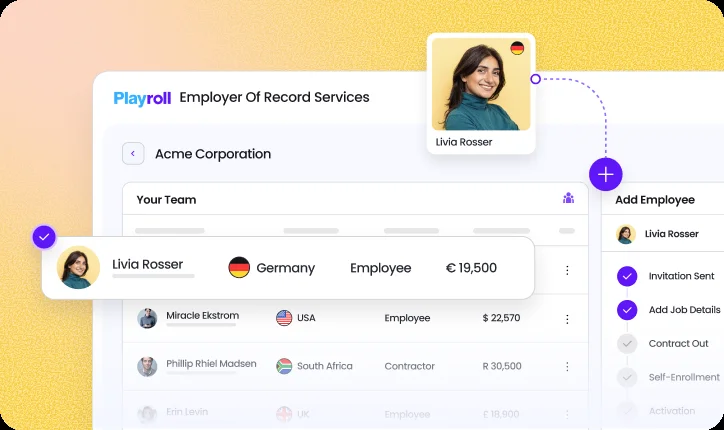
2. Remote: Best For IP-Sensitive Engineering Teams Hiring Long-Term Employees
Remote tends to be the provider of choice when companies are building permanent, globally distributed engineering teams. It’s especially attractive for companies prioritizing owned-entity structures in key markets, which can simplify IP assignment chains and reduce ambiguity around employment classification.
However, Remote is not always the fastest or most flexible in edge-case jurisdictions. In countries where it does not own the entity, it may still rely on partners. Pricing is typically at the higher end of the market, and highly customized onboarding scenarios can take longer to configure.
Why engineering teams love it:
- Clear, enforceable IP assignment structures
- Owned entities in major jurisdictions
- Consistent employee experience across regions
3. Deel: Best For Automation-Heavy And API-Driven Engineering Teams
Deel appeals to product-led companies that prefer automation and integrations over manual workflows. Its API capabilities and contractor-plus-EOR flexibility make it attractive for engineering teams managing hybrid workforces. If you’re already running a tightly integrated HR and finance stack, Deel can plug into that infrastructure cleanly.
As complexity increases, some teams report that support responsiveness can lag because of their ticketing support system. Deel is also on the pricier side relative to several competitors, particularly once add-on services are layered in.
Why engineering teams love it:
- Strong API integrations and automation capabilities
- Contractor and EOR management in one platform
- Centralized workforce visibility
4. Oyster: Best For Remote-First Engineering Teams Focused On Employee Experience
Oyster is popular with remote-first SaaS companies that prioritize benefits transparency and employee-facing experience. Its interface is clean, and the global benefits marketplace adds clarity for distributed teams.
Its EOR pricing sits toward the upper end of the market, and dedicated employer support often comes at additional cost. The support model is largely ticket-based, and it may be less flexible in highly regulated or compliance-heavy environments.
Why engineering teams love it:
- Intuitive platform and onboarding flow
- Clear global benefits visibility
- Straightforward pricing structure
5. G-P (Globalization Partners): Best For Enterprise-Scale Engineering Expansion
G-P is built for companies that prioritize legal certainty and structured compliance over speed. If you’re a large enterprise expanding engineering teams across multiple regulated jurisdictions, its global footprint and compliance-first approach can provide reassurance.
The trade-off is cost and process weight. Customers frequently report that processes are slower and more formal than newer, product-led platforms. Compared to some of the newer platforms, folks also say the whole experience feels slower and more formal, with a less modern interface, occasional support lags, and that classic enterprise vibe that prioritizes rock-solid compliance over quick, self-service speed.
Why engineering teams love it:
- Enterprise-grade compliance infrastructure
- Broad global coverage
- High-touch legal support
6. Papaya Global: Best For Finance-Led Multi-Country Engineering Payroll
Papaya Global is designed for organizations prioritizing payroll visibility and consolidated reporting across regions. CFO-led companies managing large international engineering teams may appreciate the analytics and finance controls.
On the downside, EOR services are delivered through in-country partners rather than owned entities, which can introduce communication layers and slower issue resolution. Additional service fees – including for misclassification support – are sometimes reported.
Why engineering teams love it:
- Consolidated payroll analytics
- Strong reporting capabilities
- Suitable for complex, multi-country payroll operations
7. Multiplier: Best For Cost-Conscious Engineering Expansion In APAC
Multiplier is often shortlisted for affordability, particularly in APAC and emerging markets. It’s practical and efficient for straightforward international engineering expansion where cost sensitivity is a primary factor.
Users report that invoicing structures can feel overly complex, and dedicated employee support after onboarding is limited. While client support exists, response times are sometimes described as slow.
Why engineering teams love it:
- Competitive pricing
- Solid coverage in emerging markets
- Simple onboarding for standard roles
8. Skuad: Best For Fast Hiring In Emerging Engineering Markets
Skuad is optimized for speed. If you’re building distributed engineering teams in high-growth or emerging markets and need to move quickly, it delivers a relatively streamlined onboarding process with predictable pricing.
It is less equipped for complex structuring, including senior executive hires, nuanced IP protections, equity-heavy compensation, or highly regulated fintech environments. Companies with sophisticated compliance needs would be better off choosing a provider with more solid infrastructure.
Why engineering teams love it:
- Fast onboarding timelines
- Transparent pricing
- Broad country coverage
9. RemoFirst: Best For Early-Stage Startups Hiring First Global Engineers
RemoFirst is often considered by early-stage startups making their first international engineering hires. Pricing is typically lower than many established competitors, and setup is intentionally simple.
It does, however, rely heavily on regional partners rather than owned entities, which limits direct oversight of in-country compliance operations. As hiring becomes more complex – spanning multiple jurisdictions, equity plans, or regulated industries – its tooling and automation can feel limited.
Why engineering teams love it:
- Lower starting price
- Easy initial setup
- Minimal overhead for first hires
10. Horizons: Best For Engineering Teams Hiring Heavily In Asia
Horizons stands out when Asia is the priority. If you’re hiring developers in China, Southeast Asia, or broader APAC markets, its regional expertise and local support model are key strengths.
The platform is more service-led than SaaS-driven, which means fewer native integrations and API capabilities for tech-forward teams. Workflows can feel more manual, and reporting is not as real-time or finance-centric as payroll-first competitors. It is also less ideal for evenly distributed global expansion.
Why engineering teams love it:
- Strong APAC coverage
- Local labor expertise
- Hands-on regional support
Quick Developer-Focused Comparison
No two engineering teams scale the same way. Some need to hire quickly across multiple regions after a funding round. Others prioritize airtight IP ownership ahead of an acquisition. Many are balancing cost optimization with security reviews and equity complexity at the same time.
The table below maps common developer hiring scenarios to the EOR providers that tend to work best in those situations, so you can quickly narrow down the right fit for your engineering team.
*Some providers (Papaya Global, Pebl, Horizons, etc.) vary pricing by country or service scope, so listed pricing reflects commonly reported starting points rather than fixed global rates.
Pricing and Cost Considerations for Engineering Teams
For engineering-led companies, the biggest advantage of using an EOR is predictability. Instead of setting up a local entity – which can involve incorporation fees, accounting retainers, payroll registration, and ongoing compliance overhead – you pay a recurring per-employee fee that bundles employment, payroll, and statutory administration into one structure.
If you’re hiring a small team in a new market, that simplicity can save both time and operational weight.
Most established EOR providers charge a flat monthly fee per employee, typically in the $200–$699 range, depending on the provider and country. More complex jurisdictions may cost more. That fee sits on top of the developer’s gross salary and local employer social contributions, which commonly range from 10–30% or more depending on the country’s pension, health, and social security systems. There isn’t a universally “cheap” region – statutory costs vary widely by jurisdiction.
For a senior engineer building core product or AI infrastructure, that structure gives you:
- Fully compliant local employment
- Proper IP assignment and contract protections
- Managed payroll and statutory benefits
- Reduced misclassification risk
- Predictable, transparent pricing
Instead of navigating entity setup, local labor law, and compliance risk, you’re paying a fixed monthly fee to ensure the legal and payroll infrastructure around your engineer is handled correctly.
The result is a predictable monthly cost without the fixed overhead of maintaining a local entity. For teams hiring fewer than 15–20 engineers in a country, that trade-off often makes practical sense – it keeps costs transparent while allowing you to scale globally without long-term structural commitments.
EOR vs Alternatives for Developer Hiring
For product-driven companies, global hiring decisions influence how quickly you can scale your engineering team, who legally owns the code being written, or how exposed you might be during investor due diligence. The structure you choose directly impacts product velocity, compliance risk, and long-term scalability.
Here’s how an EOR compares to alternatives engineering teams typically consider:
- EOR vs Opening a Local Entity: Setting up a local entity gives you full control, but it also comes with considerable costs, considerable time delays, accounting requirements, tax registrations, and ongoing compliance obligations. If you’re hiring fewer than 15–20 engineers in a country, that overhead can outweigh the benefit. An EOR allows you to employ developers compliantly without establishing a permanent presence, making it a practical interim solution while you test a market or build initial headcount.
- EOR vs PEO: A Professional Employer Organization (PEO) is a co-employment model where you and the PEO share employer responsibilities. The PEO typically handles payroll, benefits administration, and certain HR functions, but you must already have a registered legal entity in the U.S.. For engineering teams hiring in Poland, Brazil, India, or elsewhere, a PEO won’t solve the core challenge of cross-border employment. An EOR, by contrast, enables compliant hiring in countries where you do not have a legal entity, making it better suited to distributed product teams.
- EOR vs Contractors: Hiring developers as contractors may seem like the fastest route, especially when moving quickly after a funding round. However, long-term, embedded engineers rarely meet independent contractor standards in many jurisdictions. Misclassification can trigger back taxes, social contributions, and disputes over intellectual property ownership. An EOR structure allows you to hire developers as full employees under local law, protecting IP, reducing compliance exposure, and supporting equity participation as your team scales.
Key Takeaways
The right EOR for your engineering team ultimately depends on what you value most. Is it IP certainty, classification protection, security posture, cost control, or speed of hiring? Whichever provider you choose becomes part of your infrastructure. It influences how confidently you can hire developers across borders and how clean your IP chain looks during due diligence for example.
Playroll stands out for product-led companies that want strong compliance without slowing momentum. It combines automated global payroll, localized IP protections, contractor-to-employee transitions, and structured support designed specifically for distributed engineering teams.
If you’d like to see how it works in practice, book a demo and let’s walk through how your team can scale globally, while keeping ownership, compliance, and hiring velocity fully aligned.

ABOUT THE AUTHOR
Jaime Watkins
Jaime is a content specialist at Playroll, specializing in global HR trends and compliance. With a strong background in languages and writing, she turns complex employment issues into clear insights to help employers stay ahead of the curve in an ever-changing global workforce.

.png)

Back to Top
.svg)


.svg)