.svg)
.svg)
.svg)

.svg)


.svg)

.svg)
.svg)
.svg)
.svg)
.svg)
.svg)
.svg)
.svg)

Minimum Wage: The statutory minimum wage in Serbia is RSD 308 per hour.
Working Hours: Serbian labor law establishes a standard 40-hour work week with strict regulations on overtime, which is limited to 8 hours weekly and must be compensated at a minimum of 126% of regular wages.
Payroll Taxes: In Serbia, employers contribute about 35.05% in payroll taxes, which typically cover social security, health care, and other statutory benefits.
Average Salary: The average gross monthly salary in Serbia is approximately RSD 115,000–125,000 (about USD 1,050–1,150) as of early 2026.
Hiring independent contractors has boomed in popularity because of the cost savings and flexibility they offer. It can be a great option if you require niche skills or short-term project support. Contractors allow businesses to access specialized skills quickly, without the time and cost of setting up a local entity.
However, it’s important to know the limits of this model: contractors are not a substitute for full-time employees. Relying on them for ongoing, long-term roles can create serious compliance risks, including employee misclassification, which can lead to fines, back taxes, and reputational damage.
Playroll’s contractor management solutions make it simple to compliantly engage, onboard, and pay contractors around the world. We provide clear visibility into agreements, streamline payments, and reduce compliance risks – so you can focus on getting the work done. And when you’re ready to take the next step, we can help seamlessly convert contractors into full-time employees through our global Employer of Record service.
From compliant contracts to competitive benefits, Playroll’s EOR services keep you aligned with local labor laws and regulations, safeguarding your business, so you can focus on growth.
Book a Demo
Businesses can only operate smoothly in Serbia if they comply with local labor laws including drafting compliant employment contract agreements and meeting taxation and payroll obligations. Learn more about the employment laws and regulations in Serbia below, to avoid any compliance issues.
Employment Contract Requirements
Serbia's employment legislation is designed to safeguard the rights of the workforce. As part of the hiring process, employers must provide employees with a written employment contract outlining wages, hours worked, guaranteed time off and other employment terms.
Onboarding Process
We can help you get a new employee started in Serbia quickly, with a minimum onboarding time of just 1-2 working days. The timeline starts once the employee submits all required information onto the Playroll platform and completes any necessary local authority registrations.
For non-nationals, the Right to Work assessment (if applicable) may add up to three extra days. Additional time may be needed for follow-ups on this assessment. Please note, payroll cut-off dates can impact the actual start date. Playroll's payroll cut-off date is the 10th of each month unless otherwise specified.
Probation Period in Serbia
Probation periods in Serbia depend on the employment contract, but they cannot exceed six months. Within this period, either the employer or employee can terminate the contract with five days' notice.
In Serbia, the average gross monthly salary in early 2026 is in the range of about RSD 115,000–125,000 (roughly USD 1,050–1,150), which serves as a practical benchmark as you budget for your team. Actual pay varies significantly by experience, industry, and location, with information technology, finance and banking, and specialized manufacturing typically offering higher wages. You can expect to pay more in major urban centers, especially Belgrade and Novi Sad, where competition for skilled talent is stronger and wage levels are above the national average.
As you plan compensation for your company, you should factor in a moderate inflation environment of around 3–4% in late 2025 and early 2026, which supports relatively stable but ongoing wage increases. Real GDP growth is projected at roughly 3–4% for 2025–2026, indicating a steadily expanding economy that can put upward pressure on salaries in in-demand roles. Unemployment remains near 9–11%, giving you access to a reasonably broad pool of talent while still requiring competitive offers to attract and retain qualified employees in key sectors.

Serbian labor law establishes a standard 40-hour workweek with strict regulations on overtime, which is limited to 8 hours weekly and must be compensated at a minimum of 126% of regular wages. Employers must ensure proper rest periods, including daily rest of 12 consecutive hours and weekly rest of at least 24 hours.
Night work (10 PM to 6 AM) requires additional compensation of at least 26% of the salary base, while weekend work does not automatically warrant additional pay. Special protections exist for young workers under 18. Compliance with these regulations is essential, as violations can result in significant financial penalties ranging from 600,000 to 2,000,000 RSD and potential employee claims.

Growing your team in Serbia is exciting, but it’s not without challenges. Local labor laws are often nuanced, and hiring without the right legal structure or processes can lead to misclassification, non-compliance penalties, or disputes. An Employer of Record removes that risk by acting as the legal employer on your behalf, taking full responsibility for compliance, contracts, payroll, and employee benefits.
This gives you the freedom to scale at your own pace, whether you're adding one employee or building out an entire function, without the burden of setting up and managing a local entity. You remain in control of day-to-day responsibilities and performance, while the EOR ensures every hire is legally protected and properly supported. It's a strategic way to expand globally without spreading your internal team too thin or exposing your business to legal liabilities in unfamiliar markets.
Fiscal Year in Serbia
1 January - 31 December is the 12-month accounting period that businesses in Serbia use for financial and tax reporting purposes.
Payroll Cycle in Serbia
The payroll cycle in Serbia is usually monthly, with employees being paid on or before the last working day of each month.
Minimum Wage in Serbia
As of January 1, 2025, Serbia's minimum wage has increased to RSD 308 per hour. Monthly rates vary according to working hours per month, as follows:
Bonus Payments in Serbia
Serbia doesn't mandate 13-month payments. Employers can give bonuses as they see fit.
Employer Tax Contributions
Employer payroll contributions are generally estimated at an additional 15.15% on top of the employee salary in Serbia.
Employee Payroll Tax Contributions
In Serbia , the typical estimation for employee payroll contributions cost is around 19.9%.
Individual Income Tax Contributions
Personal income is taxed at 10%, with no influence from factors like marital status or dependents. There's a tax relief of 28,423 RSD applicable to all employees and salaries.
Pension in Serbia
To be eligible for an old-age pension in Serbia, individuals must meet age and insurance requirements defined by the law. Men aged 65 and above with at least 15 years of pensionable service or those with 45 years of pensionable service regardless of age qualify. For women, eligibility starts at 63 years and 10 months with a minimum of 15 years of pensionable service or with 45 years of pensionable service, regardless of age. In Serbia, contributions for old-age and disability pensions are combined, with employers contributing 11% to both retirement and disability insurance.

Managing payroll in Serbia requires careful attention to the country's specific tax regulations and contribution requirements. Employers must navigate a system where the combined employer and employee contribution rate reaches approximately 35.05% of gross salary, with employers responsible for withholding and submitting both their own contributions and those of their employees.
Key obligations include income tax at 10%, pension contributions split between employer and employee, and health insurance contributions. All submissions must adhere to strict monthly deadlines, typically by the 15th of the month following salary payment. Using payroll management software can help employers consolidate payroll data and stay compliant in Serbia by automating calculations, generating required reports, and ensuring timely submissions to Serbian authorities.
Employees expect to be paid accurately, on time, and in full compliance with local standards. When you're hiring in Serbia, providing a smooth payroll experience is critical to retention and trust. An Employer of Record ensures that employees receive what they’re owed, without errors, delays, or confusion about taxes or benefits.
Key Ways an EOR Supports Payroll in Serbia:
- Reliable Salary Payments: Ensures employees are paid promptly in local currency.
- Clear Payslips & Documentation: Provides employees with compliant, understandable records.
- Correct Benefits & Contributions: Delivers legally mandated contributions and any changes in compensation, like bonuses.
- Payroll Setup & Processing: Handles salary calculations, tax withholdings, and local reporting obligations.
- Boosts Employee Confidence: Builds trust with compliant, consistent payroll operations.
Make better business decisions by consolidating global payroll data, while seamlessly syncing your existing payroll operations.
Book a Demo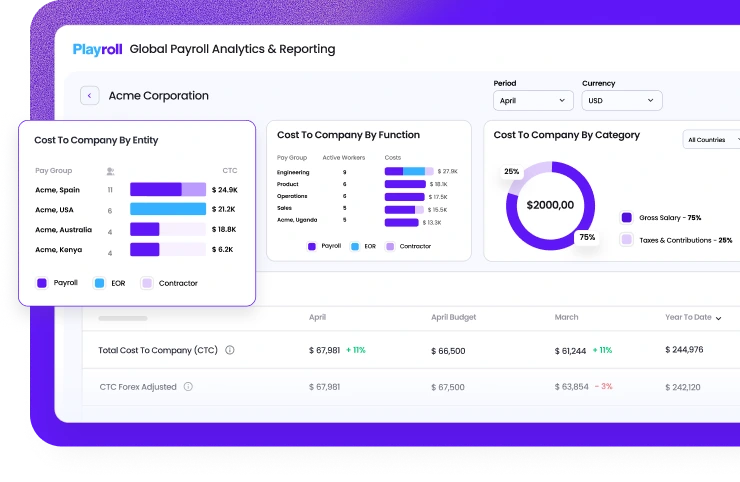
In Serbia, most foreign nationals who intend to work need both a temporary residence permit and a work permit, typically issued on the basis of employment with a Serbian company. The most common route is a temporary residence permit for employment combined with a work permit tied to a specific employer, role, and location, issued through the National Employment Service (NES) and the Ministry of Interior.
Short-term business visits may be possible on a C-type short-stay visa (where required) without a work permit, provided no productive work is performed. Longer-term assignments, intra-company transfers, and highly skilled roles are usually handled through a temporary residence permit for employment and a corresponding work permit, which can be renewed if the employment relationship continues and all legal conditions remain satisfied.
Mandatory Leave Entitlement in Serbia
The annual leave entitlement in Serbia is 20 days for a full time worker. These can include public holidays on top of that or within those days, which would otherwise be unpaid.
Public Holidays In Serbia
Employees get paid for public holidays, and if a holiday falls on a weekend, it shifts to the next workday.
Paid Time Off in Serbia
Serbian employees have a minimum of 20 working days of annual leave, which can be extended based on factors like work contributions, conditions, experience, education, and contract or act criteria. Leave accrues as follows:
- In the first year, employees earn 1/12 of their annual leave for each month worked, applicable only in the initial year.
- After a full year of work, employees are entitled to at least 20 days of paid leave, usually granted at the beginning of the calendar year.
Maternity Leave In Serbia
Employees receive paid maternity leave starting 28 days before delivery, lasting a year with full wages for the first two pregnancies. For the third pregnancy onwards, the leave extends to two years, with full wages during the entire period.
Paternity Leave In Serbia
Employees receive paid paternity leave for five business days upon the birth of their child, with funding provided by the employer.
Sick Leave In Serbia
In Serbia, employees receive 30 days of paid sick leave from their employer. Beyond 30 days, the Health Insurance Fund provides sickness benefits, typically at 65% of the calculation base (based on average salary in the 12 months preceding), but at 100% for work-related injuries, occupational diseases, or organ donations.
Parental Leave In Serbia
In specific situations, the partner can assume Maternity Leave from the mother. Adoptive parents get eight months of paid leave when the adoptive child is placed until the child is five. For children under three months, leave extends until the child is 11 months.
Bereavement Leave
Employees get five days of paid leave for the death of a close family member.
Wedding Leave
Workers get 5 days of leave for their wedding
Employee benefits in Serbia combine strong legal protections with a growing market for flexible, performance-oriented perks. Your company will need to comply with robust mandatory benefits around social security, leave, and working time, and then layer in supplemental benefits that reflect your culture and budget.
To build a compelling offer, you should start by understanding statutory leave entitlements, social insurance contributions, and overtime rules, then decide which extras such as private health coverage, meal allowances, or flexible working options will help you stand out to Serbian talent.
- Top mandatory benefits include: enrollment in state social security (pension, health, and unemployment insurance), paid annual leave and public holidays, maternity and parental leave, and sick leave with wage compensation.
- Other key mandatory elements include: overtime premiums and night/Sunday/holiday work premiums, protection during pregnancy and childcare leave, and employer obligations for workplace health and safety.
- Top supplemental benefits include: private health insurance and medical check-ups, meal and commuting allowances, performance bonuses and 13th salary, and flexible working arrangements or additional paid leave.
- Key legal and tax considerations include: correct calculation and reporting of personal income tax and mandatory social security contributions, documentation to support any tax-exempt or partially exempt benefits, and adherence to the Serbian Labor Law and related social insurance regulations.
In Serbia, failing to provide the correct employee benefits can have serious consequences. Mistakes in benefits administration may result in fines and harm your reputation as an employer. An Employer of Record ensures statutory benefits and leave are handled correctly, every time, and provides comprehensive options for extra perks to reward your team.
Beyond just avoiding legal issues, a well-managed benefits program builds trust with your employees. An EOR ensures benefits are set up quickly during onboarding, updated when employee status changes, and fully compliant with national regulations. They also manage communication with employees, so there’s no confusion around what’s offered and how to access it. This combination of legal compliance and positive employee experience is hard to replicate without local infrastructure. With an EOR, you can offer peace of mind to your team (and to yourself) knowing that your benefits program in Serbia is running as it should.
Termination Process in Serbia
Termination processes in Serbia are determined by employment and collective agreements. Employers must provide a written explanation for dismissal at least eight days before taking action. Employees have the right to respond to the notice, and not granting this opportunity may result in the court invalidating the dismissal. Valid reasons for dismissal in Serbia include:
- Fraud
- Negligence
- Dishonesty
- Other work-related offenses
Notice Period in Serbia
In Serbia, when an employee resigns, the notice period ranges from 15 to 30 days, with a minimum of five days during the probation period. For employer-initiated unilateral termination due to incompetence—where the employee lacks the required knowledge or skills—the notice period must be specified by the employer’s internal work rules or the individual employment contract but cannot be shorter than eight days or longer than 30 days. This particular ground for termination is the only one mandating a notice period. For other legal grounds of termination, the employment relationship ends on the day the termination decision is properly delivered to the employee, and no mandatory notice period is required.
Severance in Serbia
Severance payments are mandatory only for employees laid off due to redundancy. The calculation involves multiplying one-third of the annual salary by the number of years worked with the employer.
Disclaimer
THIS CONTENT IS FOR INFORMATIONAL PURPOSES ONLY AND DOES NOT CONSTITUTE LEGAL OR TAX ADVICE. You should always consult with and rely on your own legal and/or tax advisor(s). Playroll does not provide legal or tax advice. The information is general and not tailored to a specific company or workforce and does not reflect Playroll’s product delivery in any given jurisdiction. Playroll makes no representations or warranties concerning the accuracy, completeness, or timeliness of this information and shall have no liability arising out of or in connection with it, including any loss caused by use of, or reliance on, the information.

ABOUT THE AUTHOR
Jesse Weisz
Jesse is an experienced R&D Analyst at Playroll, a leading Employer of Record (EOR) provider. With a strong background in data analysis and market research, Jesse specializes in identifying emerging trends and driving innovation in global HR solutions. She is an all-rounder, critical thinker and success-seeker (often inextricably linked to being a late-night tea drinker).

.svg)


.png)

















.webp)


.svg)